

Particles, Scattering Theory, and Infrared Structure
A particle interpretation is a theorem only after the translation spectrum, localization properties, and asymptotic limits have been specified. An isolated positive-energy mass hyperboloid supports a Wigner one-particle space; locality and separated velocity supports can then produce Haag–Ruelle in- and out-states. Neither step proves asymptotic completeness. When a sharp charged mass shell is destroyed by long-range gauge fields, the surviving objects may instead be radiation fields, detectors, particle weights, infrared sectors, dressed states, or inclusive observables. This chapter states exactly which conclusion each set of hypotheses licenses.
Helpful background. LSZ reduction, poles, residues, and stable states supplies the perturbative amplitude language compared with the operator limits here. Resonances, infraparticles, and the limits of particle language distinguishes spectral eigenstates from poles reached only by continuation. Elasticity and factorization hypotheses provides the special two-dimensional setting in which strong completeness results are known.
From spectral subspaces to asymptotic observables
Section titled “From spectral subspaces to asymptotic observables”Let be the joint self-adjoint generators of translations and their joint spectral measure. A stable massive species begins with a nonzero spectral subspace
where the relevant part of is isolated from competing spectrum. Covariance identifies the irreducible summands of with Wigner representations. This is a statement about the real joint spectrum, not about a peak in a cross section or a pole on a second Riemann sheet.
For the neutral bosonic vacuum sector, assume a positive-energy local observable net, a unique vacuum with the Reeh–Schlieder property, and an isolated massive shell separated from both the vacuum and higher spectrum. Local vacuum cyclicity means that is dense in the vacuum Hilbert space for each nonempty bounded open region . Choose a bounded local operator with a nonzero one-particle projection. Smear its spacetime translates with a Schwartz function whose smooth Fourier transform has compact support near a shell patch and meets the physical spectrum only on that patch, retaining a nonzero projection. The resulting bounded, almost-local operator satisfies and . A smooth positive-energy Klein–Gordon packet then defines with independent of time. The Haag–Ruelle construction gives these definitions and normalizations explicitly.
For a precise bounded-operator implementation, Dybalski and Gérard 2012, v3, §2.2 and Eq. (2.8), pp. 5–6 (PDF) specify almost locality, energy–momentum transfer and shell filtering. Their energy-decreasing operator is called , so their creator corresponds to the creator called here.
For packets with pairwise disjoint velocity supports, locality and the almost-local tails make the relevant commutators decrease faster than any power of . Together with polynomial bounds on the remaining factors, this makes the time derivative of each finite vacuum product integrable. Cook’s argument therefore gives the vector limits
Here convergence is in Hilbert-space norm for each finite vacuum product. It is not an assertion of operator-norm convergence or strong-operator convergence on every finite-energy vector. The limits define Møller maps from the Fock space over into the physical Hilbert space. Their isometric character follows from asymptotic factorization of inner products; surjectivity is a separate assertion about their ranges. The full Fock-space statement is Buchholz and Dybalski 2024, v3, §2, Eq. (2.6) and Theorem 1, pp. 3–5 (PDF). Their stability condition also covers some non-isolated shells; the isolated massive shell assumed here is a sufficient special case.
The original massive construction and its convergence mechanism are given by Haag 1958, pp. 669–673 and Ruelle 1962, pp. 147–163. The bounded-operator argument for two-particle limits and their isometric extension is developed in Dybalski and Gérard 2012, v3, §6.2, Lemma 6.4, Theorem 6.5 and Proposition 6.6, pp. 15–18 (PDF); that two-particle statement alone does not establish the full Fock-space theorem.
LSZ reduction is a compatible distributional description of the same stable-particle regime. It needs isolated one-particle singularities with nonzero residue, sufficiently regular amputated boundary values, and scattering states whose weak limits exist. The reduction formula does not manufacture an asymptotic particle when these conditions fail. Its original scope is explicit in Lehmann, Symanzik, and Zimmermann 1955, pp. 205–225.
Long-range and massless theories split the massive chain. Neutral massless excitations may admit asymptotic radiation fields under propagation and regularity estimates adapted to the light cone. Energy-decreasing almost-local detectors can have large-time limits even when no normalizable sharp one-particle vector exists; Araki and Haag constructed the basic detector framework in Araki and Haag 1967, pp. 77–91. Charged Gauss-law sectors are more severe: charge is tied to flux at arbitrarily large distance, so compact localization and an ordinary charged Fock particle generally cannot both be retained. Buchholz’s spectral consequence for electrically charged states is stated in Buchholz 1986, pp. 331–334.
Analyticity and crossing come last in this dependency chain, not first. Locality, spectral support, stable-particle reduction, distributional boundary values, and suitable growth conditions yield analytic domains and qualified continuation relations. Unitarity and a massive gap add the ingredients used in fixed- dispersion and high-energy bounds. The rigorous crossing analysis of Bros, Epstein, and Glaser 1965, pp. 240–264 does not license a universal pointwise crossing formula outside its analytic domain, and a massless forward-channel singularity invalidates the massive assumptions behind a Froissart-type argument.
Read the massive construction from top to bottom. Its first detour asks about alternative asymptotic objects when shell isolation fails. Further LSZ and analytic conclusions require the explicitly labeled additional hypotheses.
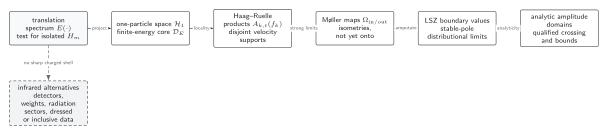
The massive route constructs Hilbert-space norm limits of finite products applied to the vacuum. Extending these states to Fock isometries requires the full finite-particle inner-product theorem and extension from a dense Fock core; isometry does not prove completeness in the physical Hilbert space. Dashed continuations to LSZ and analytic amplitudes require the additional conditions shown. The infrared detour changes the object and still requires its own existence estimates. Schematic, not to scale. Structured description and source data (JSON)
What the hypotheses actually imply
Section titled “What the hypotheses actually imply”The table is a compact way to test a proposed use of particle or scattering language. Read each row from left to right: the conclusion is one-way, and the final two columns identify the converse or extension that has not been proved.
| Object and domain | Spectral or scattering hypotheses | Licensed conclusion | Excluded converse or extension | Adversarial check |
|---|---|---|---|---|
| Joint spectral projection on a positive-energy mass hyperboloid | The shell is nonzero and isolated in the real translation spectrum; the Poincaré representation is strongly continuous. | A stable one-particle subspace carrying Wigner representations. | A resonance pole or threshold enhancement does not imply such a projection. | Replace the shell by a second-sheet pole: the spectral projection is zero, so the construction stops. |
| Finite Haag–Ruelle products applied to the vacuum | A unique gapped Reeh–Schlieder vacuum, isolated massive shell, spectrally filtered smooth almost-local operators with nonzero one-particle projection, smooth compact momentum packets, and pairwise disjoint velocity supports. | Norm limits of vacuum product vectors; asymptotic factorization gives Fock inner products for the constructed species. | Existence of these states does not imply that they span the physical Hilbert space. | Overlap two velocity supports, or remove shell isolation: the commutator estimate no longer proves convergence. |
| Møller maps from asymptotic Fock space | Haag–Ruelle limits exist and their inner products factorize on the finite-particle core. | Isometric wave operators and a scattering operator on the appropriate asymptotic ranges. | An isometry is not automatically unitary; range density is an additional completeness theorem. | Add a nonzero orthogonal bound-state or topological sector: the constructed map remains isometric but is not onto. |
| LSZ-smeared time-ordered distributions | Isolated stable-particle poles with nonzero residue, asymptotic states, tempered boundary values, and controlled amputation. | On-shell scattering matrix elements as limits of amputated distributions. | The formula does not extend unchanged to unstable particles or charged infraparticles without a sharp pole. | Apply electron LSZ in charged QED after the pole has become a continuous threshold: the external-state limit is absent. |
| Almost-local energy-decreasing detectors and particle weights | Bounded-energy states, energy–momentum transfer away from the forward cone, propagation estimates, and an appropriate large-time topology. | Asymptotic velocity-sensitive functionals or weights, sometimes without normalizable particle vectors. | A detector limit need not produce a sharp-mass state or a complete particle basis. | Use a strictly local positive operator with nonzero vacuum response: persistent vacuum contamination defeats particle selectivity. |
| Null radiation fields and charged Gauss-law sectors | For neutral radiation, suitable light-cone propagation and decay; for charge, the Gauss-law flux relation and noncompact localization are retained. | Neutral asymptotic radiation fields, or charged infrared sectors distinguished by long-range data. | Neither conclusion supplies an ordinary compactly localized charged Fock particle. | Insert a long-range charged field into a neutral radiation theorem: its localization and decay estimates fail. |
| Massive scattering amplitudes as analytic boundary values | Locality, positive energy, stable LSZ particles, a mass gap, unitarity, a specified complex domain, and polynomial growth where a bound requires it. | Qualified crossing continuations, dispersion relations, and rigorous bounds inside the proved domain. | There is no automatic global crossing identity or massless forward Froissart bound. | Add an unsubtracted massless exchange pole at zero momentum transfer: the gap and bounded-domain argument fail. |
Structured table data (JSON) preserves the same caption, headers, rows, and reading order.
The five pairs below are independent tests of proposed conclusions. Each dashed arrow changes a premise or strengthens a claim; no arrow asserts an implication between different tests.
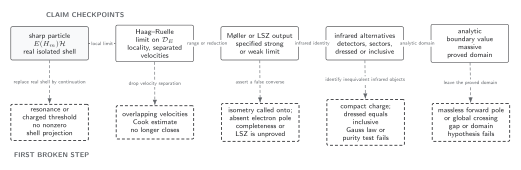
A second-sheet resonance alone does not give an isolated real-shell particle. Overlapping velocities invalidate the displayed Cook estimate without proving that every construction fails. Isometry does not imply completeness, a missing pole defeats ordinary LSZ, and infrared identities or analytic extensions need their own hypotheses. The five pairs are independent diagnostics. Schematic, not to scale. Structured description and source data (JSON)
A coherent route through the chapter
Section titled “A coherent route through the chapter”- Particles as mass-shell spectral subspaces defines the sharp object before any scattering construction.
- Haag–Ruelle scattering-state construction proves the massive large-time limits from locality, shell isolation, and separated velocities.
- Wave operators and asymptotic fields packages those limits and separates isometry from surjectivity.
- LSZ reduction and amputated distributions relates stable-particle limits to on-shell distributional boundary values.
- Araki–Haag detectors and particle weights develops asymptotic observables that remain meaningful beyond sharp Fock states.
- Asymptotic completeness: definitions and known models distinguishes the competing completeness claims and records where they are actually proved.
- Massless scattering and radiation fields replaces massive velocity separation by null asymptotics under theorem-specific estimates.
- Infraparticles and velocity superselection explains why charged spectral weight may begin continuously at a mass threshold.
- Gauss-law charges and infrared sectors derives the localization obstruction from flux at infinity.
- Dressed, inclusive, and algebraic infrared observables compares three non-equivalent ways to retain infrared-finite predictions.
- Scattering analyticity, crossing, and rigorous bounds closes the chain with the analytic conclusions supported by locality, spectrum, reduction, and growth hypotheses.
The chapter deliberately stops before computing cross sections or cataloguing amplitude techniques. It also does not assume that a general interacting four-dimensional theory is asymptotically complete. Its aim is narrower and more useful: given a claimed particle, scattering state, reduction formula, detector, infrared observable, or analytic bound, identify the mathematical object, the topology of its limit, the hypotheses that make it exist, and the strongest conclusion that survives when a hypothesis fails.
References
Section titled “References”- Araki, H., and Haag, R. (1967). “Collision Cross Sections in Terms of Local Observables.” Communications in Mathematical Physics 4, 77–91. DOI.
- Bros, J., Epstein, H., and Glaser, V. (1965). “A Proof of the Crossing Property for Two-Particle Amplitudes in General Quantum Field Theory.” Communications in Mathematical Physics 1, 240–264. DOI.
- Buchholz, D. (1986). “Gauss’ Law and the Infraparticle Problem.” Physics Letters B 174, 331–334. DOI.
- Buchholz, D., and Dybalski, W. (2024). “Scattering in Relativistic Quantum Field Theory: Basic Concepts, Tools, and Results.” arXiv:math-ph/0509047, version 3, 3 November 2024. Versioned preprint. Open PDF.
- Dybalski, W., and Gérard, C. (2012). “Towards Asymptotic Completeness of Two-Particle Scattering in Local Relativistic QFT.” arXiv:1211.3393, version 3, 20 November 2012. Versioned preprint. Open PDF.
- Haag, R. (1958). “Quantum Field Theories with Composite Particles and Asymptotic Conditions.” Physical Review 112, 669–673. DOI.
- Lehmann, H., Symanzik, K., and Zimmermann, W. (1955). “Zur Formulierung quantisierter Feldtheorien.” Il Nuovo Cimento 1, 205–225. DOI.
- Ruelle, D. (1962). “On the Asymptotic Condition in Quantum Field Theory.” Helvetica Physica Acta 35, 147–163. Open PDF.
Original QFT.org content:CC BY 4.0, unless an item supplies different terms. Third-party material retains its own terms.