

Microlocal QFT and Renormalized Local Fields
Microlocal QFT turns the informal instruction “subtract the ultraviolet singularity” into a sequence of theorems about cotangent directions. Wavefront sets orient singularities; transversality licenses products and restrictions; hyperbolic propagation carries singular data along null bicharacteristics; graph cones extend spectral orientation to higher-point distributions; the Hadamard condition fixes the universal two-point singularity; and locality, covariance, and scaling classify the finite freedom in composite fields and time-ordered products. Every arrow has hypotheses. None of these analytic results alone proves positivity, selects a preferred state, or establishes convergence of an interacting perturbation series.
Helpful background. Singular support and wavefront sets supplies the distribution theory; Hadamard admissibility and the two-point wavefront criterion gives the physical state test; Wick polynomials and Hadamard point splitting gives the first local-observable application.
Enter the microlocal proof chain
Section titled “Enter the microlocal proof chain”Let be an oriented, time-oriented, globally hyperbolic spacetime unless a result states a smaller domain. Green-hyperbolic operators supply causal propagators and an exact sequence from compact sources to spacelike-compact solutions Bär 2015, Theorem 3.22 (Open PDF). A distribution is controlled by , not merely by its singular support. For a Klein–Gordon two-point function, the essential datum is a future-directed null covector in the first slot paired with the transported negative covector in the second; under the free-field hypotheses, this oriented relation is equivalent to Hadamard form Radzikowski 1996, Theorem 5.1, pp. 544–550. The propagation theorem preserves singularities along null Hamilton flow inside a source-free conic region Duistermaat and Hörmander 1972, § 6.1, Theorem 6.1.1, printed p. 196 (PDF). Products, diagonal restrictions, worldline pullbacks, and kernel compositions are canonically licensed when their covectors satisfy the relevant Hörmander transversality condition; failure of that sufficient test does not prove that every specially defined replacement is impossible.
The next layer is genuinely local and covariant. A Hadamard parametrix removes the universal singular part without choosing a global vacuum. Hadamard normal ordering makes the diagonal pullback that defines a Wick power meaningful Brunetti, Fredenhagen, and Köhler 1996, § 5, Proposition 5.3 and Theorems 5.4 and 5.7, preprint pp. 15–18 (Open PDF), and prescriptions across spacetimes must also obey naturality, scaling, and smooth or analytic background dependence. Causal factorization determines time-ordered products away from diagonals; scaling degree governs their extension onto diagonals. The remaining freedom consists of finitely many local curvature terms at each order, as classified for Wick powers and time-ordered products by Hollands and Wald 2001, Theorems 5.1–5.2, pp. 30–40.
The dependency map separates the analytic implications from the additional state and renormalization conditions. Its main line runs directly from the Hadamard two-point cone through subtraction to local composites. The higher-point graph condition is a separate consequence under quasifree or generalized-free hypotheses, while the dashed state branch emphasizes that cone control alone does not construct a positive state.
On a narrow screen, swipe or use the Left and Right arrow keys to pan across the figure. Home and End move to its edges. A full-size link is also available.
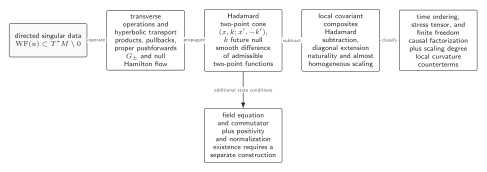
Directed wavefront data license operations and propagate along the characteristic relation. Hadamard subtraction directly supports local Wick fields, while covariance and scaling restrict time-ordering and stress-tensor freedom to finite local terms. Separately, quasifree or generalized-free hypotheses assemble the Hadamard two-point orientation into higher-point graph cones; an arbitrary hierarchy needs its own theorem. The dashed state-existence branch is additional rather than a consequence of cone control. The diagram is schematic and not to scale. Structured description and source data (JSON)
A route through the results
Section titled “A route through the results”Read the chapter in order: the early pages establish the operations, the middle pages characterize admissible states and composites, and the final pages classify locally covariant renormalization.
- Microlocal Calculus for Quantum Fields defines directed singularities and shows why singular support loses positive-frequency orientation.
- Wavefront-Set Products, Pullbacks, and Pushforwards states the transversality and proper-support conditions for QFT kernels.
- Green-Hyperbolic Operators and Causal Propagators constructs advanced and retarded inverses and the exact sequence of compact sources and spacelike-compact solutions.
- Propagation of Singularities for Hyperbolic Fields transports wavefronts along null bicharacteristics, including through caustics.
- Higher-Point Microlocal Spectrum Conditions encodes curved-spacetime spectral restrictions by directed graph cones.
- Hadamard States and the Wavefront-Set Characterization identifies the local parametrix with the global oriented two-point cone under the free-field hypotheses.
- Wick Polynomials under Microlocal Conditions constructs coincident composite fields after Hadamard subtraction.
- Local Covariant Wick Powers and Operator Products imposes naturality and classifies the finite curvature mixing of local fields.
- Time-Ordered Products and the Renormalized Stress Tensor extends causal products onto diagonals and enforces stress-tensor conservation.
- Microlocal Renormalization Ambiguities and Their Classification identifies the exact local redefinitions relating admissible prescriptions.
Hypotheses and licensed conclusions
Section titled “Hypotheses and licensed conclusions”The table records what each theorem establishes and the quickest countertest to a stronger claim. “Excluded converse” means that the hypotheses in that row do not prove the converse; it does not assert that every special construction fails.
| Object and domain | Essential hypotheses | Licensed conclusion | Excluded converse or adversarial check |
|---|---|---|---|
| Distribution on a smooth manifold | Localized Fourier estimates in conic cotangent neighborhoods; nonzero covectors | A closed conic wavefront set with coordinate-invariant position and direction data | Equal singular supports do not distinguish a positive-frequency kernel from its transpose |
| Products, restrictions, and kernel compositions | No opposing covector sum for products; conormal transversality for pullback; proper support for pushforward | A canonical distributional operation with a calculable wavefront-set bound | A null worldline can have a conormal Hadamard covector; local cone compatibility does not imply proper fiber support |
| Green-hyperbolic solution and propagation | Globally hyperbolic spacetime; two-sided advanced and retarded inverses; real principal type in the source-free region | An exact source–solution sequence and transport of singularities along null Hamilton orbits | A timelike boundary without boundary conditions destroys uniqueness; a caustic does not terminate a wavefront |
| Higher-point distributions | Smooth-path graph cones with future-causal parallel labels; compatible products; for the simple derivation, quasifree Wick factorization and a Hadamard two-point function; causal- and null-path cones are stronger variants | The microlocal spectrum bound for the full quasifree hierarchy | Reversing one graph edge violates orientation; two-point data do not determine nonquasifree truncated functions |
| Free-field Hadamard two-point function | Smooth, oriented and time-oriented, four-dimensional boundaryless globally hyperbolic spacetime; real scalar normally hyperbolic operator; exact bisolution and fixed commutator; either local Hadamard form or the one-sided null cone; positivity only for state status | Equivalence of the Hadamard expansion and the future-directed null wavefront relation | Dynamics, the commutator, and positivity still admit a symmetric wrong-frequency admixture; the cone alone does not construct a state |
| Reference-state Wick powers | Quasifree Hadamard normal ordering; admissible diagonal kernels; common invariant dense domain | Operator-valued Wick distributions, an extended Wick algebra, and canonical smooth state-change isomorphisms | A positive wrong-frequency admixture retains a quadratic coincidence divergence |
| Local covariant Wick powers | Locally constructed Hadamard subtraction; naturality, scaling, and smooth or analytic background dependence | Natural local fields whose prescription changes are finite curvature-polynomial mixings | Reference-state normal ordering is not generally local covariant; a coordinate-dependent finite term violates naturality |
| Time-ordered products and stress tensor | Causal factorization; scaling-degree extension; microlocal regularity; local covariance; field identities and conservation normalization | Formal local time-ordering and a conserved renormalized stress tensor, unique up to finite local covariant terms | Flat-space subtraction misses curvature singularities; nonlocal inverse operators are not admissible counterterms |
Structured table data (JSON) preserves the caption, scoped headers, rows, and reading order.
Where the proof chain first fails
Section titled “Where the proof chain first fails”The most common overclaims omit one qualitative datum rather than one algebraic factor. Removing covector orientation leaves only singular support: this confuses a two-point function with its transpose and an allowed higher-point graph with a frequency-reversed one. Restricting to a characteristic submanifold can violate transversality. Dropping global hyperbolicity introduces unprescribed boundary data. Applying a non-Hadamard subtraction makes the coincident limit singular. Finally, allowing a Green operator or coordinate function inside a purported counterterm destroys local covariance. The failure map pairs each omission with the strongest conclusion that still survives.
On a narrow screen, swipe or use the Left and Right arrow keys to pan across the figure. Home and End move to its edges. A full-size link is also available.
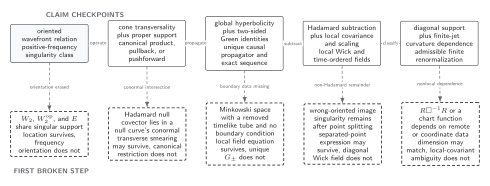
Each dashed branch removes a necessary hypothesis and states the narrower surviving result. Base-point singularity, a formal differential equation, or correct engineering dimension cannot replace orientation, transversality, global support control, Hadamard regularity, or locality. The diagram is schematic and not to scale. Structured description and source data (JSON)
A reusable microlocal check
Section titled “A reusable microlocal check”For a proposed distributional operation, name the manifold or product manifold, every kernel domain, and every support condition. Write the full wavefront cone with signs in all slots, compute the conormal or zero-sum obstruction, and verify properness before integrating a shared variable. For a state claim, add the field equation, commutator, positivity, and normalization; the two-point cone is not a substitute for them. For a local-field claim, identify the subtraction kernel and common operator domain, then test covariance under embeddings, scaling dimension, analytic background dependence, and conservation where applicable. Finally, try the null-restriction, timelike-boundary, wrong-orientation, and nonlocal-counterterm examples. They isolate different missing hypotheses and therefore cannot be replaced by a single generic regularity test.
References
Section titled “References”- Bär, Christian. “Green-Hyperbolic Operators on Globally Hyperbolic Spacetimes.” Communications in Mathematical Physics 333 (2015): 1585–1615. DOI. Open PDF.
- Brunetti, Romeo, Klaus Fredenhagen, and Michael Köhler. “The Microlocal Spectrum Condition and Wick Polynomials of Free Fields on Curved Spacetimes.” Communications in Mathematical Physics 180 (1996): 633–652. DOI. Open PDF.
- Duistermaat, J. J., and Lars Hörmander. “Fourier Integral Operators. II.” Acta Mathematica 128 (1972): 183–269. DOI.
- Hollands, Stefan, and Robert M. Wald. “Local Wick Polynomials and Time Ordered Products of Quantum Fields in Curved Spacetime.” Communications in Mathematical Physics 223 (2001): 289–326. DOI. Open PDF.
- Radzikowski, Marek J. “Micro-Local Approach to the Hadamard Condition in Quantum Field Theory on Curved Space-Time.” Communications in Mathematical Physics 179 (1996): 529–553. DOI.
Original QFT.org content:CC BY 4.0, unless an item supplies different terms. Third-party material retains its own terms.