

Perturbative AQFT and Causal Renormalization
Perturbative algebraic QFT constructs interactions from causal support and local distribution extension rather than from a formal path integral. Causal factorization fixes time-ordered products away from coincidence; Epstein–Glaser induction reduces the remaining ultraviolet problem to extending distributions across diagonals; scaling degree bounds the finite local ambiguity; and the Stückelberg–Petermann group compares admissible prescriptions. Bogoliubov maps then produce formal interacting observables and locally switching-independent nets. Ward identities and perturbative agreement impose further conditions, while anomalies, infrared limits, nonperturbative representations, and convergence remain separate questions.
Helpful background. Products, scaling degree, and distribution extensions supplies the analytic extension theorem. Counterterms, subdivergences, and locality supplies the physical renormalization comparison. Adiabatic limits and infrared obstructions fixes the boundary between local construction and global switching limits.
From causal support to local interacting nets
Section titled “From causal support to local interacting nets”Let denote compactly supported local functionals on a globally hyperbolic spacetime, and let be a formal local S-matrix. Its causal factorization law,
holds when is not in the causal past of . Expanding in the arguments determines each on configurations admitting a causal partition. Lower-order products agree on overlaps because they already satisfy the same law. What is not determined lies on coincidence diagonals.
The extension step is local. If a numerical distribution is defined off a diagonal of codimension and has finite scaling degree , it admits extensions with the same scaling degree. The extension is unique only when ; otherwise two extensions can differ by derivatives of the delta distribution up to order . That is the mathematical origin of local counterterms. Epstein and Glaser give the causal induction in Epstein and Glaser 1973, §§3–4, pp. 223–253, while the finite-scaling-degree extension theorem is stated and proved in Brunetti and Fredenhagen 2000, §5.2, Theorems 5.2–5.3, pp. 638–642.
The construction uses functionals whose derivatives obey the microcausal wavefront restriction; for closure as smooth functionals, the equicausal refinement adds uniform control on compact configuration sets. These conditions make the declared contractions with the causal propagator and chosen Hadamard two-point function well defined. They are not cosmetic: a distribution concentrated on a characteristic hypersurface can violate Hörmander’s product criterion and make even the Peierls bracket undefined, while pointwise wavefront control without equicontinuity need not preserve smoothness under the bracket Hawkins, Rejzner, and Visser 2026, §§4–7, pp. 20–36 of the open manuscript. Curved spacetime introduces no preferred Fourier transform, so support, wavefront set, local covariance, and scaling replace momentum-space subtractions.
An admissible set of time-ordered products must also satisfy symmetry, unitarity, field independence, causal Wick expansion, and any declared covariance, scaling, equation-of-motion, or Ward conditions. If and satisfy the same basic axioms, the main renormalization theorem gives a unique local formal map with
The locality and additivity properties of are conclusions forced by causal factorization; an arbitrary nonlocal field redefinition is not an element of this group. The precise theorem and its converse construction are Brunetti, Dütsch, and Fredenhagen 2009, Theorem 4.1 and equations (4.11)–(4.19), pp. 1561–1563.
For a compactly supported interaction , the relative S-matrix
and its derivative define retarded interacting observables. If two switchings coincide around the causal hull of a bounded region, causal factorization intertwines the corresponding local algebras. This algebraic adiabatic limit does not require a global . It is therefore compatible with an infrared obstruction to a global vacuum or scattering construction.
The dependency map displays this one-way construction and its two additional constraint branches. Inspect the diagonal-extension stage: it is where finite freedom enters, before Ward or background-independence conditions restrict that freedom.
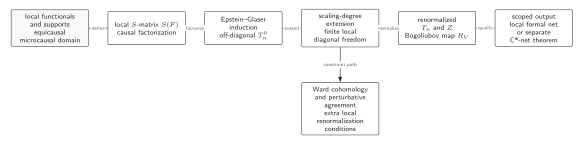
Causal induction determines products away from diagonals; finite-scaling-degree extension supplies controlled local freedom; admissible normalization produces the Stückelberg–Petermann comparison and formal interacting observables. Ward identities and perturbative agreement require additional local conditions. The diagram is schematic and not to scale. Structured description and source data (JSON)
What each hypothesis licenses
Section titled “What each hypothesis licenses”The table keeps each object and domain beside the hypothesis used, the strongest conclusion proved, the excluded converse, and a concrete test. Formal-series statements and nonperturbative C*- or von Neumann-net theorems occupy different rows because neither is a completion of the other without an additional comparison theorem.
| Object and domain | Essential hypotheses | Licensed conclusion | Excluded converse or extension | Adversarial check |
|---|---|---|---|---|
| Equicausal functionals and Peierls kernel | Normally hyperbolic linearization; compact functional support; Hörmander-compatible microcausal cones plus equicontinuity for every derivative family. | The retarded and advanced variations and the Peierls bracket are defined and remain smooth on the declared functional domain. | Pointwise microcausality alone need not give smooth closure, and locality does not make arbitrary distributional smearings admissible. | Use the regular-functional counterexample to smooth closure, or smear on a characteristic surface so covectors sum to zero. |
| Local S-matrix $S(F)$ and coefficients $T_n$ | Compact supports, a specified causal order, normalized unit, and causal factorization. | Factorization in ordered configurations and inductive determination of $T_n$ away from coincidence diagonals. | No factorization formula is licensed for overlapping causally unordered supports. | Choose two overlapping supports with neither later than the other and attempt to swap them. |
| Off-diagonal distribution $t^0$ | Finite scaling degree at the diagonal and lower-order extensions already compatible on partial diagonals. | An extension exists with controlled local ambiguity; it is unique only below the codimension threshold. | Existence does not imply uniqueness at $\operatorname{sd}(t^0)\ge d$, nor does choosing extensions independently preserve causal induction. | Extend $(\Delta_F)^2$ in four dimensions and exhibit its delta-function ambiguity. |
| Renormalized $T_n$ and comparison map $Z$ | Causal Wick expansion, locality, additivity, field independence, covariance, scaling, and the same declared basic axioms for two prescriptions. | Finite differences are local diagonal counterterms organized by a Stückelberg–Petermann transformation. | A momentum-dependent nonlocal redefinition is not licensed, and a change of Hadamard normal ordering must be re-expanded consistently. | Insert a nonlocal kernel into $Z$ and test additivity for disjointly supported interactions. |
| Bogoliubov map, quadratic background shift, or Ward differential | Compact interaction; controlled Møller maps for perturbative agreement; local anomaly consistency and an admissible counterterm class for Ward identities. | Formal retarded observables, equivalence for the proved background split, and restoration of a Ward identity exactly when its local class is trivial. | The formal series need not converge; arbitrary noncompact metric changes are not covered; consistency does not force an anomaly class to vanish. | Treat the series as norm convergent, use an uncontrolled kinetic shift, or cancel one current divergence while breaking consistency. |
| Local interacting algebra $\mathfrak A_g(O)$ | Switchings agree on a causal neighborhood of $O$ and relative-S intertwiners obey the cocycle relation. | The local algebra is independent of switching up to canonical isomorphism and fits into an isotonic local net. | Local stabilization does not imply a global constant-coupling S-matrix, vacuum, KMS state, or massless adiabatic limit. | Let a massless switching sequence grow and observe infrared-dependent coefficients while fixed bounded regions remain equivalent. |
| Formal state or separately constructed local operator algebra | For a formal state, ordered-series positivity and coefficientwise microlocal conditions; for a factorizing model, regular-strip analyticity and modular nuclearity; for a dynamical C*-algebra, its exact defining relations. | A normalized positive formal functional, or the particular nonperturbative local-net conclusion proved by the separate theorem. | Negative numerical truncations do not refute formal positivity; wedge locality alone does not prove compact intersections; neither construction proves general four-dimensional interacting existence. | Evaluate $1-2\lambda$ at $\lambda=1$, remove the regularity strip, or demand an unspecified vacuum representation. |
Structured table data (JSON) preserves the caption, scoped headers, row order, and boundary tests.
The failure map should be read as ordered diagnostic checkpoints, not as a converse theorem. Each dashed edge drops the hypothesis named by its upper checkpoint and records the first conclusion that must be withdrawn.
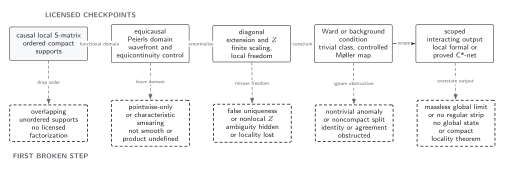
Unordered supports stop factorization; incompatible wavefront sets stop products; finite scaling degree does not erase local ambiguity; Ward consistency and perturbative agreement have independent obstructions; and local formal nets do not imply global infrared limits or nonperturbative compact localization. The diagram is schematic and not to scale. Structured description and source data (JSON)
Reading sequence
Section titled “Reading sequence”- Causal Factorization and Time-Ordered Products turns causal order into the basic local S-matrix identity and tests overlapping supports.
- Local and Microcausal Functionals with Peierls Brackets fixes functional support and wavefront domains before a propagator contraction is made.
- Epstein–Glaser Induction constructs higher time-ordered products off the total diagonal from lower orders.
- Scaling Degree and Extension of Distributions proves existence, the uniqueness threshold, and the local derivative-of-delta ambiguity.
- Time-Ordered Products, Causal Wick Expansion, and Renormalization combines numerical extensions with Wick polynomials and normalization conditions.
- Renormalization Freedom and the Stückelberg–Petermann Group compares admissible prescriptions by a local formal transformation.
- Perturbative AQFT and the Bogoliubov Map constructs retarded interacting observables and their local algebra.
- Perturbative Agreement and Background Independence compares controlled quadratic shifts between the free and interacting descriptions.
- Ward Identities and Anomalous Obstructions reduces restoration to local cohomology and tests a chiral-current anomaly.
- Adiabatic Limits and Algebraic Interacting Nets removes switching dependence locally while keeping global infrared claims separate.
- Nonperturbative Local C*-Net Developments: Construction and Scope compares factorizing-model and dynamical-C*-algebra theorems without conflating their outputs.
- Formal-Power-Series Interacting Constructions, States, and Scope defines formal positivity, checks a second-order interacting Hadamard functional, and states the mandatory nonconvergence boundary.
The order follows the proof: define the causal and microlocal domain, solve the off-diagonal and extension problems, classify finite freedom, construct interacting observables, impose additional identities, and only then compare local infrared, formal-state, and genuinely nonperturbative conclusions.
References
Section titled “References”- Brunetti, Romeo, Michael Dütsch, and Klaus Fredenhagen. “Perturbative Algebraic Quantum Field Theory and the Renormalization Groups.” Advances in Theoretical and Mathematical Physics 13 (2009): 1541–1599. DOI; Open PDF.
- Brunetti, Romeo, and Klaus Fredenhagen. “Microlocal Analysis and Interacting Quantum Field Theories: Renormalization on Physical Backgrounds.” Communications in Mathematical Physics 208 (2000): 623–661. DOI.
- Epstein, Henri, and Vladimir Glaser. “The Role of Locality in Perturbation Theory.” Annales de l’Institut Henri Poincaré A 19, no. 3 (1973): 211–295. EuDML record.
- Hawkins, Eli, Kasia Rejzner, and Berend Visser. “A Novel Class of Functionals for Perturbative Algebraic Quantum Field Theory.” Revised 2026. Open manuscript, arXiv:2312.15203.
- Hollands, Stefan, and Robert M. Wald. “Existence of Local Covariant Time Ordered Products of Quantum Fields in Curved Spacetime.” Communications in Mathematical Physics 231 (2002): 309–345. DOI; Open manuscript.
Original QFT.org content:CC BY 4.0, unless an item supplies different terms. Third-party material retains its own terms.