

Local Counterterms and Subdivergence Structure
Ultraviolet subtractions are local because the large-loop-momentum part of a graph is insensitive to slowly varying external data. Expanding that short-distance part in external momenta produces a finite Taylor polynomial whose degree is bounded by power counting. In position space, the polynomial is a sum of derivatives of delta functions, so it can be generated by local operators in the action.
Subdivergences add a crucial order of operations. A divergent proper subgraph must first be replaced by its own local counterterm insertion. Only after every lower-order ultraviolet region is removed is the remaining overall divergence guaranteed to be local. An individual unrenormalized multiloop graph can contain a nonlocal pole such as a pole times ; that term cancels against the counterterm graph for its subdivergence rather than being subtracted by a nonlocal action.
Required background. Ultraviolet Sensitivity and the Renormalization Problem supplies the bare/input/prediction split. Wick’s Theorem and Free Gaussian Factorization supplies the local contraction structure, and Power Counting of Divergences and Perturbative Renormalizability supplies the degree of the full graph and every proper subgraph.
Helpful background. Local and Composite Operator Insertions clarifies why a contracted ultraviolet subgraph behaves as a local insertion in the reduced graph.
Taylor subtraction isolates the local ultraviolet ambiguity
Section titled “Taylor subtraction isolates the local ultraviolet ambiguity”Let be a Euclidean integrand with independent external momenta collected into and loop momenta collected into . Suppose its superficial degree is the nonnegative integer . Define the Taylor operator at a nonexceptional subtraction point by
The multi-index records powers of the independent momentum components. At large , each external-momentum derivative improves the ultraviolet falloff. Under the usual massive or nonexceptional Euclidean assumptions, the remainder
is ultraviolet convergent once all subdivergences have already been removed. The integrated Taylor term is a polynomial in through degree . Its coefficients may diverge with the regulator, but its momentum dependence is local.
For a scalar amplitude, a degree-zero ambiguity is a constant. A degree-two two-point ambiguity has the general form
after Lorentz symmetry and parity are imposed. These are generated by mass and kinetic counterterms. A tensor amplitude admits the finite set of momentum and metric tensors allowed by its indices and symmetry identities.
The position-space statement is equivalent. A momentum polynomial
Fourier transforms to a distribution supported at coincidence,
Thus two admissible ultraviolet extensions can differ only by local contact terms of bounded degree. Scaling Degree and Extension of Distributions supplies the theorem-level version and hypotheses; the present page uses the perturbative momentum-space construction.
A logarithmic bubble makes the separation explicit
Section titled “A logarithmic bubble makes the separation explicit”Consider the massive Euclidean bubble
Its superficial degree is zero, so subtract its value at . With
the subtracted integrand is
The original integrand falls as , giving a logarithm in four dimensions. The difference falls at least as before angular cancellations and is ultraviolet integrable. The subtraction term is independent of , exactly as locality predicts.
Using dimensional regularization to evaluate the finite difference gives
The additive constant is scheme dependent; the nonpolynomial momentum dependence is not. After continuation , the logarithm develops the two-particle branch cut at . A local counterterm cannot remove that cut, because no finite momentum polynomial has a discontinuity across it. Thresholds, cuts, and nonlocal logarithms are therefore part of the renormalized dynamics rather than subtraction freedom.
More generally, two local schemes can differ by
with a symmetry-allowed polynomial of degree at most . Once the corresponding renormalized parameters are related by that finite local map, physical predictions agree through the retained order.
A primitive subdivergence becomes a local insertion
Section titled “A primitive subdivergence becomes a local insertion”Now let a larger graph contain a proper 1PI subgraph . The lines connecting to the rest of carry momenta that are external to even if some are integrated in the full graph. Suppose is primitively divergent: it has no divergent proper subgraphs of its own.
Power counting assigns . Replace its integrand by the local Taylor part
The minus sign denotes the counterterm insertion. Because is polynomial in the momenta entering , it is the Feynman rule for a local vertex in the reduced graph . The pair
has the ultraviolet region internal to removed. It may still have an overall divergence, and it may have other subdivergences. This one-subgraph argument establishes locality without pretending to solve the full combinatorics.
The ordering is essential. If the unrenormalized value of contains a pole and the outer integral supplies a logarithm of , the basic graph can contain
That is a nonlocal divergence and cannot be cancelled by a local overall counterterm. The counterterm graph contains the opposite pole-log term. Their sum has only the local overall pole allowed by the degree of . Collins works this cancellation explicitly in a two-loop self-energy before giving the general induction Collins 1984/2023, §§ 5.1–5.3, pp. 89–106.
Nested, disjoint, and overlapping regions
Section titled “Nested, disjoint, and overlapping regions”With more than one divergent subgraph, compatibility matters. Inspect the three panels below: nested and disjoint subgraphs can be replaced together, whereas overlapping subgraphs require separate subtraction terms.
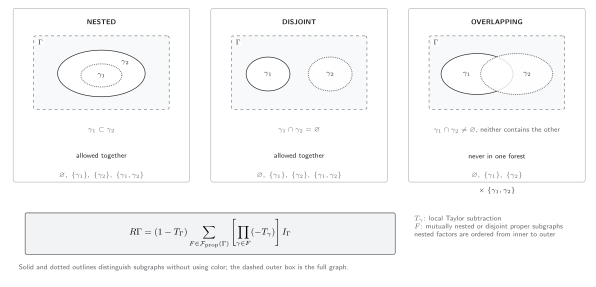
Subdivergence topology and local contraction. Each replaces a divergent proper subgraph by a bounded momentum polynomial, hence a local vertex in the reduced graph. Nested operations run from inner to outer; disjoint operations commute; overlapping subgraphs never appear together in one forest. The formula previews the next page’s recursion and the set diagram is schematic, not a particular Feynman graph.
| Relation | Locality operation | Remaining issue |
|---|---|---|
| Nested, | Renormalize before taking the local part of | The outer Taylor operator must act on the already-renormalized inner structure |
| Disjoint, | Replace either or both by their local vertices | All combinations must appear once, including the double replacement |
| Overlapping | Replace or in separate terms | A simultaneous contraction is not defined because the subgraphs share lines without containment |
This table explains why a single counterterm drawn for the overall graph is insufficient. It does not yet enumerate every allowed combination or fix signs. The R-Operation, Forest Formula, and Overlapping Divergences supplies that recursion. Zimmermann’s forest formula makes the compatible sets explicit and yields local subtractions under its stated momentum-space hypotheses Zimmermann 1969, pp. 208–234.
From graph counterterms to a local action
Section titled “From graph counterterms to a local action”A graph-by-graph subtraction becomes a renormalized QFT only if counterterms with the same local structure are identified across every graph. Write
Each is a local operator allowed by the symmetries and working order. One coefficient generates all counterterm vertices associated with that operator; it is not independently adjusted for each occurrence. The graph analysis determines the pole or regulator dependence of those coefficients, while renormalization conditions determine their finite parts.
The local action must pass four filters:
- Degree: the operator and derivative count must lie within the Taylor bound for the divergent sector.
- Symmetry: Lorentz, internal, discrete, Ward, Slavnov–Taylor, or BRST conditions restrict the allowed linear combinations.
- Redundancy: integration by parts, algebraic identities, and qualified field redefinitions can relate operators, although off-shell counterterm closure may require retaining a larger set.
- Order: loop and EFT counting determine when each insertion contributes.
Locality does not mean every coefficient is observable. Finite local terms are scheme coordinates until tied to physical inputs or matched coefficients. Nor does locality require a finite number of operators at all orders: an EFT has an infinite local action but a finite counterterm set at any fixed power-counting order.
Assumptions and limits of the argument
Section titled “Assumptions and limits of the argument”The Taylor proof uses more than the symbol .
- The starting interaction is local, or quasi-local with a controlled derivative expansion.
- External momenta are kept fixed while the selected subgraph momenta become large.
- The subtraction point does not introduce an uncontrolled infrared singularity. Massive Euclidean or nonexceptional momentum-subtraction kinematics are the cleanest setting.
- Every proper ultraviolet subdivergence has already been subtracted before the overall Taylor argument is applied.
- The regulator and algebra admit the required large-momentum expansion and momentum routing, or any breaking is restored by allowed local terms.
- Symmetry identities are imposed on the complete counterterm functional, not guessed from an individual graph.
Massless BPHZ subtraction at zero momentum can create artificial infrared divergences; infrared rearrangement or a nonexceptional subtraction point is then needed. Noncommutative, explicitly nonlocal, boundary, or curved-background problems can change the admissible local structures and require their own locality theorem. The theorem-first causal construction, including Epstein–Glaser Induction and Time-Ordered Products, Causal Wick Expansion, and Renormalization, is developed in Mathematical QFT.
Common pitfalls
Section titled “Common pitfalls”Subtracting the whole large logarithm. A term such as is nonlocal. Subtract only its local UV pole or a finite local polynomial fixed by the scheme; retain the kinematic logarithm.
Applying the overall Taylor operator before subdivergences. An unremoved subgraph can make the overall pole nonlocal. Insert the lower-order local counterterm first, then assess the overall remainder.
Equating support locality with small numerical size. A local counterterm can carry a large coefficient or heavy threshold. “Local” describes its dependence on fields and derivatives, not its magnitude.
Choosing a zero-momentum subtraction point in a massless graph. The ultraviolet subtraction can generate an infrared singularity. Use nonexceptional kinematics or an explicit infrared rearrangement and keep the two operations distinct.
Inventing one counterterm per graph. Graph counterterms must assemble into the finite operator set allowed by the action, symmetries, and working order. Otherwise the construction has not established predictive closure.
Exercises
Section titled “Exercises”1. Bubble falloff. Show that subtracting the massive bubble at improves the integrand enough to be ultraviolet convergent in four dimensions.
Solution
The difference is . At large , its absolute leading behavior is . With the four-dimensional radial measure , the tail behaves as and converges. The removed term is independent of , so it is a local degree-zero counterterm.
2. Degree-two ambiguity. What local two-point structures can a Lorentz-invariant scalar graph with require?
Solution
The Taylor polynomial contains a constant, a term linear in , and a quadratic tensor. Parity and Lorentz invariance remove the linear term and reduce the symmetric quadratic tensor to . The counterterms are therefore a mass term and a kinetic term, subject to any additional internal symmetry.
3. Nonlocal pole. A two-loop basic graph contains . Why is a counterterm not the solution?
Solution
That operator is nonlocal and would change the physical cut and long-distance momentum dependence. The pole-log signals an unsubtracted proper subgraph. Its local counterterm graph supplies the opposite pole-log; only then is the remaining overall pole a local polynomial.
Locality and the next step
Section titled “Locality and the next step”The bounded result is
Nonlocal logarithms and thresholds remain in the renormalized amplitude. When several ultraviolet regions coexist, their local replacements must be combined without omission or double subtraction.
Continue to The R-Operation, Forest Formula, and Overlapping Divergences for the complete recursive combinatorics. Continue to Symmetry Constraints and the Space of Counterterms after the renormalized rule set is built to restrict the local operator space by functional identities. Return to Power Counting of Divergences and Perturbative Renormalizability if the Taylor degree or candidate subgraph set is not yet fixed.
References
Section titled “References”-
Collins, John C. 1984; open-access reissue 2023. Renormalization: An Introduction to Renormalization, the Renormalization Group and the Operator-Product Expansion. Cambridge Monographs on Mathematical Physics. Cambridge University Press. DOI and Open PDF.
-
Zimmermann, Wolfhart. 1969. “Convergence of Bogoliubov’s Method of Renormalization in Momentum Space.” Communications in Mathematical Physics 15: 208–234. DOI.
Original QFT.org content:CC BY 4.0, unless an item supplies different terms. Third-party material retains its own terms.