

Effective Field Theory of Gravity: Architecture and Power Counting
At energies well below the first omitted gravitational threshold, general relativity is a predictive quantum effective field theory. The low-energy variables are the metric and every matter field light enough to propagate over the distances being probed. Diffeomorphism invariance permits infinitely many local curvature operators, but derivative and loop counting ensure that only finitely many enter any fixed-accuracy calculation. Local higher-curvature coefficients require matching or measurement; nonanalytic effects from retained massless fields are low-energy predictions.
This page treats perturbative quantum corrections about a declared smooth four-dimensional background. It does not assume that the cutoff equals the Planck mass, resum a finite higher-derivative truncation into a fundamental theory, or choose among ultraviolet completions of gravity.
Required background. Map the Effective-Theory Architectures supplies the architecture card used below. Power Counting as a Predictive Order supplies the graph and truncation logic. Levi-Civita Connection, Geodesics, and Riemann Curvature supplies the curvature tensors and Bianchi identities.
Diffeomorphism invariance orders the action
Section titled “Diffeomorphism invariance orders the action”Choose a background metric and write
where and is canonically normalized near flat space. The retained action contains every local generally covariant operator built from , the light fields , and covariant derivatives:
Here denotes six-derivative invariants such as cubic curvatures and structures. Couplings between curvature and light matter belong to as well. The coefficient is a vacuum-energy parameter; a background is chosen only after its renormalized value and the light stress tensor have been included in the background equations.
Curvature counts as two derivatives. If denotes the largest relevant external momentum, light mass, inverse background length, or curvature scale , then an invariant with derivatives is suppressed by powers of relative to lower-derivative terms. Heavy states affect the local coefficients because their propagators are analytic in below threshold. Light and massless states remain explicit because their propagation produces infrared nonlocality. This is the separation at the heart of gravitational EFT Donoghue 1994, § 3, preprint pp. 5–14, Open PDF.
The displayed curvature-squared list is deliberately redundant until the observable and domain are fixed. In four dimensions,
is the Euler density. Its integral is topological on a closed manifold, while equations of motion and local field redefinitions can remove additional operators from an on-shell scattering basis. Those reductions do not justify dropping the same structures from an off-shell background effective action, from a theory with boundaries, or from a matter-coupled problem. The basis must match the question.
Power counting low-energy gravitons
Section titled “Power counting low-energy gravitons”Expanding a two-derivative Einstein vertex with graviton fields gives the schematic scaling
Every loop brings both two additional powers of and the four-dimensional loop factor. For an off-shell background functional, or for amplitudes with matter or nonvacuum backgrounds, the first four-derivative terms scale schematically as
The local curvature-squared contribution and the one-loop Einstein contribution occur at the same derivative order for those general observables. A complete prediction at that order includes both: the loop fixes logarithmic and other nonanalytic pieces, while its local polynomial part renormalizes the . The important exception is pure four-dimensional vacuum gravity on shell. There the leading equations of motion and the Gauss–Bonnet relation remove an independent curvature-squared amplitude, so the one-loop nonanalytic contribution has no arbitrary on-shell partner; the first independent local pure-gravity correction is instead curvature-cubed at six derivatives. The benchmark below derives this distinction.
More generally, adding a loop to a graph built from two-derivative vertices raises its low-energy order by two derivatives. Replacing a two-derivative vertex by one with derivatives raises the order by . At any declared order only finitely many loop topologies and operator insertions contribute. This is the precise sense in which the EFT is predictive despite requiring an infinite action.
The useful small quantities are not interchangeable:
The first two control omitted local physics and the background derivative expansion; the last controls graviton loops. New particles, large Wilson coefficients, a dense spectrum, or a special state can make lower than . Setting every suppression scale equal to a Planck convention is an assumption, not a consequence of diffeomorphism invariance.
The gravitational architecture card
Section titled “The gravitational architecture card”| Card entry | Gravitational EFT choice |
|---|---|
| Degrees of freedom | or the fluctuation , plus every matter field light on the scale |
| Hierarchy and background | and curvature invariants small in cutoff units about a specified solution or controlled off-shell background |
| Symmetry and locality | Diffeomorphism invariance, background covariance, and a local derivative expansion for short-distance effects |
| Counting | Derivatives and curvatures, loops, light masses, and any additional state or occupation-number expansion |
| Matching and inputs | , vacuum energy, higher-curvature coefficients, and matter couplings from measurement or UV matching at a stated scale and scheme |
| Outputs | Low-energy graviton and matter amplitudes, background effective actions, and long-distance nonanalytic corrections |
| Uncertainty | First omitted derivative order, loop order, matching and input errors, and background-expansion errors |
| Validity boundary | A new mode becomes light, curvature or momentum reaches the cutoff, the loop expansion fails, or the chosen background/state is not perturbatively controlled |
The shared selection map places gravity on the covariant local-operator branch. Inspect the common card at the right: the symmetry principle determines the admissible invariants, but matching, power counting, observable choice, and a validity boundary are separate data.
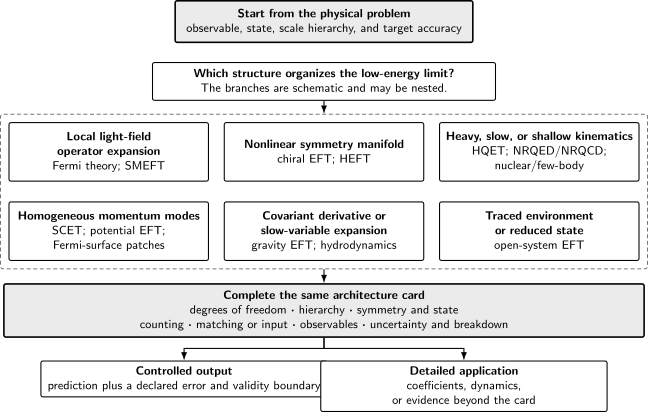
An EFT name is not a construction. Starting from the observable, state, scale hierarchy, and target accuracy, identify the dominant low-energy organizing structure, then declare degrees of freedom, symmetry and state, counting, matching or input, observables, uncertainty, and breakdown. Branches may be nested; the diagram is schematic and not to scale.
First application: the one- and two-loop benchmark
Section titled “First application: the one- and two-loop benchmark”Consider pure Einstein gravity in four dimensions, regulated dimensionally with . A background-field calculation gives the one-loop local divergence in one standard convention as
The coefficients depend on the off-shell field and gauge convention, but the conclusion does not: the divergence has the four-derivative form already allowed by the EFT. It is absorbed into renormalized curvature-squared coefficients. For a vacuum on-shell graviton amplitude, the leading Einstein equation gives and hence ; after using the four-dimensional Euler relation, no independent curvature-squared divergence remains. This is the celebrated one-loop on-shell finiteness of pure gravity ’t Hooft and Veltman 1974, pp. 69–94, CERN record.
Each qualification matters:
- Matter qualification: light matter loops generate curvature-squared counterterms, and with matter present the background need not be Ricci-flat.
- On shell: an off-shell effective action still requires local curvature counterterms.
- One loop: the cancellation relies on the special four-derivative identities and equations of motion; it does not repeat at every order.
At two loops, pure gravity has a nonvanishing on-shell divergence. With the same convention, its invariant structure is
An overall sign changes if the effective-action or convention is reversed; the nonzero coefficient and cubic-Riemann operator are invariant content. The term cannot be eliminated on a Ricci-flat background. It therefore requires a six-derivative Wilson coefficient, establishing that the Einstein term is not perturbatively renormalizable by a finite parameter set Goroff and Sagnotti 1985, pp. 81–86. Donoghue gives both divergences in the EFT organization and shows how increasing loop order feeds higher-derivative counterterms Donoghue 1994, § 3, preprint pp. 11–14, Open PDF.
This result does not destroy low-energy predictivity. For off-shell, matter-coupled, or nonvacuum observables, a relative order calculation fixes the finite set of four-derivative coefficients and includes all diagrams at that order. For pure four-dimensional vacuum scattering on shell, those curvature-squared coefficients are redundant and the first independent local input enters at six derivatives. In either case, the number of required inputs grows with requested accuracy, not with the number of digits already calculated at a fixed order.
Local coefficients and nonanalytic predictions
Section titled “Local coefficients and nonanalytic predictions”A matter-coupled amplitude or background response near can have the schematic form
The polynomial term is local. It receives contributions from unresolved heavy physics and from the short-distance part of low-energy loops, so its finite value is not predicted without matching or measurement. The logarithm is nonanalytic at . A local counterterm cannot imitate its branch cut, and unitarity relates its discontinuity to on-shell propagation of retained light states. Once the low-energy spectrum and lower-order couplings are fixed, its coefficient is calculable.
The separation is scale dependent but the amplitude is not. Running of cancels the explicit dependence of the logarithm. Fourier transformation turns nonanalytic momentum dependence into long-range corrections, whereas analytic powers produce contact terms or shorter-range contributions. This is why gravitational EFT can make parameter-independent long-distance predictions even when local curvature coefficients are unknown Donoghue 1994, §§ 3–5, preprint pp. 7–21, Open PDF.
“Universal” here means insensitive to unresolved heavy dynamics at the stated order, not independent of the low-energy process. The coefficient can depend on the retained massless species, external states, and observable. Individual off-shell form factors can also be gauge dependent; universality should be asserted for a physical amplitude or another properly defined observable.
Backgrounds, boundaries, and the validity boundary
Section titled “Backgrounds, boundaries, and the validity boundary”A smooth horizon does not by itself invalidate EFT; large local invariants or uncontrolled state dependence do. Conversely, a small external momentum does not guarantee control if the background curvature, a local energy measured by a freely falling observer, or a large occupation number reaches the omitted scale. The calculation must name the background, state, boundary conditions, and observable whose expansion is being used.
Boundary terms are not optional bookkeeping when the variational problem or observable is boundary sensitive. The Einstein action needs its appropriate boundary completion, higher-curvature operators generally require further boundary terms, and the Euler density can contribute through topology or boundaries even though it does not supply an independent local bulk equation on a closed four-manifold.
The present page stops at architecture and the bounded flat- or weak-curvature loop benchmark. Quantum fields and renormalization on general curved backgrounds, including background-sensitive observables, continue in Applying EFT Power Counting to Gravity. Claims about how a UV theory generates the Wilson coefficients or raises the cutoff require additional evidence; the quantum-gravity discussion continues with Bulk Interaction Scaling and Effective Cutoffs.
Common pitfalls
Section titled “Common pitfalls”Equating nonrenormalizable with incalculable. A finite-order gravitational EFT calculation uses a finite set of coefficients. The two-loop divergence proves that new operators are needed at higher orders, not that lower-order predictions are undefined.
Promoting the one-loop cancellation to a theorem of finiteness. It is restricted to pure gravity, on-shell vacuum amplitudes, four dimensions, and one loop. Matter, off-shell backgrounds, and the two-loop cubic-curvature invariant evade it.
Treating a truncated higher-derivative action as exact. Solving an truncation nonperturbatively can introduce extra poles near or above the cutoff. EFT uses higher-derivative terms as ordered corrections; poles outside the proven domain are not automatically physical states.
Calling every logarithm universal. Only nonanalytic dependence tied to retained light propagation is protected from local UV redefinitions. Its coefficient is still process and spectrum dependent, and only a physical observable is gauge independent.
Assuming the cutoff is exactly the Planck mass. The reduced and unreduced Planck masses differ by convention, and new states or large coefficients can lower the physical breakdown scale. State the actual hierarchy being used.
Dropping curvature-squared terms because the vacuum equations set . That simplification belongs to an on-shell pure-gravity basis. It does not remove the counterterms needed for off-shell functionals, matter backgrounds, or boundary-sensitive questions.
References
Section titled “References”-
Donoghue, John F. 1994. “General Relativity as an Effective Field Theory: The Leading Quantum Corrections.” Physical Review D 50: 3874–3888. DOI. Open PDF.
-
Goroff, Marc H., and Augusto Sagnotti. 1985. “Quantum Gravity at Two Loops.” Physics Letters B 160: 81–86. DOI.
-
’t Hooft, Gerard, and Martinus Veltman. 1974. “One Loop Divergencies in the Theory of Gravitation.” Annales de l’Institut Henri Poincaré A 20: 69–94. CERN record.
Original QFT.org content:CC BY 4.0, unless an item supplies different terms. Third-party material retains its own terms.