

Nuclear and Few-Body EFT Architecture
Nuclear and few-body EFT is organized by low momenta, interaction ranges, and shallow poles. When a two-body scattering length is much larger than the force range, the leading contact interaction is promoted and iterated to all orders; range corrections remain perturbative. In three-body channels with Efimov ultraviolet behavior, two-body data alone do not produce a regulator-independent answer, and one three-body datum enters already at leading order. These infrared facts—not the canonical dimensions of contact operators—select the architecture.
Required background. Nonperturbative Iteration, Shallow Scales, and Power-Counting Consistency supplies the renormalization test for an iterated kernel.
Helpful background. Chiral Effective Theory and Nonlinear Symmetry distinguishes Goldstone derivative counting from the additional promotion caused by shallow nuclear states.
A shallow pole promotes the leading interaction
Section titled “A shallow pole promotes the leading interaction”Consider one nonrelativistic -wave channel of particles with mass . Let be the range of the interaction and a typical external momentum. Below the range scale, the on-shell amplitude is fixed by unitarity and the effective-range expansion,
For a natural interaction, , and a contact vertex may be treated perturbatively at . A shallow state instead has
Then and are the same order. The leading amplitude must retain both exactly,
while the effective range gives a relative correction of order . For , the pole at has
so a new binding scale appears far below the microscopic range scale.
The EFT origin of this amplitude is a geometric series of contact-interaction bubbles. In power-divergence subtraction, one illustrative convention gives
and choosing makes . Each bubble contributes , so every term is and the entire chain is leading. Operators with two derivatives encode and are inserted perturbatively around that resummed amplitude. Kaplan, Savage, and Wise derive the PDS amplitude, its RG equations, and this promoted counting in Kaplan, Savage, and Wise 1998, preprint pp. 2–5, Open PDF.
The scheme-specific value of is not observable. The invariant content is the pole structure, the effective-range parameters, and the order at which each new parameter enters.
The architecture card for a few-body channel
Section titled “The architecture card for a few-body channel”The same nucleus can require different countings in different partial waves, so the card is assigned channel by channel before it is assembled into a reaction calculation.
| Card entry | Required declaration |
|---|---|
| Degrees of freedom | Nucleons or atoms; explicit pions only when resolves their range; optional dimer fields as auxiliary representations of shallow channels. |
| Hierarchy | , , effective ranges, binding momenta, excitation thresholds, and any Coulomb or mass-splitting scales. |
| Symmetry | Galilean invariance at leading nonrelativistic order, spin/isospin and discrete symmetries, gauge invariance for currents, and nonlinear chiral symmetry when pions are retained. |
| Counting | Which contacts are promoted, which kernels are iterated, which range, pion, recoil, current, and many-body operators are perturbative, and how loops scale. |
| Matching or input | Two-body effective-range data, one datum for every promoted few-body counterterm, and—when used—QCD, lattice, or electroweak matching information. |
| Observables | On-shell scattering, pole positions and residues, bound-state matrix elements, or reactions in a declared kinematic regime. |
| Uncertainty | EFT truncation, input covariance, regulator artifacts, numerical solution, current matching, and omitted-channel effects, each kept distinct. |
| Validity boundary | An omitted pion, excitation, breakup, relativistic, inelastic, density, or collective scale becomes comparable to , or regulator independence cannot be obtained with the advertised counterterms. |
An auxiliary dimer field can make the bubble resummation and three-body equations compact, but it does not add a physical elementary particle. Eliminating it reproduces contact operators. Conversely, a real low-lying resonance or cluster that improves locality and counting may deserve an explicit field, provided its matching and breakdown consequences are stated.
The figure places shallow kinematics in the heavy/slow/shallow branch. Inspect the common card below the branches: promotion licenses a controlled output only after matching and a regulator-independence test.
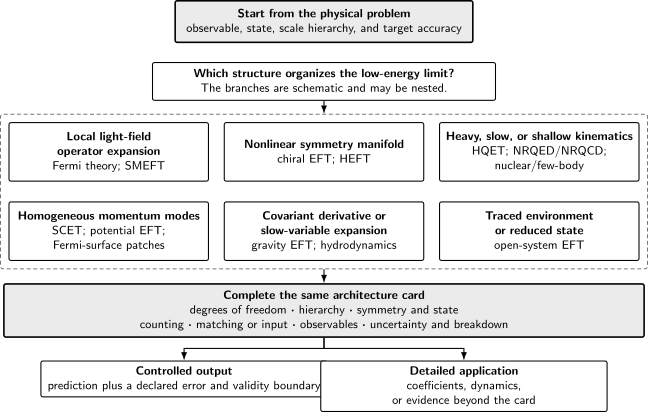
An EFT name is not a construction. Starting from the observable, state, scale hierarchy, and target accuracy, identify the dominant low-energy organizing structure, then declare degrees of freedom, symmetry and state, counting, matching or input, observables, uncertainty, and breakdown. Branches may be nested; the diagram is schematic and not to scale.
Regulator independence is an order-by-order test
Section titled “Regulator independence is an order-by-order test”Iteration samples loop momentum beyond the external scale, so a symmetry-allowed potential is not sufficient. At each order:
- regulate the integral or differential equation without confusing the regulator with a physical resolution scale;
- fit exactly the low-energy constants assigned at that order;
- change the regulator form and cutoff over a range with ;
- verify that on-shell observables approach a common limit or differ only at the first omitted order; and
- repeat the test as and the fitted data set change.
If an iterated kernel generates cutoff dependence larger than the truncation estimate, the counting is incomplete. The remedy is to promote the local operator with the required quantum numbers or to restrict the cutoff/domain—not to report the cutoff spread as the full EFT uncertainty. A cutoff taken far above the breakdown scale can also amplify unphysical details of a truncated kernel; regulator removal and finite-cutoff formulations are both acceptable only with a stated renormalization argument and residual-error estimate.
For a prediction through relative order , a useful schematic decomposition is
where the terms need not be statistically independent. is a failed-control diagnostic if it exceeds the nominal omitted order; it is not automatically combined with the truncation error as though the two were separate random samples.
First application: pionless two-body EFT
Section titled “First application: pionless two-body EFT”Take and integrate out pion exchange along with shorter-distance QCD dynamics. In one -wave channel, the leading contact operator is tuned to the measured scattering length and iterated. Matching the bubble sum gives
This single expression demonstrates the architecture:
- the amplitude satisfies elastic unitarity exactly because ;
- a large is retained nonperturbatively rather than expanded in ;
- short-distance details first enter through , shape parameters, and higher-body operators;
- for the same amplitude contains the shallow dimer pole; and
- fitting at each cutoff must make phase shifts and the pole regulator independent at leading order.
At next order, insert the two-derivative operator once. Equivalently, expand the effective-range denominator without resumming beyond the claimed accuracy:
The sign follows by expanding about . Resumming may introduce additional poles outside the intended domain; a partial resummation therefore needs its own pole and power-counting check.
Two-body finite-volume spectra can supply , , and coupled-channel information through Elastic Two-Body Quantization Conditions. Nuclear forces, currents, fits, and phenomenological validation belong to Nuclear Forces and the Chiral Expansion.
The leading three-body consistency question
Section titled “The leading three-body consistency question”Now scatter a particle from the shallow dimer in a channel with the ultraviolet behavior of three identical bosons. Iterating the leading two-body amplitude produces a Skorniakov–Ter-Martirosian-type integral equation. In the window
its homogeneous solutions behave as
The two-body input does not fix the ultraviolet phase. As changes, low-energy three-body observables therefore oscillate instead of converging. In the sharp-cutoff normalization of Bedaque, Hammer, and van Kolck, a leading three-body coupling can be written
so that
One three-body datum fixes the phase . Other low-energy observables in the same channel then become predictions, up to higher-order range corrections. The explicit running is regulator and normalization dependent; the need for one leading three-body parameter and the resulting discrete scaling are physical. Bedaque, Hammer, and van Kolck derive the asymptotic solutions, the nonuniqueness without a counterterm, and the running above in Bedaque, Hammer, and van Kolck 1999, preprint pp. 1–4, Open PDF.
This conclusion is channel dependent. Pauli statistics, spin/isospin recoupling, mass ratios, and angular momentum can change the ultraviolet eigenvalue and delay or remove the leading three-body force. The required question is therefore: after all promoted two-body interactions are iterated, does the three-body amplitude become regulator independent with the counterterms assigned at this order? A universal “three-body forces are always leading” rule is incorrect.
Braaten and Hammer review the large- two-body limit, Efimov spectrum, discrete scaling, and extensions to other particle statistics and mass ratios in Braaten and Hammer 2006, §§ 2–4 and 8–9, pp. 265–303 and 355–376.
Pionless, chiral, and many-body regimes
Section titled “Pionless, chiral, and many-body regimes”The architecture changes when another scale enters:
| Regime | Retained structure | New obligation |
|---|---|---|
| Pionless few-body EFT | Nucleons or atoms and promoted shallow channels | Match effective-range and few-body parameters; stop as pion/range or inelastic scales are resolved. |
| Chiral nuclear EFT | Nucleons and explicit pions with nonlinear chiral symmetry | Reconcile chiral order with reducible-loop enhancement, force/current iteration, and regulator independence. |
| Cluster EFT | Composite shallow clusters treated as fields | Demonstrate separation between cluster excitation/breakup scales and external momenta. |
| Finite-density or many-body EFT | Fermi momentum, occupation, collective modes, and possibly pairing/order parameters | Reassess counting, Pauli blocking, induced operators, and whether few-body inputs remain sufficient. |
Chiral symmetry constrains nuclear forces but does not alone settle their nonperturbative renormalization. Epelbaum, Hammer, and Meißner survey pionless and chiral regimes, force hierarchies, and few-body applications in Epelbaum, Hammer, and Meißner 2009, §§ I.D–II and IV, pp. 1778–1797 and 1805–1813. Strong bound-state integral-equation dynamics belongs to Bethe–Salpeter and Faddeev Bound-State Equations, while the density extrapolation is tested at From Few-Body Inputs to Many-Body Predictions.
Common pitfalls
Section titled “Common pitfalls”Expanding in when is large. Near a shallow pole, even though . Keep the full dependence at leading order and expand in range corrections.
Iterating every higher-order operator. Promotion is selective. Uncontrolled resummation of effective-range or pion corrections can generate spurious deep poles and import terms beyond the claimed accuracy.
Calling cutoff variation the uncertainty. Regulator variation tests whether renormalization works. A stable result still needs an EFT truncation estimate and input/numerical errors; an unstable result signals a missing counterterm or an invalid domain.
Assuming one three-body rule for every channel. Efimov ultraviolet behavior promotes a three-body force in specific channels. Statistics, recoupling, and angular momentum must be analyzed before assigning its order.
Using few-body success as a many-body proof. Density introduces , occupation effects, collective modes, and possibly new operators. The transfer of few-body inputs is a hypothesis to test, not an automatic consequence of matching and .
References
Section titled “References”-
Bedaque, Paulo F., Hans-Werner Hammer, and Ubirajara van Kolck. 1999. “Renormalization of the Three-Body System with Short-Range Interactions.” Physical Review Letters 82 (3): 463–467. DOI. Open PDF.
-
Braaten, Eric, and Hans-Werner Hammer. 2006. “Universality in Few-Body Systems with Large Scattering Length.” Physics Reports 428 (5–6): 259–390. DOI. Open PDF.
-
Epelbaum, Evgeny, Hans-Werner Hammer, and Ulf-G. Meißner. 2009. “Modern Theory of Nuclear Forces.” Reviews of Modern Physics 81 (4): 1773–1825. DOI. Open PDF.
-
Kaplan, David B., Martin J. Savage, and Mark B. Wise. 1998. “A New Expansion for Nucleon–Nucleon Interactions.” Physics Letters B 424 (3–4): 390–396. DOI. Open PDF.
Original QFT.org content:CC BY 4.0, unless an item supplies different terms. Third-party material retains its own terms.