

Fierz Relations and Dimension-Specific Identities
A Fierz relation is a completeness statement for a specified spinor representation in a specified integer dimension. Its coefficients depend on the metric, gamma-matrix normalization, chirality convention, field ordering, and whether the spinors are anticommuting fields or commuting wavefunctions. Internal-group completeness, Schouten identities, self-duality, and Levi-Civita duality have their own assumptions. These labels are part of the operator definition, because a four-dimensional relation need not survive dimensional continuation.
Required background. Representation and Spurion Constraints on Operator Bases constructs the unreduced invariant tensors. Spinors, Conjugations, Bilinears, Chirality, and Fierz Identities supplies the spinor index conventions and bilinear algebra.
Four-dimensional Clifford completeness
Section titled “Four-dimensional Clifford completeness”Use the global metric and define
The sixteen complex matrices are spanned by
Count each antisymmetric tensor component once and choose a dual basis such that
Matrix completeness is then
Multiplying this identity by the desired Dirac matrices and taking traces gives every four-dimensional Fierz coefficient. This derivation prevents a scalar, tensor, or chiral formula from being imported with an incompatible normalization.
For chiral currents it is shorter to use the equivalent two-component basis. Let
Completeness of the matrices gives
The final minus sign is a matrix identity. Reordering anticommuting fields into the new bilinears produces a second minus sign. Hence four distinct Dirac fields satisfy
The sigma-matrix completeness relations, their Fierz consequences, and the explicit distinction between commuting and anticommuting spinors are collected in Dreiner, Haber, and Martin 2010, § 2 and Appendix B.1, preprint pp. 16–19 and 160–164, Open PDF.
Algebraic identities have separate domains
Section titled “Algebraic identities have separate domains”Not every useful reduction is a spacetime Fierz identity:
| Identity | Convention and domain | Typical use |
|---|---|---|
| Dirac or Weyl completeness | Fixed integer dimension, metric, gamma basis, field ordering | Rearrange spinor pairings |
| generator completeness | and a declared representation | Rearrange internal-index pairings |
| Schouten antisymmetrization | Number of indexed vector or spinor components fixed | Remove over-antisymmetrized tensors |
| Hodge self-duality | Integer dimension, signature, orientation, and form degree fixed | Relate dual field-strength structures |
| Levi-Civita contraction | Integer dimension and epsilon normalization fixed | Convert epsilon tensors to metric determinants |
For fundamental generators with ,
This internal identity does not depend on the spacetime dimension. It may be used in provided the group representation and normalization are unchanged. By contrast, a four-vector Schouten relation or a chiral Fierz rearrangement is dimension-specific.
Construction must precede closure
Section titled “Construction must precede closure”An integer-dimensional relation can reduce the final physical basis, but it cannot be used to assume that the dimensionally regulated counterterm space is already closed.
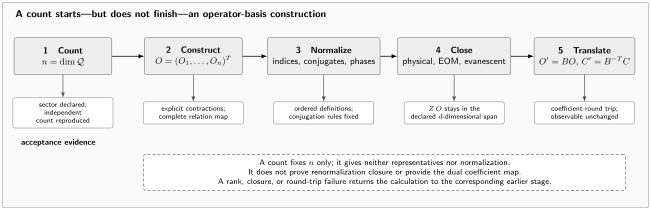
An operator-basis result is a five-stage package. Counting fixes ; construction supplies explicit contractions and relations; normalization fixes ordering, conjugation, and phases; closure enlarges the -dimensional renormalization space when EOM or evanescent operators are required; and translation applies with the dual coefficient map . The lower row states the acceptance evidence at each stage. A count alone is neither an explicit basis nor proof of RG closure. The diagram is schematic and not to scale.
The safe order is: construct in the dimension used by the regulator, renormalize in a closed enlarged space, and project to the integer-dimensional physical representatives only after the finite prescription has been declared.
First application: a four-fermion reduction
Section titled “First application: a four-fermion reduction”Let all be distinct anticommuting Dirac fields in the fundamental of , and keep the color indices explicit. Define
The four-dimensional chiral identity above swaps the second and fourth spinors while leaving their internal indices attached to the fields, so
For the ordered candidate list , the relation matrix is
Choose as representative. The coefficient map is
This proves both spanning and the dimension-one count in the stated four-dimensional sector. It also records what was used: distinct anticommuting fields, the metric, the definition of , and the displayed color ordering. Identifying any of the fields would add permutation signs and possibly further relations.
An independent component check follows directly from the Weyl identity: evaluate both sides before suppressing dotted and undotted indices. No numerical gamma-matrix representation is needed, and a chosen representation supplies a second exact check if desired.
What fails in dimensional continuation
Section titled “What fails in dimensional continuation”In , the Clifford relation still gives
not the strictly four-dimensional coefficient . More generally, the finite sixteen-matrix basis relies on four-dimensional dualities involving and . Antisymmetrized gamma products that reduce or vanish in four dimensions remain distinct during dimensional continuation. Appendix B.2 of Dreiner, Haber, and Martin 2010, preprint pp. 165–166, Open PDF identifies which sigma identities continue and why Fierz completeness does not continue unambiguously.
For the worked pair, define
Its four-dimensional matrix elements vanish, but it is not zero as a -dimensional operator. A loop can generate
An projection of onto a physical operator then leaves an finite term. Setting before subtraction loses that term and changes the finite renormalization scheme. Dugan and Grinstein establish this role of evanescent four-fermion operators in Dugan and Grinstein 1991, pp. 239–244; definition changes and their induced scheme transformations are analyzed in Herrlich and Nierste 1995, §§ 2–4, preprint pp. 3–10, Open PDF.
The next page treats as part of a closed renormalization system rather than completing that calculation here: Evanescent Operators, Finite Renormalization, and RG Closure.
The operator-basis reproducibility record
Section titled “The operator-basis reproducibility record”For a Fierz reduction, the dimensional-identity and operator-definition rows are decisive. Use the same chapter-wide record without abbreviating them.
| Record | Declare before reduction | Verification retained with the result |
|---|---|---|
| Field content and order | Spacetime dimension, dynamical fields, exact symmetries, charges, EFT grading, and truncation | Every candidate and relation has the declared labels and order |
| Flavor, Hermiticity, and CP | Flavor-index ranges, conjugation rule, coefficient reality conditions, and CP convention | Conjugate completion and independent real parameter count agree |
| Operator definition | Ordered names, explicit index contractions, derivative placement, signs, and normalization factors | Each symbolic or numerical column maps to one unambiguous operator |
| Renormalization data | Regulator, subtraction scheme, gauge convention when relevant, renormalization scale , and coupling definitions | Coefficients and matrix elements use the same scheme and scale |
| Dimensional identities | Dimension used for Lorentz and spinor algebra, prescription when present, and evanescent-operator definitions | The renormalized basis closes before any four-dimensional projection |
| Redundancy generators | IBP currents and boundary conditions, lower-order EOM, field maps, and algebraic identities | Every relation row is reproducible from a displayed generator |
| Basis map | Candidate and reduced dimensions, matrix orientation, exact rank, pivots, and representative ordering | Nullities and ranks satisfy the quotient dimension and no pivot is tolerance-dependent |
| Coefficient map | Dual transformation, transpose convention, finite shifts, and perturbative order | is unchanged through the retained order |
| Implementation identity | Source or notebook version, dependency versions, input hash, and output checksum | A clean rerun reproduces the ordered map and checksum |
| Round trip and physics | Forward and inverse maps on the common subspace plus one amplitude, correlator, or counting benchmark | The round trip is the identity and the benchmark is basis independent to the stated tolerance |
For the example, retain the ordered pair , , rank one, the coefficient map , the four-dimensional gamma conventions, and the -dimensional definition . A later change is a scheme change, not a harmless relabeling.
Common pitfalls
Section titled “Common pitfalls”Quoting an unlabeled Fierz identity. Metric, gamma normalization, chirality, spinor type, and Grassmann ordering control its signs and factors.
Mixing internal and spacetime completeness. The identity remains valid under dimensional continuation; the four-dimensional chiral identity does not.
Using commuting-wavefunction signs for operator fields. Reordering external c-number spinors and reordering anticommuting quantum fields are different operations. Derive the sign in the convention actually used.
Projecting before subtraction. An evanescent tensor times a UV pole can leave a finite physical contribution. Keep the enlarged space through renormalization.
Treating as convention-free in . State the prescription and finite symmetry-restoring terms when they are required.
Exercises
Section titled “Exercises”Derive from the Clifford algebra.
Solution
Use :
Use the fundamental completeness relation to reduce
Solution
Substitution gives
No spacetime Fierz rearrangement has yet been used, so this step is valid in any regulator dimension.
References
Section titled “References”- Dreiner, Herbi K., Howard E. Haber, and Stephen P. Martin. “Two-Component Spinor Techniques and Feynman Rules for Quantum Field Theory and Supersymmetry.” Physics Reports 494, no. 1–2 (2010): 1–196. DOI; Open PDF
- Dugan, Michael J., and Benjamin Grinstein. “On the Vanishing of Evanescent Operators.” Physics Letters B 256, no. 2 (1991): 239–244. DOI
- Herrlich, Stefan, and Ulrich Nierste. “Evanescent Operators, Scheme Dependences and Double Insertions.” Nuclear Physics B 455, no. 1–2 (1995): 39–58. DOI; Open PDF
Original QFT.org content:CC BY 4.0, unless an item supplies different terms. Third-party material retains its own terms.