

Operator Anomalous-Dimension Matrices
An anomalous-dimension matrix is the connection induced on a renormalized operator basis when the subtraction scale changes at fixed bare data. Its sign and index direction are not universal typography: they follow from the declared equation relating bare and renormalized operators. With this chapter’s column convention , the operator equation is .
This page derives that equation, extracts from minimal-subtraction poles, transforms it under finite basis changes, and identifies fixed-point scaling operators using the correct left eigenvectors. Wilson coefficients are mentioned only as an invariant check; their transpose equation and noncommuting path ordering belong to the next page.
Required background. Operator Mixing and Renormalization Matrices supplies a closed basis and . Renormalization Conditions, Schemes, and Finite Parts supplies finite scheme changes.
Helpful background. Commutators and Operator Exponentials is useful when matrices at different scales fail to commute.
Differentiating at fixed bare data
Section titled “Differentiating at fixed bare data”Let
for a closed column of local operators. The RG derivative at fixed bare fields and parameters is
where the omitted terms include any additional running renormalized coordinates. Bare insertions do not depend on the arbitrary subtraction scale:
Multiplication by gives
The boxed definition fixes all three convention choices:
- is a column;
- , not ;
- the minus sign appears in the operator equation.
Writing indices removes any ambiguity:
A reference using has . If it defines , then
The formulas look different but describe the same operator flow. Comparing a sign before first translating the direction is meaningless.
Collins derives the composite-operator RG equation from the scale independence of bare insertions and proves finiteness of its matrix coefficients Collins 1984/2023, § 7.12, pp. 219–221.
The figure keeps the dual transformations together. Read the upper map from bare to renormalized operators, then follow the inverse transpose on the source or Wilson-coefficient side. The same structure fixes both the sign convention above and the coefficient evolution derived on the next page.
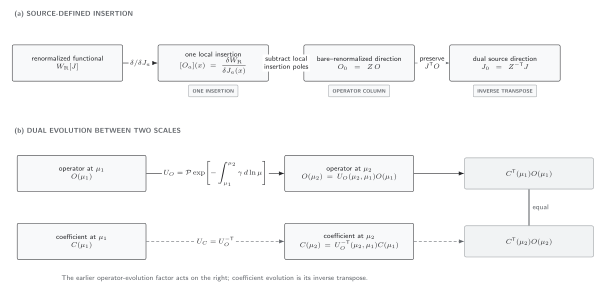
Operator–coefficient duality for the convention . Sources obey , and ordered operator evolution is compensated by coefficient evolution . The diagram is schematic and not to scale.
Extracting γ from minimal-subtraction poles
Section titled “Extracting γ from minimal-subtraction poles”For one dimensionless coupling , suppose
so its -dimensional beta function begins as
Write the operator matrix in a pure-pole scheme as
At fixed bare data,
The finite term produced when multiplies the simple pole is
This equation holds order by order after the higher-pole consistency relations are imposed. Products involving and cancel all remaining poles. Failure of that cancellation signals a missing subdivergence, an incomplete operator sector, or inconsistent lower-order input.
For several couplings with , the simple-pole formula becomes
Matrix order matters in the full definition , but the displayed simple-pole derivative acts entry by entry. A mass-dependent scheme adds explicit derivatives and generally cannot be reconstructed from a pure pole residue alone.
As a check, the preceding insertion page found
for , where . Therefore
Direct differentiation of the full gives the same finite result. The positive entry appears in ; changing the sign in the operator equation would also require changing the definition of .
A two-operator pole benchmark
Section titled “A two-operator pole benchmark”Let a dimensionless coupling satisfy , so . Suppose a normalized two-operator calculation gives the simple-pole matrix
The simple-pole formula gives
The lower-left zero is inherited from a closed triangular physical–redundant sector. A missing off-diagonal subtraction would instead appear as an uncancelled pole in .
At a fixed point , assume both operators have the same engineering dimension . A scaling operator is a linear combination
Its RG equation is diagonal only when is a left eigenvector:
For above, the left eigenvectors and eigenvalues are
so the full scaling dimensions in this algebra benchmark are
Right eigenvectors would diagonalize the evolution of coordinate columns, not the linear combinations of basis operators written as . Confusing the two transposes gives the wrong scaling operators even though the eigenvalue set happens to agree.
The numerical matrix is the first segment of a reproducible calculation. It is a deterministic algebra and ordering benchmark, not a claim about the spectrum of a named QFT; the benchmark absorbs the overall coupling into its RG-time interval.
Fixed points, degeneracy, and Jordan blocks
Section titled “Fixed points, degeneracy, and Jordan blocks”At a fixed point, and is constant in a fixed basis. If it is diagonalizable, left eigenoperators scale with definite anomalous dimensions. If two eigenvalues coincide, diagonalizability must still be checked. A Jordan block
produces logarithmic mixing:
There is then no basis of two independent ordinary scaling eigenoperators. The extra power of is physical within the stated sector and cannot be removed by pretending the matrix is diagonal.
Away from a fixed point, even a diagonalizable need not admit one scale-independent eigenbasis. Matrices at different scales can fail to commute:
Pointwise diagonalization introduces derivatives of the basis matrix, so simply integrating instantaneous eigenvalues is generally wrong. Ordered evolution is developed on the coefficient-evolution page.
Finite basis covariance
Section titled “Finite basis covariance”Let
be an invertible finite basis change. Differentiating and comparing
with gives
For constant , this is a similarity transformation. At a fixed point, a nonsingular coupling-dependent also has , so the eigenvalue spectrum of is invariant. Away from a fixed point, the connection term is essential and the eigenvalues of the instantaneous matrix are not scheme-invariant observables.
For the triangular scalar sector of the previous page,
where denotes the field-coordinate derivative there. Direct multiplication gives
The equation-of-motion direction has zero diagonal entry in its contact normalization, while the physical representative can still shift by it. A finite redefinition changes the off-diagonal entry by the derivative term in the boxed covariance law and leaves the physical quotient unchanged.
Checks before interpreting eigenvalues
Section titled “Checks before interpreting eigenvalues”| Check | What to calculate | Failure diagnosed |
|---|---|---|
| Sign | Differentiate explicitly | A convention imported from the inverse relation |
| Finiteness | Evaluate including higher poles | Missing subdivergence or incomplete lower-order counterterms |
| Closure | Project every pole onto the enlarged basis | Omitted EOM, total-derivative, BRST-exact, identity, or evanescent operator |
| Basis covariance | Apply a finite and include | Spurious scheme dependence or a missing connection term |
| Eigenoperator orientation | Test | Right eigenvectors mistaken for operator combinations |
| Fixed-point status | Verify all beta functions vanish and is nonsingular | Running matrix eigenvalues misreported as scaling dimensions |
| Jordan structure | Compare algebraic and geometric multiplicities | Logarithmic mixing hidden by an invalid diagonalization |
| Physical quotient | Retain the redundant block until after renormalization | On-shell projection used to conceal uncancelled off-shell poles |
These entries specialize the chapter’s mixing convention record.
Common pitfalls
Section titled “Common pitfalls”Defining without stating . The sign is inseparable from whether bare operators equal times renormalized operators or the inverse relation.
Keeping only the simple pole but skipping pole consistency. The simple-pole formula is the finite result of cancellations involving higher poles, the beta function, and . Those cancellations must be verified.
Diagonalizing with right eigenvectors. With basis operators stored as a column, a linear combination is and uses a left eigenvector.
Calling running eigenvalues critical exponents. Scaling dimensions are fixed-point data. Away from a fixed point they depend on basis and receive a connection term under -dependent finite changes.
Exercises
Section titled “Exercises”- Derive the operator RG equation from without assuming that commutes with its derivative.
Solution
At fixed bare data,
Multiplying from the left by gives
Therefore . Reversing the factors is not allowed for a noncommuting matrix.
- Let and . Find the leading anomalous-dimension matrix.
Solution
Here , so
The answer changes if the bare coupling carries instead; the engineering exponent must be declared.
- Verify the left eigenvectors of the benchmark matrix and show that the right eigenvector with eigenvalue does not give the operator .
Solution
For
one finds
Thus the operator combinations are and . The right eigenvector at eigenvalue is proportional to ; treating it as coefficients of a row combination would incorrectly produce .
- Derive the finite-basis transformation of .
Solution
Differentiate :
Comparing with gives
Continue to Dual Evolution of Operators and Wilson Coefficients to solve noncommuting scale evolution and derive the coefficient transpose from invariance of . Continue to Symmetry-Protected Operators, Currents, and Improvement to determine when a zero anomalous dimension follows from an exact identity rather than a basis choice.
References
Section titled “References”-
Collins, John C. 1984; open-access reissue 2023. Renormalization: An Introduction to Renormalization, the Renormalization Group and the Operator-Product Expansion. Cambridge Monographs on Mathematical Physics. Cambridge University Press. DOI and Open PDF.
-
Joglekar, Satish D., and Benjamin W. Lee. 1976. “General Theory of Renormalization of Gauge Invariant Operators.” Annals of Physics 97 (1): 160–215. DOI.
Original QFT.org content:CC BY 4.0, unless an item supplies different terms. Third-party material retains its own terms.