

Accidental Symmetries and Emergent Selection Rules
An accidental symmetry is respected by the leading terms of an EFT because the retained fields and exact spacetime and gauge symmetries admit no low-dimension operator that violates it. It need not be a fundamental symmetry of the ultraviolet theory. Its selection rules are approximate, with a calculable first failure from higher-dimension operators, anomalies, nonperturbative sectors, or a change of low-energy field content.
The minimal Standard Model provides the canonical example: its gauge-invariant operators of dimension at most four conserve baryon number and lepton number classically, although neither conservation law was imposed as a gauge principle. Dimension-five and dimension-six operators, together with the electroweak anomaly, reveal the limits of that statement.
Required background. Degrees of Freedom, Symmetry, and the Local Operator Expansion supplies the operator-inventory logic.
Helpful background. Multiplets, Invariants, and Selection Rules explains symmetry-based amplitude constraints. Technical Naturalness and Symmetry Protection distinguishes a quantum symmetry from a low-order accidental rule.
Operator dimension sets the first violation
Section titled “Operator dimension sets the first violation”Let contain every local operator through dimension allowed by the exact symmetries and chosen fields. Suppose all of those terms respect a global charge , but the first allowed operator with has dimension . Then
For a process characterized by light scales , where can include external energies, the Higgs expectation value, and light masses, dimensional analysis gives the relative amplitude scaling
up to couplings, symmetry factors, and kinematic or infrared enhancements. A rate generated only by this amplitude is quadratically suppressed; an allowed interference term can instead make the leading fractional correction linear in . The selection rule is therefore an order-by-order EFT statement with a breakdown scale, not an exact prohibition.
This mechanism differs from imposing a microscopic global symmetry. The exact constraints are Lorentz invariance, gauge invariance, locality, and the retained field representations. The accidental charge summarizes a pattern shared by the low-dimension invariants that survive those constraints.
The renormalizable Standard Model conserves B and L classically
Section titled “The renormalizable Standard Model conserves B and L classically”Use left-handed Weyl fields
with their Standard Model gauge representations. Assign , , , and . Gauge kinetic terms, the Higgs potential, and the Yukawa invariants
all carry . No Lorentz- and gauge-invariant operator of dimension at most four built from this minimal field content violates total or . Their classical conservation is therefore accidental at the renormalizable level.
The field-content qualification is essential. Adding a gauge-singlet right-handed neutrino permits a renormalizable neutrino Yukawa interaction and a dimension-three Majorana mass. The latter violates lepton number unless another exact charge forbids it. Adding other light multiplets can likewise lower the dimension of a violating invariant. “Accidental in the Standard Model” is not “automatic for every extension.”
Dimension five first violates lepton number
Section titled “Dimension five first violates lepton number”With the minimal fields, the unique dimension-five operator class is the Weinberg operator,
where the two Weyl spinors are contracted and an overall factor can be absorbed into the definition of . It has
After electroweak symmetry breaking it produces a Majorana neutrino-mass matrix with the convention-independent scaling
Weinberg’s operator analysis identifies this leading lepton-number violation and the higher-dimension baryon-number channels Weinberg 1979, pp. 1566–1570. The inference is limited: the low-energy coefficient does not by itself select whether the parent mechanism contains heavy singlet fermions, scalar triplets, loops, or another realization.
Dimension six first violates baryon number
Section titled “Dimension six first violates baryon number”Gauge and Lorentz invariance admit four-fermion operators such as
with weak-isospin and spinor contractions chosen to form singlets. This operator has and . Conjugate-field structures such as carry the opposite charges. Their coefficients enter as .
At a hadronic scale, dimensional analysis gives
The fifth power follows from dimensions; reliable process predictions require RG evolution, operator mixing, hadronic matrix elements, and channel-specific phase space. Wilczek and Zee’s operator analysis makes the connection between gauge-invariant four-fermion structures and nucleon-decay selection rules explicit Wilczek and Zee 1979, pp. 1571–1573.
The hierarchy of first violations is now visible:
- the dimension-four inventory conserves classical and ;
- dimension five permits but no baryon-number violation; and
- dimension six permits four-fermion interactions.
This page establishes that architecture and power suppression. Accidental Symmetries and Their Violations develops the complete Standard Model inventory, flavor structure, anomalous selection rules, and process-level phenomenology.
The electroweak anomaly changes the exact charges
Section titled “The electroweak anomaly changes the exact charges”The classical currents are not both exact quantum currents. For fermion generations, the anomaly contains
Integrating a gauge-field history with integer topological charge gives
For the Standard Model, : a unit transition changes both and by three. At zero temperature the weak-coupling tunneling rate is exponentially suppressed; in a hot electroweak plasma sphaleron transitions can be important. The nonperturbative selection rule follows from the anomalous fermion zero modes developed by ‘t Hooft 1976, pp. 3432–3450.
This anomaly does not make the local operator expansion useless. Perturbative diagrams built only from renormalizable Standard Model vertices still obey the accidental and counting, while nonperturbative topological sectors supply a distinct, explicitly identified violation. The precise statement must label which expansion and sector it concerns.
Separate the sources before reporting a rule
Section titled “Separate the sources before reporting a rule”The figure places an accidental selection rule in the QFT-structure column. Its support comes from fields, exact gauge symmetry, operator dimension, and—when relevant—the quantum anomaly. Priors and explanatory judgments do not alter the first allowed operator.
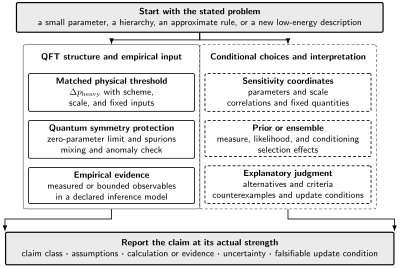
An accidental selection rule is a structural EFT result: retained fields and exact symmetries determine the first violating operator, while anomalies and physical thresholds delimit the rule. Empirical limits constrain coefficients only after this classification; priors and explanatory judgments remain separate. The diagram is schematic and not to scale.
A reproducible accidental-symmetry statement records:
- the retained fields and their exact gauge and spacetime representations;
- the complete operator inventory through a declared dimension or power-counting order;
- the accidental charge assignment of the leading inventory;
- the first allowed violating operators and their independent coefficients;
- the amplitude or rate suppression, including interference and matrix elements;
- the anomalous divergence and topological selection rule, if present;
- any light fields or thresholds that change the first allowed operator; and
- the energy range and omitted order.
Under RG evolution, exact gauge and Lorentz quantum numbers constrain operator mixing. Accidental-charge sectors remain separate when only charge-conserving vertices are inserted; a violating insertion can mix into every operator with compatible exact quantum numbers and the same net spurion charge. Multiple insertions can generate larger charge changes. This is why the leading violating basis, rather than one favorite operator, is the stable unit of analysis.
Common pitfalls
Section titled “Common pitfalls”Calling an accidental symmetry fundamental. Its origin is the absence of low-dimension violating invariants for a chosen field content. New light representations or higher-order terms can remove it.
Ignoring the anomaly because no local renormalizable vertex violates the charge. Perturbative operator counting and nonperturbative topological transitions are different expansions. State both when claiming quantum conservation.
Quoting only a power of . A process rate also depends on Wilson coefficients, running, mixing, matrix elements, and phase space. The EFT power is a starting estimate, not a prediction by itself.
Treating the Weinberg operator as a unique UV mechanism. Its coefficient fixes the leading low-energy interaction. Several inequivalent parent theories can match to the same operator.
Importing Standard Model phenomenology into the architectural claim. The EFT classification identifies where violations can begin. Current bounds and channel-specific conclusions belong with the detailed Standard Model treatment linked above.
References
Section titled “References”-
‘t Hooft, Gerard. 1976. “Computation of the Quantum Effects Due to a Four-Dimensional Pseudoparticle.” Physical Review D 14: 3432–3450; erratum 18 (1978): 2199. DOI.
-
Weinberg, Steven. 1979. “Baryon- and Lepton-Nonconserving Processes.” Physical Review Letters 43: 1566–1570. DOI.
-
Wilczek, Frank, and A. Zee. 1979. “Operator Analysis of Nucleon Decay.” Physical Review Letters 43: 1571–1573. DOI.
Original QFT.org content:CC BY 4.0, unless an item supplies different terms. Third-party material retains its own terms.