

The R-Operation, Forest Formula, and Overlapping Divergences
The R-operation is the recursive rule that turns the local subtraction of one ultraviolet region into a consistent subtraction of every ultraviolet region of a graph. Its closed-form solution is the forest formula. A forest is a compatible set of divergent 1PI subgraphs: any two members are nested or disjoint, never overlapping. Summing over all forests implements inclusion–exclusion without subtracting any region twice.
The construction has two logically distinct outputs. First, it produces a finite graph under the usual Euclidean and infrared-safety hypotheses. Second, it proves inductively that every counterterm is a bounded momentum polynomial, hence a local vertex. The formula organizes counterterms; it does not replace power counting, symmetry constraints, or an infrared analysis.
Required background. Local Counterterms and Subdivergence Structure supplies the Taylor-locality argument and the distinction between an overall divergence and a subdivergence. Power Counting of Divergences and Perturbative Renormalizability identifies the superficially divergent full graphs and proper subgraphs to which subtraction operators can apply.
Helpful background. Products, Scaling Degree, and Extensions of Singular Distributions gives the distributional origin of local ambiguities. Anatomy of a Loop Integral helps distinguish ultraviolet regions from threshold and infrared singularities.
The recursive R-operation
Section titled “The recursive R-operation”Let be a connected Feynman graph and its regulated amplitude or integrand. A renormalization part is a connected 1PI subgraph whose superficial ultraviolet degree satisfies , subject to the theory’s field content and symmetry selection rules. The complete graph may itself be a renormalization part.
For each such , define a local projection :
- in momentum-subtraction BPHZ, takes the Taylor polynomial in the external momenta of through degree ;
- in dimensional regularization with minimal subtraction, it extracts the pole part, including the prescribed powers of the renormalization scale;
- in another local scheme, it selects the corresponding local singular and finite terms.
Acting on , the operator replaces by that local polynomial while leaving the reduced graph . The subtraction inserted in the graph is .
It is useful to separate proper subdivergences from the overall divergence. Write for after every proper ultraviolet subdivergence has been subtracted, but before subtracting the overall divergence. The overall counterterm and renormalized graph are
If is not superficially divergent, set . The proper-subgraph operation can be written recursively as
Here runs over nonempty sets of mutually disjoint proper renormalization parts, often called spinneys, and contracts every member of to a vertex. Nested subtractions enter through the recursively computed ; disjoint counterterms multiply. This recursion starts at primitive graphs, for which . Collins gives this recursive construction and its graph-level meaning before deriving the forest solution Collins 1984/2023, §§ 5.3–5.5, pp. 102–112.
The order in these equations is not optional. The local part of an outer subgraph must be taken only after its own subdivergences have been removed. Otherwise can contain a pole multiplying a nonlocal logarithm, which cannot be a counterterm in a local action.
Forests solve the recursion
Section titled “Forests solve the recursion”A forest of is a set of renormalization parts such that every pair obeys exactly one of
The cases in the display are alternatives: for nested subgraphs only one of the two inclusions holds, while disjoint subgraphs satisfy the third relation. Thus overlapping subgraphs—subgraphs that intersect but contain neither one another—cannot belong to the same forest. Let include the empty forest and, when is superficially divergent, forests containing the full graph. Define
Operators for disjoint members commute. Operators for nested members are applied from the smallest subgraph outward. The forest formula is
The empty forest contributes . Forests not containing , called normal forests, subtract subdivergences. Adding to each compatible normal forest supplies the overall subtraction. Equivalently,
Zimmermann proved that this sum solves the Bogoliubov recursion and converges under the BPHZ momentum-space hypotheses Zimmermann 1969, pp. 208–234. The combinatorics are scheme independent as long as each is a consistent local projection; what changes with the scheme is the polynomial selected by that projection.
Three topologies and their subtraction terms
Section titled “Three topologies and their subtraction terms”The figure compares the admissible sets. Inspect which boxes can coexist: containment and separation define forests, while overlap excludes a simultaneous pair.
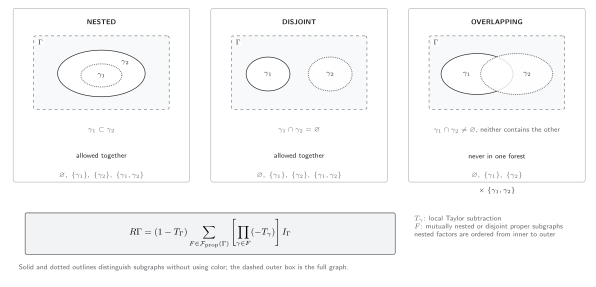
Forest compatibility and recursive locality. Each contracts a divergent subgraph to a local momentum polynomial. Nested operations act from inner to outer, disjoint operations commute, and overlapping subgraphs never occur together. The diagram and graph symbols are schematic, not quantitative and not to scale.
| Topology | Admissible normal forests | Characteristic subtraction |
|---|---|---|
| One proper subgraph inside a divergent full graph | ||
| Two disjoint primitive subgraphs | ||
| Two overlapping subgraphs |
The table is a semantic statement of the figure. If is also divergent in the last two rows, apply to the displayed proper-subgraph sum.
Nested two-loop graph
Section titled “Nested two-loop graph”Suppose a two-loop graph contains one primitive one-loop renormalization part , and itself is superficially divergent. Its four forests are
The sum is
The last term is not an optional correction. The bare overall subtraction also contains the ultraviolet behavior of ; restores that doubly subtracted contribution. Because acts first, the combined overall counterterm is
which is local even when by itself is not.
For two proper nested parts , the forest contributes , with applied first. Reversing the order would ask the outer projection to act on an unrenormalized inner graph and generally gives the wrong counterterm.
Disjoint-subgraph benchmark
Section titled “Disjoint-subgraph benchmark”Let contain two primitive one-loop subgraphs and with no common line or vertex. The normal-forest sum is
The double replacement has a plus sign. It is the inclusion–exclusion term for the region in which both loop momenta are hard, and it is also the graph containing both local counterterm vertices. Since the subgraphs are disjoint,
Omitting the double term leaves a duplicate-subtraction residual. Adding it twice overcounts the same forest. This four-term identity is the minimal deterministic benchmark for a forest enumerator.
Overlapping-divergence graph
Section titled “Overlapping-divergence graph”Now suppose and share internal structure but neither contains the other. The pair is not a forest, so there is no term . If the full graph is divergent,
This does not ignore the simultaneous hard region. Each singleton forest removes its own proper scaling region; the overall projection acts on their combined remainder and removes the common enclosing ultraviolet behavior. A two-loop sunset-type graph in four-dimensional scalar theory provides a concrete topology: its logarithmically divergent four-point subgraphs share lines pairwise, so they occur one at a time in normal forests, while the full two-point graph supplies the enclosing subtraction.
The forest rule therefore converts “overlap” from a special exception into an ordinary compatibility test. No arbitrary ordering between and is introduced.
Why the result is local and finite
Section titled “Why the result is local and finite”The locality proof is an induction on the number of loops.
- For a primitive divergent graph, is local by the definition and Taylor bound of .
- Assume every proper divergent subgraph has a local counterterm. Replacing any disjoint set of them in therefore produces an ordinary graph with local vertices.
- Their recursive sum has no proper ultraviolet subdivergence.
- Its only possible ultraviolet divergence is the overall one, so is again a bounded local polynomial.
- Subtracting it leaves ultraviolet finite under the convergence hypotheses.
The last step uses power counting for every subgraph, not merely for . In a BPHZ integrand formulation, the Taylor remainders improve each ultraviolet scaling region enough for Weinberg’s convergence criterion. In minimal subtraction, the corresponding claim is made for the regulated Laurent coefficients and counterterm insertions rather than for an unregulated integrand term by term. Weinberg’s original convergence theorem states the needed all-subgraph power-counting condition Weinberg 1960, pp. 838–849.
The forest formula proves ultraviolet locality only within its domain. Exceptional external momenta can create infrared divergences in Taylor subtractions; massless graphs may require nonexceptional subtraction points or infrared rearrangement. Gauge theories require the complete counterterm functional to satisfy Ward or Slavnov–Taylor identities. Composite insertions require their own enlarged forest and mixing structure. Those qualifications change the admissible local space, not the compatibility rule for nested, disjoint, and overlapping ultraviolet subgraphs.
A practical forest-enumeration algorithm
Section titled “A practical forest-enumeration algorithm”For a fixed graph and perturbative order:
- List connected 1PI subgraphs and compute .
- Retain the symmetry-allowed renormalization parts with .
- Build the pairwise relation table: nested, disjoint, or overlapping.
- Enumerate all subsets whose every pair is nested or disjoint; include .
- Add to each compatible normal forest when an overall subtraction is required.
- Apply from inner to outer; commute only disjoint operations.
- Assign the sign , sum once over each forest, and check primitive, disjoint-factorization, and overlap limits.
- Verify locality of every contracted vertex and finiteness in every ultraviolet scaling region.
A reproducible calculation should cover the bounded nested, disjoint, and overlapping fixtures. The analytic forest lists and signs above remain the no-execution reference: a computational result that disagrees with them has duplicated, omitted, or misordered a subtraction.
Common pitfalls
Section titled “Common pitfalls”Allowing overlapping subgraphs in one forest. Intersection is not enough; forest members must be nested or disjoint. The enclosing overall term handles the common hard behavior after the singleton subtractions.
Multiplying all factors blindly. That product creates forbidden overlap terms and hides the order of nested projections. Enumerate compatible forests first.
Applying nested operators outside to inside. The outer local projection would see an unresolved inner subdivergence. Apply the smallest subgraph first.
Dropping the disjoint double-counterterm graph. Inclusion–exclusion requires the plus term . Without it, the region where both disjoint loop momenta are hard is subtracted twice.
Claiming ultraviolet finiteness from the superficial degree of the full graph. Every proper subgraph must pass the convergence criterion after subtraction. A graph with can still contain divergent subgraphs.
Confusing ultraviolet and infrared failures. A forest can remove every ultraviolet region while a threshold, soft, collinear, or subtraction-induced infrared singularity remains. Diagnose those regions separately.
Exercises
Section titled “Exercises”1. Full forests. A divergent graph has one primitive proper subgraph . Enumerate the forests and recover the nested formula.
Solution
The normal forests are and . Adding gives and . Their signs are , so
The inner operation is applied before .
2. Three disjoint subgraphs. How many normal forests occur for three mutually disjoint primitive subgraphs, and what is the coefficient of the triple replacement?
Solution
Every subset is compatible, so there are normal forests. The forest containing all three members has cardinality three and coefficient . The sum factorizes as
3. An overlap mistake. Why is absent when and overlap?
Solution
There is no well-defined simultaneous contraction: the two subgraphs share structure but neither contraction is contained in the other. They therefore appear in separate singleton forests. The full-graph projection removes the remaining enclosing ultraviolet divergence from their combined remainder.
Result and the next step
Section titled “Result and the next step”The forest formula is a precise inclusion–exclusion rule:
Nested regions are ordered inside to outside, disjoint regions generate every product, and overlapping regions appear only in separate terms. The recursive locality proof then makes every subtraction a vertex generated by a local counterterm action.
Continue to Renormalized Perturbation Theory and Counterterm Rules to assemble these graph-level contractions into ordinary Feynman rules and loop-order bookkeeping. Continue to Symmetry Constraints and the Space of Counterterms to restrict the local vertices by Ward, Slavnov–Taylor, or BRST identities. For a theorem-first causal construction of local extensions, use Scaling Degree and Distribution Extension and Epstein–Glaser Induction.
References
Section titled “References”-
Collins, John C. 1984; open-access reissue 2023. Renormalization: An Introduction to Renormalization, the Renormalization Group and the Operator-Product Expansion. Cambridge Monographs on Mathematical Physics. Cambridge University Press. DOI and Open PDF.
-
Weinberg, Steven. 1960. “High-Energy Behavior in Quantum Field Theory.” Physical Review 118: 838–849. DOI.
-
Zimmermann, Wolfhart. 1969. “Convergence of Bogoliubov’s Method of Renormalization in Momentum Space.” Communications in Mathematical Physics 15: 208–234. DOI.
Original QFT.org content:CC BY 4.0, unless an item supplies different terms. Third-party material retains its own terms.