

Naturalness Arguments: Scope, Evidence, and Limits
A naturalness argument is strongest when written as a chain: a calculated threshold or quantum symmetry establishes a technical premise; a declared parameterization, correlation model, or prior supplies a conditional inference; and empirical data update that inference within a specified theory space. No single step licenses the others automatically.
This page compares chiral-fermion protection, pseudo-Goldstone protection, and heavy-threshold sensitivity of an elementary scalar. It then records the evidential status, historical lessons, counterexamples, and update conditions without issuing a verdict on whether nature “is natural.”
Required background. Technical Naturalness and Symmetry Protection supplies the quantum-symmetry test. Hierarchies, Thresholds, and Fine-Tuning Measures supplies the coordinate and prior checks.
Helpful background. Ultraviolet and Infrared Fixed Points: Criteria and Evidence distinguishes fixed-point evidence from extrapolation. Emergent Variables and Reorganized Effective Descriptions shows how new low-energy variables can be justified without a tuning verdict.
A naturalness claim has separable premises
Section titled “A naturalness claim has separable premises”For a low-energy quantity , distinguish five ingredients:
- Quantitative QFT premise: a matched relation, RG flow, Ward identity, or controlled nonperturbative result.
- Independence premise: a declaration of which parent parameters vary independently and which are related by a mechanism.
- Sensitivity functional: a correction ratio, derivative, norm, or finite parameter-space volume.
- Statistical premise: a normalized prior or measure, likelihood, conditioning data, and selection effects when probability language is used.
- Explanatory judgment: a stated preference for autonomy of scales, simplicity, mechanism, unification, or research usefulness.
The first ingredient can be a theorem or calculation. The next three are conditional structures. The fifth is a comparative judgment. Williams’s analysis of autonomy of scales makes clear why radiative sensitivity can motivate an explanatory concern without turning that concern into an observable Williams 2015, §§ 2–5, pp. 84–93.
A defensible conclusion names the ingredients actually supplied. For example:
In the declared parent theory and scheme, independent inputs and match to with . This is a large correction-to-result ratio in that decomposition. It becomes statistically atypical only under the separately stated measure.
Removing the last sentence’s condition would change the claim class rather than strengthen the calculation.
Three small masses support different conclusions
Section titled “Three small masses support different conclusions”Chiral fermion
Section titled “Chiral fermion”For a fermion mass matrix , a nonanomalous chiral symmetry is restored when all chirality-breaking spurions vanish. Counterterms obey
This establishes technical stability of a chosen small mass. It does not calculate the mass eigenvalues or a distribution over Yukawa couplings.
Pseudo-Goldstone boson
Section titled “Pseudo-Goldstone boson”If is the complete explicit breaking of an exact shift symmetry, then
The mass vanishes on the exact-symmetry surface, so a small breaking remains small. Additional spurions can contribute with their own selection rules; symmetry does not choose .
Elementary scalar with a heavy threshold
Section titled “Elementary scalar with a heavy threshold”For the two-scalar model matched at ,
Setting does not forbid the additive threshold. The calculation establishes sensitivity to an actual heavy state with coupling . It does not show that such a threshold exists in nature, that and are independent in every parent theory, or that a cancellation has a unique probability.
The enhanced-symmetry criterion behind the first two examples is the core of technical naturalness ‘t Hooft 1980, pp. 135–157. Susskind’s hierarchy analysis gives the contrasting elementary-scalar concern Susskind 1979, §§ I–II, pp. 2619–2623.
Case comparison and update conditions
Section titled “Case comparison and update conditions”The following table states each conclusion at the strength of its evidence. “Update” means information that would change the listed inference, not evidence that retroactively changes a valid calculation.
| Case | Technical input | Licensed conclusion | Limitation or counterexample | Concrete update condition |
|---|---|---|---|---|
| Chiral fermion mass | Nonanomalous chiral Ward identity; complete breaking-spurion inventory | Corrections vanish with the chiral spurions at the retained order | An anomalous current or another heavy-sector chirality-breaking spurion can remove simple multiplicativity | Demonstrate a new allowed additive term in matched observables, or prove the enlarged quantum symmetry forbids it |
| Pseudo-Goldstone mass | Exact shift symmetry at zero breaking; matched explicit-breaking spurions | The potential and mass carry symmetry-breaking factors | Additional explicit breakings, anomaly terms, or loss of the Goldstone EFT regime can dominate | Measure or derive a new breaking source and rematch its contribution to the mass |
| Elementary scalar plus a physical heavy state | Renormalized threshold | The light relevant operator is additively sensitive in the declared parent theory | A quantum symmetry, enforced parameter relation, or absent coupling can change the relation | Discover or exclude the threshold and measure its couplings; test the proposed protection or correlation |
| Electroweak hierarchy | Higgs-sector matching in a specified extension plus collider and precision data | Particular models and parameter regions acquire conditional sensitivity and empirical constraints | Measures, correlations, spectra, and search acceptance are model dependent; null results do not prove a universal no-go theorem | A confirmed new state, Higgs-coupling deviation, or stronger null result updates the corresponding model likelihood and sensitivity analysis |
| Vacuum energy | Semiclassical gravity plus EFT contributions to the renormalized cosmological term | There is an extreme mismatch between straightforward radiative estimates and the observed scale | No accepted symmetry or statistical premise presently turns the mismatch into a unique prediction | A verified adjustment mechanism, selection measure, or modified gravitational response with quantitative tests would change the inference |
The first two rows are successful symmetry protections. The third is a calculable conditional sensitivity. The last two show why extrapolating either structure into a universal expectation requires additional physics.
Keep evidence sources visually separate
Section titled “Keep evidence sources visually separate”The diagram is a reading guide for any naturalness claim. Follow the solid boxes first: physical thresholds, quantum symmetry, and observations provide different evidence. Then inspect the dashed boxes: coordinates, priors, and explanatory criteria determine distinct conditional conclusions.
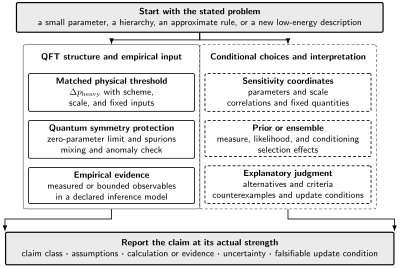
Naturalness reasoning is reliable only when physical thresholds, quantum symmetries, empirical evidence, parameter coordinates, priors, and explanatory judgments remain labeled. A final claim should state its class, assumptions, uncertainty, and update condition. The diagram is schematic and not to scale.
This separation blocks two opposite errors. Coordinate dependence of a tuning measure does not erase a calculated threshold. A calculated threshold does not supply an ensemble measure or force one explanatory response.
Claim-classification table
Section titled “Claim-classification table”This fixed table is the chapter’s claim boundary. A naturalness argument can combine rows only by providing the evidence and conditions required by each row.
| Claim class | Evidence or mathematical object | Conditional choices that must be declared | Licensed conclusion | Does not establish |
|---|---|---|---|---|
| Calculated threshold | Renormalized parent-to-EFT matching relation | Scheme, matching scale, matched observable, fixed inputs, and perturbative order | Size and operator structure of a heavy-scale contribution in that relation | Probability, inconsistency, or a preferred UV theory |
| Technical stability | Enhanced quantum symmetry, Ward identities, and spurion selection rules | Field content, symmetry limit, anomaly status, thresholds, basis, and retained order | Which corrections vanish or carry declared symmetry-breaking factors | Numerical value, typicality, or empirical success |
| Sensitivity diagnostic | Cancellation ratio or derivative such as | Parameter coordinates, correlations, scale, observable, and quantities held fixed | Local response or cancellation in the declared chart | Coordinate-free observable, probability, or universal model ranking |
| Probabilistic typicality | Normalized measure, prior, likelihood, and posterior | Sample space, measure, conditioning data, selection effects, and parameterization | Probability within the declared ensemble and inference model | Ensemble-independent fact or theorem of QFT |
| Empirical fact | Measurement, exclusion, or reproducible bound | Dataset, likelihood, model assumptions, date, and validity domain | What observations favor or exclude within those assumptions | A unique explanatory principle or prior |
| Explanatory heuristic | Comparative argument about autonomy, simplicity, mechanism, or research priority | Alternatives, virtues, counterexamples, historical scope, and update conditions | A transparent conditional preference or strategy | Calculation, symmetry theorem, probability, or empirical result |
Historical successes are conditional precedents
Section titled “Historical successes are conditional precedents”Retrospective naturalness examples include the role of the positron in softening the electron self-energy, hadronic structure in regulating charged–neutral pion mass sensitivity, and the charm quark in the short-distance description of neutral-kaon mixing. Giudice reconstructs these cases and the assumptions under which new degrees of freedom entered at the inferred scale Giudice 2008, § 6, pp. 13–14, Open PDF.
These cases support a research heuristic: a physically identified large correction can be evidence that degrees of freedom or symmetries are missing from a provisional description. They do not prove that every hierarchy must be resolved nearby. Selection effects matter—we remember successful estimates more readily than failed ones—and each case contained independent experimental and theoretical structure beyond a large number.
The vacuum-energy problem is a central counterexample. Ordinary EFT reasoning permits contributions vastly larger than the observed cosmological term, yet no accepted nearby threshold or symmetry mechanism has resolved the discrepancy. The scope of the problem and the difficulty of adjustment mechanisms were already explicit in Weinberg 1989, §§ I–VI, pp. 1–23; modern naturalness reviews retain it as a warning against treating the heuristic as a theorem Craig 2022, §§ 3–4, pp. 7–17, Open PDF.
Current empirical statements need dates and model qualifiers
Section titled “Current empirical statements need dates and model qualifiers”An empirical null result constrains a likelihood, not a symmetry theorem. The Particle Data Group review updated on 1 December 2025 reports no significant evidence for weak-scale supersymmetry in analyzed LHC data, describes tension between some naturalness expectations and nonobservation, emphasizes model-dependent limits, and explicitly says that current searches do not rule out the entire framework Particle Data Group 2025 update, § 87.7, printed pp. 23–25, PDF.
This dated statement supports neither “naturalness is experimentally false” nor “the null results are irrelevant.” It lowers the plausibility of the tested spectra under the relevant likelihoods and increases their conditional sensitivity in many parameterizations. Other spectra, correlations, neutral partners, high-scale solutions, emergent mechanisms, or statistical accounts require their own calculations and evidence. No model ranking is maintained here.
Craig’s 2022 review similarly treats the absence of expected weak-scale partners as a substantive failure of specific expectations while separating it from the validity of the hierarchy question itself Craig 2022, § 5, pp. 18–28, Open PDF. That is the appropriate update discipline: revise the affected inference without rewriting a valid Ward identity or matching equation.
A practical argument template
Section titled “A practical argument template”For any proposed naturalness conclusion, write:
- Object: the observable, renormalized parameter, hierarchy, or probability being discussed.
- Calculation: the matching or RG relation, symmetry identity, order, scheme, scale, and uncertainty.
- Variation: the independent inputs, correlations, and coordinate chart.
- Inference: the exact sensitivity functional or normalized statistical model.
- Evidence: dated measurements, exclusions, and likelihood assumptions.
- Alternatives: symmetry protection, UV correlations, selection effects, emergent descriptions, and known counterexamples.
- Claim ceiling: what the supplied evidence does not establish.
- Update condition: a calculation or observation that would materially change the conclusion.
This format leaves room for naturalness to be useful—as a symmetry criterion, diagnostic, probabilistic inference, or research heuristic—without allowing those uses to trade authority silently.
Common pitfalls
Section titled “Common pitfalls”Treating technical naturalness as a probability. A Ward identity constrains radiative corrections. It does not normalize a distribution of breaking spurions.
Using regulator power divergences as empirical thresholds. A physical scale-sensitivity claim requires a matched state or scale, not only a cutoff term.
Calling coordinate dependence fatal to all hierarchy reasoning. It limits the sensitivity functional, not the underlying matching calculation. Report both at their proper strength.
Turning one historical success into a universal induction. Each successful case had specific dynamics and evidence. Include counterexamples and selection effects.
Writing undated model-viability claims. Cite a dated review or dataset, state the likelihood assumptions, and supply an update condition.
References
Section titled “References”-
Craig, Nathaniel. 2022. “Naturalness: A Snowmass White Paper.” arXiv:2205.05708 [hep-ph]. arXiv. Open PDF.
-
Giudice, Gian Francesco. 2008. “Naturally Speaking: The Naturalness Criterion and Physics at the LHC.” In Perspectives on LHC Physics, edited by G. Kane and A. Pierce, 155–178. World Scientific. DOI. Open PDF.
-
Navas, S., et al. (Particle Data Group). 2024. “Supersymmetry, Part I (Theory).” In Review of Particle Physics, Physical Review D 110: 030001; 2025 update dated 1 December 2025. PDG 2025 PDF.
-
Susskind, Leonard. 1979. “Dynamics of Spontaneous Symmetry Breaking in the Weinberg–Salam Theory.” Physical Review D 20: 2619–2625. DOI.
-
‘t Hooft, Gerard. 1980. “Naturalness, Chiral Symmetry, and Spontaneous Chiral Symmetry Breaking.” In Recent Developments in Gauge Theories, edited by Gerard ‘t Hooft et al., 135–157. NATO Advanced Study Institutes Series B, vol. 59. Boston: Springer. DOI.
-
Weinberg, Steven. 1989. “The Cosmological Constant Problem.” Reviews of Modern Physics 61: 1–23. DOI.
-
Williams, Porter. 2015. “Naturalness, the Autonomy of Scales, and the 125 GeV Higgs.” Studies in History and Philosophy of Modern Physics 51: 82–96. DOI.
Original QFT.org content:CC BY 4.0, unless an item supplies different terms. Third-party material retains its own terms.