

NRQED, NRQCD, and Potential EFT Architecture
NRQED and NRQCD describe heavy particles moving with speed after hard fluctuations at the mass have been removed. A near-threshold pair contains two lower scales: relative momentum and kinetic or binding energy . Potential EFTs exploit the second separation by integrating out soft fluctuations at , promoting spatially nonlocal but time-local potentials to Wilson coefficients, and retaining potential heavy particles plus ultrasoft radiation. The matching sequence is therefore fixed by the state, not by the gauge theory’s name.
Required background. Heavy-Particle EFT and HQET Architecture supplies the particle/antiparticle projection and inverse-mass expansion. Modes, Virtualities, and EFT Scale Separation supplies homogeneous mode scaling and overlap tests. Integrating Out Heavy Fields supplies the distinction between exact elimination and a local expansion.
A heavy pair creates three separated scales
Section titled “A heavy pair creates three separated scales”Work in the pair center-of-mass frame with equal constituent masses . Near threshold, a quark and antiquark have momenta
where
The hard, soft, and ultrasoft scales are therefore
This hierarchy is kinematic. Weak coupling can relate to a gauge coupling, but nonrelativistic EFT only assumes the scale separation that the target state actually has. In QCD, is an additional scale whose position relative to and decides whether soft matching and low-energy matrix elements are perturbative.
The word “potential” is used for two distinct objects, which must not be conflated. A potential heavy particle has energy and momentum and remains dynamical. A potential gauge exchange has the same energy transfer but momentum , hence spacelike virtuality ; after soft matching it is encoded in a potential coefficient.
| Region or field | Energy scaling | Momentum scaling | Virtuality or role | Potential-EFT status |
|---|---|---|---|---|
| Hard fluctuation | Integrated out in QED/QCD NRQED/NRQCD matching | |||
| Soft radiation | Integrated out when matching to a potential EFT | |||
| Potential heavy particle | residual energy | Near its nonrelativistic pole | Retained and iterated | |
| Potential gauge exchange | Encoded in spatial potentials | |||
| Ultrasoft radiation | Retained and multipole coupled |
Pineda states this scale hierarchy and sequential construction in Pineda 2012, §§ 1–3, pp. 737–751.
Hard matching gives NRQED or NRQCD
Section titled “Hard matching gives NRQED or NRQCD”At a hard scale , remove relativistic virtuality, hard pair creation, and other fluctuations of order . Retain separate two-component fields and for a heavy particle and antiparticle, together with the light gauge and matter fields. A representative one-particle sector is
The antiparticle sector has the conjugate gauge representation and the corresponding sign changes. Four-fermion operators describe short-distance scattering and annihilation. The kinetic coefficient is fixed by the nonlinear realization of Lorentz invariance; magnetic, Darwin, spin–orbit, current, and four-fermion coefficients are found by matching full-theory and EFT amplitudes with the same infrared prescription.
NRQED and NRQCD share this architecture. NRQED uses the electromagnetic gauge field and charge representation. NRQCD retains non-Abelian gluons, light quarks, color-singlet and color-octet pair channels, and additional gauge self-interactions. Named coefficient values and process-dependent operator bases belong to their physical applications, not to the architecture card.
Integrating out does not yet make every remaining operator homogeneous in one power of : NRQCD still contains the soft and ultrasoft scales. Brambilla, Pineda, Soto, and Vairo describe the NRQCD degrees of freedom, inverse-mass operator expansion, matching, and this residual counting problem in Brambilla et al. 2005, § II, pp. 1434–1455.
Soft matching turns potentials into Wilson coefficients
Section titled “Soft matching turns potentials into Wilson coefficients”When is a useful separation, a second matching step integrates out soft modes and off-shell potential exchange. Schematically,
For a non-Abelian pair, convenient pNRQCD fields are a color singlet and a color octet , where is relative separation and is the center coordinate. The leading structure is
with
Color normalizations are suppressed because they depend on the chosen singlet/octet field convention. The structural point is invariant: , , and their spin- and momentum-dependent corrections are Wilson coefficients obtained by NRQCD-to-pNRQCD matching. They are nonlocal in but local in time after the energy expansion. Ultrasoft fields vary over distances much longer than , so they are multipole expanded about ; the first chromoelectric interaction is proportional to .
Potential iteration is not part of the soft coefficient. The resolvent
contains the low-energy propagation of retained potential particles. Terms with an intermediate denominator belong to this iteration and must be subtracted from matching, or they will be counted both in and in the Schrödinger evolution. Pineda separates potential iteration from the soft contribution and explains potentials as matching coefficients in Pineda 2012, §§ 3.1–3.5, pp. 746–758.
First application: a Coulombic equal-mass pair
Section titled “First application: a Coulombic equal-mass pair”Take an attractive Coulomb potential
where for oppositely charged unit-QED particles and for a color-singlet quark–antiquark pair at leading weak-coupling order. For equal masses the reduced mass is , so the relative Hamiltonian is
With , balancing kinetic and potential terms gives
up to order-one factors. The exact Coulomb spectrum fixes those factors:
Defining the constituent speed gives
The example therefore realizes all three scales: hard , soft , and ultrasoft . Moreover , so each additional Coulomb exchange accompanied by a potential propagator is order one. The Coulomb potential must be iterated even though its coefficient is perturbatively calculable. Corrections in , the multipole expansion, and radiative matching are then inserted according to their assigned order.
This is an architecture benchmark, not a precision spectrum. Bound-state QED coefficients and observables belong to Bound-State QED and NRQED; quarkonium counting, production, decay, and spectroscopy belong to Quarkonium and Nonrelativistic QCD.
The nonrelativistic architecture card
Section titled “The nonrelativistic architecture card”| Card entry | Required declaration |
|---|---|
| Degrees of freedom | Particle and antiparticle Pauli fields, light gauge and matter fields; after soft matching, potential pair fields or singlet/octet fields plus ultrasoft radiation. |
| Hierarchy and state | and the ordering of , , , , widths, thresholds, and external momentum transfer. |
| Symmetry | Gauge and rotational invariance, discrete symmetries, separate low-energy particle numbers, and nonlinear Poincaré constraints on coefficients. |
| Counting | Powers of , velocity, gauge couplings at their natural scales, multipoles, potential insertions, and loops. |
| Matching | Full theory NRQED/NRQCD at ; when justified, NR theory potential EFT at ; run coefficients and potentials toward . |
| Observables | Threshold amplitudes, spectra, transition and decay matrix elements, and inclusive rates in a declared factorization regime. |
| Uncertainty | Missing velocity and inverse-mass orders, hard/soft/ultrasoft perturbative terms, mass and potential schemes, nonperturbative inputs, widths, and numerical bound-state solution. |
| Validity boundary | The velocity expansion fails, scales cease to separate, open channels or widths reorganize the state, or required soft matching is neither perturbatively nor nonperturbatively controlled. |
The common selection figure places the pair problem on both the heavy/slow branch and the homogeneous-mode branch. Inspect their convergence on one card: the field reduction and the mode hierarchy are simultaneous obligations.
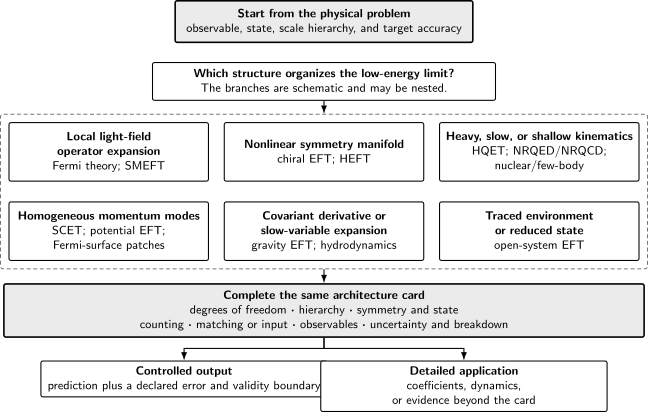
An EFT name is not a construction. Starting from the observable, state, scale hierarchy, and target accuracy, identify the dominant low-energy organizing structure, then declare degrees of freedom, symmetry and state, counting, matching or input, observables, uncertainty, and breakdown. Branches may be nested; the diagram is schematic and not to scale.
Weak- and strong-coupling soft regimes
Section titled “Weak- and strong-coupling soft regimes”The label “potential EFT” does not guarantee a perturbative potential. The location of decides the matching evidence.
| Regime | Soft matching at | Low-energy content | Required control |
|---|---|---|---|
| Perturbative in | Singlet/octet potential fields and ultrasoft gluons or light fields | Scale variation, RG consistency, mass/potential scheme cancellation, and higher velocity orders | |
| Nonperturbative Wilson-loop or spectral input | States below the next gluonic or open-flavor excitation, often with fewer active pair channels | Lattice or other nonperturbative matching, a demonstrated excitation gap, and controlled multipoles | |
| No gap above the target energy | No justified potential reduction | Stay at NRQCD or enlarge the retained state space | Coupled channels, threshold effects, and observable-specific factorization |
The spatial potential can change under unitary transformations or field redefinitions while the spectrum and amplitudes remain unchanged. Gauge choice, matching prescription, subtraction scheme, mass convention, and the bound-state Hamiltonian must be translated together. A potential by itself is not an observable.
Nonperturbative integral-equation dynamics is developed at Bethe–Salpeter and Faddeev Bound-State Equations. Lattice access to static energies and screening diagnostics is developed at Wilson and Polyakov Loops, Static Energies, and Screening Diagnostics. Brambilla et al. distinguish weak- and strong-coupling pNRQCD and their matching conditions in Brambilla et al. 2005, §§ III–VII, pp. 1455–1542.
Common pitfalls
Section titled “Common pitfalls”Using only an inverse-mass expansion. After hard matching, soft and ultrasoft scales remain. A claimed velocity order is incomplete unless fields, derivatives, potentials, and loops all have compatible homogeneous scalings.
Integrating out the potential particle. Potential gauge exchange is encoded in , but the nearly on-shell heavy particles remain dynamical. Their small energy denominators generate bound-state iteration.
Matching a ladder iteration into the potential. Contributions containing the retained denominator belong to solving the EFT. Subtract them during matching to avoid double counting.
Calling a potential observable. Field redefinitions and unitary transformations can move terms among potentials and iterations. Compare spectra or amplitudes after translating the complete Hamiltonian, current operators, and scheme.
Assuming weak-coupling pNRQCD from . Nonrelativistic motion does not imply . The position of the strong scale decides whether soft coefficients are perturbative.
References
Section titled “References”-
Brambilla, Nora, Antonio Pineda, Joan Soto, and Antonio Vairo. 2005. “Effective Field Theories for Heavy Quarkonium.” Reviews of Modern Physics 77 (4): 1423–1496. DOI. Open PDF.
-
Pineda, Antonio. 2012. “Review of Heavy Quarkonium at Weak Coupling.” Progress in Particle and Nuclear Physics 67 (3): 735–785. DOI. Open PDF.
Original QFT.org content:CC BY 4.0, unless an item supplies different terms. Third-party material retains its own terms.