

Matching with Amplitudes, Green Functions, and Background Fields
A matching object is the quantity required to agree between the full theory and the EFT through a declared order. On-shell amplitudes, off-shell Green functions, background-field vertices, and functional actions contain the same physical information when used completely, but they expose different coefficient combinations and carry different gauge, field-coordinate, redundant-operator, and infrared bookkeeping. Strategy choice is therefore part of the matching specification, not a cosmetic preference.
Required background. Integrating Out Heavy Fields defines the nonlocal light-field action and its local expansion. The 1PI Effective Action and Mean-Field Equations supplies the off-shell functional language. Helpful background. LSZ Reduction: Poles, Residues, and Stable External States fixes the on-shell residues and external-state conditions. Form Factors and Local Operator Insertions gives additional physical projectors for operator coefficients.
Matching objects and what they determine
Section titled “Matching objects and what they determine”Let be a generating operator set large enough to represent the chosen off-shell vertices, including equation-of-motion and other redundant directions. Let be a reduced physical basis. A matching strategy must do two jobs:
- provide enough independent projections to determine the coefficient combinations in its chosen basis; and
- specify how those coefficients are translated to the basis and field normalization used in predictions.
The principal choices are:
| Object | Best use | Data that must accompany it | Characteristic blind spot or failure |
|---|---|---|---|
| On-shell amplitudes or form factors | Direct access to physical combinations with equation-of-motion redundancy removed | Stable external states, helicities or species, kinematics, LSZ residues, loop order, and an infrared prescription | A chosen process may not span the coefficient space; infrared singularities and evanescent sectors still require care |
| Amputated off-shell Green functions | Efficient tensor and momentum projections in a generating basis | External virtualities, gauge, field coordinates, contact terms, wave-function convention, and redundant sectors | Coefficients of unphysical directions can be gauge and field-definition dependent |
| Background-field vertices | Manifest background-gauge covariance and compact extraction of gauge-covariant structures | Quantum gauge fixing, background normalization, ghost sector, projection momenta, and the target basis map | Background covariance does not make every off-shell coefficient gauge-parameter independent |
| Functional action or determinant | Whole operator families, pure-heavy loops, and covariant derivative expansions | Heavy/light split, quadratic operator, measure, regularization, mixed-loop treatment, and local expansion domain | A pure-heavy determinant alone can miss mixed heavy–light loops |
On-shell matching is economical when a sufficiently rich set of amplitudes exists. Georgi shows how perturbative on-shell matching automatically avoids several redundant interactions in Georgi 1991, pp. 339–350. Off-shell and functional methods are often more efficient for large tensor structures or gauge multiplets, but they must carry the additional unphysical sectors until a valid projection is made.
The diagram below makes the common endpoint explicit. Whichever object is selected, the full and EFT calculations must share their light and infrared data before their difference can be interpreted as a local hard coefficient.
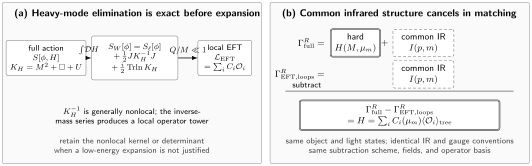
Heavy-field elimination and matching separate two steps. Panel (a) integrates a Gaussian heavy field with quadratic operator and light source , producing an exact, generally nonlocal source term and a field-dependent determinant; only for are these expanded into local operators. Panel (b) shows a renormalized loop matching condition: with the matching object, light states, infrared prescription, gauge, scheme, fields, and basis aligned, the common infrared term cancels and the remainder fixes the hard Wilson coefficients. The diagram is schematic and not to scale.
One scalar model, on shell and off shell
Section titled “One scalar model, on shell and off shell”Use the heavy-scalar interaction . Take four light momenta incoming, , and define
After removing the overall Feynman-rule phase, the tree-level four-light matching vertex is
At low virtualities,
Momentum conservation gives the useful identity
At a nonexceptional Euclidean symmetric point with , the term is and can be projected directly. The background-field action gives the same information by expanding about a slowly varying and differentiating the resulting vertex functional.
For massless on-shell external states, however, and therefore . The physical four-point amplitude is blind to this entire correction. That does not make the off-shell result wrong: it means the corresponding four-field derivative interaction lies in a redundant direction for this on-shell process. The on-shell strategy proceeds directly in a reduced basis, while the off-shell strategy records the coefficient in a Green basis and removes it by a field redefinition.
This example also shows why “match one convenient amplitude” can be insufficient. The on-shell four-point amplitude fixes the leading contact coefficient and the dimension-eight combination proportional to , but it cannot determine how a redundant dimension-six term is redistributed into six-field interactions. Additional amplitudes or an explicit basis map supply that information.
Translating a Green basis to a physical basis
Section titled “Translating a Green basis to a physical basis”Consider the local scalar Lagrangian
Perform the perturbative local field redefinition
Through , the coefficients become
Choosing removes the derivative operator and gives
The off-shell two descriptions now have different vertices, while their on-shell amplitudes agree after all induced interactions and external residues are included. This is the practical content of the equivalence theorem for a perturbative local, invertible field change Kamefuchi, O’Raifeartaigh, and Salam 1961, pp. 529–549. Arzt shows how classical equations of motion implement such reductions in effective Lagrangians without discarding loop effects, provided the induced terms and renormalization are handled consistently Arzt 1995, pp. 189–195.
For the heavy-scalar expansion,
where denotes equality up to a total derivative. The background-field or off-shell vertex sees this coefficient. A massless on-shell four-point amplitude does not; after the field redefinition, the same information contributes through induced higher-field operators and diagrams. Comparing the raw coefficient of between the two strategies would therefore compare different coordinates on the same theory space.
The translation must be performed at the same perturbative and EFT order. At loop level, the basis map also acts on counterterms and anomalous dimensions; in dimensional regularization, evanescent operators may be needed before the physical projection. A basis reduced for tree amplitudes is not automatically closed under renormalization.
Gauge and infrared data are part of the object
Section titled “Gauge and infrared data are part of the object”For gauge theories, an off-shell Green function depends on the quantum gauge fixing and generally on field coordinates. Background-field gauge can make background covariance manifest, which greatly restricts the local structures, but it does not turn the off-shell effective action into an observable. Gauge-parameter dependence must cancel after the basis, field map, external residues, and observable are assembled.
On-shell amplitudes avoid many gauge-dependent redundant directions, but they can have soft or collinear singularities. Matching does not require each side to be infrared finite. It requires the infrared structure to be identical and to cancel in the renormalized full-minus-EFT difference. A small light mass, dimensional infrared poles, off-shell Euclidean virtuality, analytic regulator, or overlap subtraction can be used, but the same prescription and order of limits must be applied on both sides.
Functional methods reproduce the same matching when their field split and determinant are complete. Pure-heavy functional traces are only one class of one-loop contribution; mixed heavy–light loops require the resolved nonlocal action or an equivalent subtraction. Henning, Lu, and Murayama formulate this separation and a gauge-covariant derivative expansion in Henning, Lu, and Murayama 2018, §§ 1–3, pp. 2–29.
The matching validation record
Section titled “The matching validation record”The following record is reused on the chapter’s consistency, threshold, and nondecoupling pages. A blank field means that two calculations have not yet been shown to define the same matching problem.
| Record | Declare before matching | Closure check |
|---|---|---|
| Matching object and external data | Amplitude, form factor, Green function, background vertex or functional action; external species, polarizations, momenta and projections | The chosen objects span every coefficient combination claimed |
| Kinematics and retained order | On- or off-shell conditions, exceptional limits, expansion variables, inverse-mass order and loop order | Full and EFT expressions are expanded in the same variables and compared through the same order |
| Fields and normalization | Field coordinates, kinetic normalization, masses, LSZ residues and finite field maps | Two-point functions and external residues agree, or an explicit field transformation relates them |
| Gauge and auxiliary sectors | Quantum and background gauge fixing, ghosts, BRST-exact sectors and anomaly assumptions | Gauge-parameter or auxiliary-sector dependence cancels in the final observable |
| Operator basis and redundancies | Generating or reduced basis, integration-by-parts, equation-of-motion, evanescent and contact sectors | A complete map to the target basis reproduces the same amplitudes or invariant correlators |
| Ultraviolet scheme and matching scale | Regulator, subtraction convention, finite counterterms and | Scheme and dependence cancels against coefficient running and matrix elements through the retained order |
| Infrared prescription | Light masses or virtualities, infrared regulator, overlap or zero-bin subtraction and order of limits | Every common infrared pole and logarithm cancels in full minus EFT before a hard coefficient is read off |
| Threshold and decoupling assumptions | Active fields, heavy-mass origin, coupling scaling, threshold order and hierarchy among heavy scales | Sequential and one-step organizations agree to the claimed order where both are valid |
| Observable closure and uncertainty | Validation observable, input parameters, truncation estimate, numerical tolerance and fit covariance | Independent observables agree within the decomposed uncertainty and show the expected residual scaling |
The record does not require every strategy to use the same intermediate basis. It requires the transformations and checks needed to reach the same physical prediction to be explicit.
Selecting a strategy
Section titled “Selecting a strategy”A reliable choice can be made with four questions.
- Which coefficients are needed? If only a few physical combinations enter one process, on-shell projectors are economical. If a whole gauge-covariant action is required, background or functional methods may be better.
- Can the object avoid infrared complications without losing information? Nonexceptional Euclidean Green functions can regulate massless infrared behavior, but they enlarge the redundant and gauge-dependent sectors.
- Is the target basis closed at the requested loop order? If not, match first in a generating basis that includes evanescent and redundant counterterms, then project.
- What independent calculation will close the result? A different amplitude, background-field projection, low-energy theorem, or full-model observable should reproduce the translated coefficients.
A reproducible calculation uses the scalar amplitude and a separate pole record to expose inconsistent field maps and subtraction schemes. It complements, rather than replaces, the analytic translation above.
Common pitfalls
Section titled “Common pitfalls”Off-shell coefficients are observables. They can depend on gauge and field coordinates. Their value becomes meaningful only as part of a declared basis and a closed prediction.
On-shell matching needs no basis bookkeeping. It avoids equation-of-motion redundancy in the matched amplitudes, but incomplete external states, evanescent operators, and loop closure can still leave coefficients undetermined.
Background gauge invariance means gauge independence. Background covariance constrains the form of the action. Dependence on the quantum gauge parameter can remain off shell and must cancel in physical results.
A pure-heavy determinant is the complete one-loop match. Mixed heavy–light loops are not generally contained in that determinant. They must be generated and subtracted by a complete functional or diagrammatic procedure.
Exercises
Section titled “Exercises”Prove that for four incoming momenta and explain the massless on-shell consequence.
Solution
Using ,
If all four external particles are massless and on shell, every vanishes, so the order- four-point correction vanishes. An off-shell projector need not vanish.
Apply to and find the value of that removes .
Solution
The kinetic term produces , while the quartic term produces . Hence
Setting gives and . Both bases yield the same on-shell amplitudes when all induced terms are included.
References
Section titled “References”- Arzt, C. “Reduced Effective Lagrangians.” Physics Letters B 342 (1995): 189–195. DOI · Open PDF
- Georgi, Howard. “On-Shell Effective Field Theory.” Nuclear Physics B 361 (1991): 339–350. DOI
- Henning, Brian, Xiaochuan Lu, and Hitoshi Murayama. “One-Loop Matching and Running with Covariant Derivative Expansion.” Journal of High Energy Physics 2018, no. 1 (2018): 123. DOI · Open PDF
- Kamefuchi, S., L. O’Raifeartaigh, and A. Salam. “Change of Variables and Equivalence Theorems in Quantum Field Theories.” Nuclear Physics 28 (1961): 529–549. DOI
Original QFT.org content:CC BY 4.0, unless an item supplies different terms. Third-party material retains its own terms.