

Matching onto Factorized Operator Structures
Hard matching can turn a local full-theory current into an operator assembled from fields in several EFT sectors. Collinear gauge invariance dresses each energetic field with a collinear Wilson line; leading-power soft decoupling moves long-distance cross-sector interactions into soft Wilson lines in the operator. This is an operator-level separation of scales. It becomes a factorization theorem for an observable only after the measurement, overlaps, long-distance exchanges, and renormalization also separate consistently.
This page constructs that hierarchy for a color-singlet current producing two back-to-back jets. An additive event-shape insertion gives a concrete candidate hard–jet–soft formula. A leading Glauber operator then shows why a factorized-looking current and a decoupled Lagrangian are not by themselves a proof.
Required background. Multipole Expansion and Homogeneous Mode Power Counting supplies projected soft coordinates and overlap subtraction. Matching Conditions Beyond Tree Level supplies infrared-safe full-minus-effective matching. Hard, Jet, and Soft Factorization develops observable-level factorization and its scattering applications.
Sector building blocks after hard matching
Section titled “Sector building blocks after hard matching”Let a color-singlet QCD vector current carry timelike momentum into two energetic directions and , with and . At leading power,
The collinear quark building block
contains a collinear Wilson line and is invariant under -collinear gauge transformations up to the transformation at the line endpoint. The analogous belongs to the other sector. Unsuppressed derivatives along the large light-cone directions require the current to be nonlocal on those rays:
The Fourier transform of depends on the large label momenta and therefore on . It contains hard fluctuations, while matrix elements of the sector fields reproduce the infrared behavior. The matching condition is
with the same external states and infrared regulator on both sides. For on-shell dimensional regularization, EFT loop integrals are scaleless; their ultraviolet counterterm carries the infrared poles of the QCD amplitude, leaving the renormalized finite. This shortcut is valid only after the infrared structures have been shown to agree.
The scalar-current and general -jet versions of this construction are derived in Becher, Broggio, and Ferroglia 2015, §§ 3.2 and 8.1, preprint pp. 20–25 and 91–96, Open PDF.
Soft decoupling leaves Wilson lines in the operator
Section titled “Soft decoupling leaves Wilson lines in the operator”At leading power, the -collinear Lagrangian contains the ultrasoft field through . Introduce a soft Wilson line
where or is fixed by whether the energetic line is outgoing or incoming and by the associated prescription. The leading-power field redefinition
removes ultrasoft fields from the two collinear Lagrangians. It does not remove them from the current. After multipole expansion at the hard vertex,
The roles are now distinct:
| Structure | Gauge and scale content | What it can establish |
|---|---|---|
| Hard, infrared-insensitive coefficient | Matching at virtuality | |
| , | Separately collinear-gauge-invariant sector fields | Candidate jet matrix elements |
| Eikonal color transport of long-wavelength radiation | Candidate soft matrix element and its color correlations | |
| Multipole point | Leading interaction coordinate seen by ultrasoft fields | Homogeneous soft–collinear expansion |
The decoupling transformation and the survival of soft Wilson lines in a two-direction current are shown explicitly in Becher, Broggio, and Ferroglia 2015, §§ 4.5–4.8, preprint pp. 38–45, Open PDF.
First application: insert an additive two-jet measurement
Section titled “First application: insert an additive two-jet measurement”Let be an infrared-safe two-jet event shape whose leading-power value is additive across the three modes,
Do not assume that a colored hadronic final state factorizes into three independent states. Instead, insert the measurement operator before using completeness:
Additivity gives the operator identity
Each measurement factor now acts only on fields in its own sector and commutes with fields in the other sectors. Combining this identity with the decoupled leading action and the matched current produces the candidate leading-power form
with
The jet functions are measured matrix elements of the corresponding fields. The soft function is a vacuum matrix element of the time- and anti-time-ordered products of and with . The Wilson-line directions, color representations, and measurement definition are part of these operator definitions, not optional notation.
Bauer, Fleming, Lee, and Sterman construct the event-shape operator, prove its leading sector decomposition, and derive this convolution without assuming a tensor-product decomposition of colored final states in Bauer, Fleming, Lee, and Sterman 2008, § 2B–E, pp. 5–10, Open PDF.
Conditions that turn the candidate into a theorem
Section titled “Conditions that turn the candidate into a theorem”The boxed expression is established only if each row below has affirmative evidence.
| Condition | Required evidence | Failure signal |
|---|---|---|
| Complete modes | Pinch and power-counting analysis reproduces every leading region | Missing logarithm, uncanceled regulator dependence, or nonanalytic remainder |
| Controlled overlaps | Pairwise and nested zero-bins remove double counting | Sector sum disagrees with expansion by regions |
| Complete operator basis | All leading gauge-invariant sector structures and causal Wilson-line orientations are included | Matching depends on external infrared choices or violates a Ward identity |
| Leading-action separation | Field redefinitions remove the declared cross-sector interactions at the retained power | A leading interaction remains in the Lagrangian |
| Measurement separation | decomposes into commuting sector operators after multipole expansion | Clustering, recoil, or a boundary depends jointly on two sectors |
| Long-distance exchange control | Glauber contributions cancel, are absorbed consistently, or are retained as explicit operators | A pinched transverse exchange connects nominally separate sectors |
| Renormalized closure | Sector convolutions exist as distributions and all auxiliary scales cancel | Endpoint divergence or unmatched or rapidity dependence |
Renormalization supplies a sharp operator-level check. For the simple multiplicative representation in Laplace space,
In momentum space this is a distributional convolution identity. Failure means that a mode, overlap, operator, or regulator counterterm is missing; it cannot be repaired by choosing all scales equal. The next page turns this consistency relation into evolution kernels.
A leading Glauber obstruction
Section titled “A leading Glauber obstruction”A soft Wilson-line field redefinition does not eliminate every long-distance interaction. In forward or spectator-sensitive kinematics, a pinched Glauber exchange has transverse momentum parametrically larger than its light-cone components and can generate a leading operator of the schematic form
The collinear bilinears and the intervening soft operator are separately gauge-covariant building blocks, but the whole expression couples the , soft, and rapidity sectors. With no emitted soft gluons, contains a factor proportional to , leaving the expected single transverse potential .
For sufficiently inclusive color-singlet observables, sums over cuts can cancel relevant Glauber phases. That cancellation is an observable-dependent result, not a consequence of writing . Less inclusive measurements or initial–final color connections can retain the exchange and invalidate the candidate formula. Rothstein and Stewart derive the leading gauge-invariant Glauber basis and its transverse-potential structure in Rothstein and Stewart 2016, § 5.1, preprint pp. 21–25, Open PDF.
Measurement coupling provides a second obstruction. If a jet boundary changes when a soft momentum is added to a collinear cluster, then generally
at the claimed power. One must alter the mode content, retain a coupled measurement operator, or prove that the coupling is power suppressed. A divergent endpoint convolution is likewise a diagnostic to revisit modes and operator overlap; it is not automatically a factorization theorem or automatically a proof that none can exist.
The construction map
Section titled “The construction map”The right panel places operator matching after the multipole and overlap step. Its final dashed box is essential: Glauber exchange, measurement coupling, endpoints, and missing modes must be checked before the hard, jet, and soft matrix elements can be interpreted as a factorization theorem.
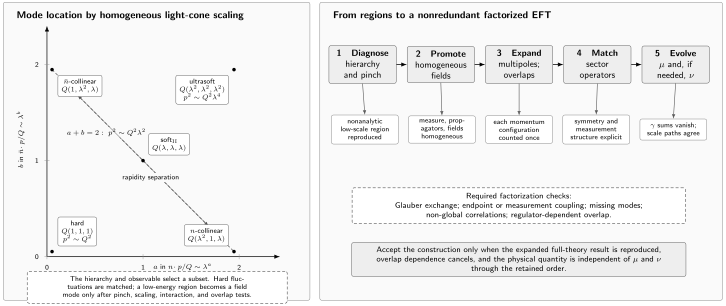
Mode locations are shown in the exponents and of , with the transverse exponent written in each label. The line contains -collinear, -collinear, and soft-II scalings of virtuality ; their separation along the line is a rapidity separation. Ultrasoft momentum has virtuality , while hard fluctuations are matched at . The points are alternatives selected by a hierarchy and observable, not a universal simultaneous field list. A consistent construction requires homogeneous fields, multipole and overlap expansion, sector matching, and and, when needed, evolution, with explicit factorization checks. The diagram is schematic and not to scale.
Common pitfalls
Section titled “Common pitfalls”Equating field redefinition with factorization. Leading soft–collinear interactions can disappear from the Lagrangian while soft Wilson lines remain in operators. Measurements and Glauber exchange still require separate proofs.
Factorizing colored final states by assumption. Sector-wise measurement operators let the complete state sum be performed without asserting that a physical hadron state is a tensor product of colored pieces.
Calling every Wilson line soft. enforces collinear gauge invariance inside a sector; encodes long-wavelength eikonal interactions between sectors. They arise at different stages and have different natural matrix elements.
Treating the hard function as a process-independent constant. Its spin, color, causal, and large-momentum structure comes from matching the complete leading operator basis. Only its infrared insensitivity is universal.
Exercises
Section titled “Exercises”-
Why does the hard coefficient not contain the small event-shape scale?
Solution
Hard matching integrates out fluctuations of virtuality . Dependence on the much smaller measurement scale is infrared physics reproduced by jet and soft matrix elements, so it cancels from the full-minus-EFT coefficient.
-
What double counting does the zero-bin subtraction remove?
Solution
It removes the soft scaling limit already contained in a collinear integral when that same limit is represented by a separate soft mode. This also gives the separate functions consistent ultraviolet and infrared pole assignments.
References
Section titled “References”-
Bauer, Christian W., Sean Fleming, Christopher Lee, and George Sterman. 2008. “Factorization of Event Shape Distributions with Hadronic Final States in Soft Collinear Effective Theory.” Physical Review D 78 (3): 034027. DOI. Open PDF.
-
Becher, Thomas, Alessandro Broggio, and Andrea Ferroglia. 2015. Introduction to Soft-Collinear Effective Theory. Lecture Notes in Physics 896. Cham: Springer. DOI. Open PDF.
-
Rothstein, Ira Z., and Iain W. Stewart. 2016. “An Effective Field Theory for Forward Scattering and Factorization Violation.” Journal of High Energy Physics 2016 (8): 025. DOI. Open PDF.
Original QFT.org content:CC BY 4.0, unless an item supplies different terms. Third-party material retains its own terms.