

Elastic Two-Body Quantization Conditions
An elastic two-particle spectrum encodes an infinite-volume phase shift because the wavefunction outside the interaction region obeys the free Helmholtz equation while periodicity restricts its allowed singular solutions. Matching the exterior solution to the infinite-volume partial wave gives a quantization condition. The relation is controlled only for stable constituents, short-range interactions, one open two-body channel, a declared frame and cubic irrep, and a tested partial-wave truncation; neglected massive wrapping terms remain exponential in .
Required background. Spectra from Euclidean Correlation Matrices supplies correlated finite-volume levels. Partial-Wave Unitarity supplies the phase-shift and amplitude normalization.
Helpful background. Relativistic Scattering Kinematics supplies and . Exponential Finite-Volume Effects identifies the omitted short-range images.
Elastic S-wave quantization at rest
Section titled “Elastic S-wave quantization at rest”Begin with two stable spin-zero particles of masses in a periodic cubic box. For total momentum , a measured level defines by
Elastic finite-volume convention and regime. The displayed scalar relation is restricted to a periodic cube, one open two-body channel, short-range interactions, and the stated S-wave and scattering-length signs.
The detailed choices, including the retained exponential remainder, are:
| Field | Choice used on this page |
|---|---|
| Amplitude | , consistent with the site’s phase-space-normalized partial wave |
| Scattering length | ; this is the negative of the common nuclear-physics convention |
| Zeta function | by analytic continuation to |
| Box and irrep | Periodic cube, , even-parity irrep; the displayed scalar equation neglects mixing |
| Domain | One open two-body channel, short interaction range , and energy below the first omitted inelastic or three-particle threshold |
| Remainder | Exponentially suppressed massive images, discretization effects, and partial waves omitted by truncation are propagated separately |
The S-wave quantization condition is
Equivalently, define a continuous pseudo-phase by
The integer is a branch label. It must be followed continuously through noninteracting poles of the zeta function; applying a principal arctangent independently to each level can shift by and corrupt its derivative.
Why matching produces the condition
Section titled “Why matching produces the condition”Outside a finite interaction region, the relative wavefunction obeys
In infinite volume its S-wave component is proportional to
In the box, periodicity replaces the outgoing Green function by
Expanding into spherical waves and matching the ratio of regular to irregular S-wave pieces to the infinite-volume exterior solution yields the zeta-function equation. The only power-law volume dependence retained in this step comes from the two propagators going on shell. Contributions whose loop contours remain deformable are part of the exponential remainder. Lüscher’s field-theoretic derivation proves this separation for two stable particles (Lüscher 1991, §§ 2–4, pp. 535–559).
The structural form that survives spin, channels, moving frames, and partial waves is
Here the sign of is defined by this equation, is real on the elastic real axis, and the determinant acts only in the declared channel–spin–partial-wave–multiplicity basis. This compact formula is not a license to suppress its indices.
Threshold expansion as an analytic benchmark
Section titled “Threshold expansion as an analytic benchmark”For equal masses and , write the regulated sum as
with and . Keeping the scattering length gives
Since ,
The leading minus sign is not a disagreement with formulas written using : their scattering length is . With the present convention, weak repulsion has and raises the level. Dimensions, the free limit , and this sign translation independently check the formula. The large-volume scattering-state expansion, including its stated domain, is derived in Lüscher 1986, Part II, §§ 2–3.
For a level below threshold set with . The physical-sheet bound-state pole condition is
One must analytically continue both the effective-range function and the finite-volume geometry. A negative extracted from one box is not by itself a bound state; its volume trajectory must approach the pole condition with the expected exponential correction.
Inversion and forward closure
Section titled “Inversion and forward closure”Each energy provides one value of after masses, , and the zeta function are propagated through the same resample. A robust inference then:
- fits all correlated levels to a real elastic parametrization such as the effective-range expansion;
- enforces a common branch choice across volumes;
- solves the quantization condition forward for every level rather than treating converted phase-shift points as independent data;
- varies the energy range and the first omitted partial wave; and
- predicts at least one held-out level in another volume or frame.
Converted points are useful plots, but the likelihood belongs at the energy level because the map is nonlinear and branch dependent.
Adversarial failure. Suppose a level lies above a second-channel threshold but its converted “phase shift” forms a smooth curve with lower levels. Smoothness does not restore elasticity. The missing channel creates another on-shell singularity and changes the determinant dimension. The correct response is to stop the elastic fit or restrict its energy range, not to enlarge an effective range polynomial.
The shared map below identifies the elastic quantization condition as one branch-specific bridge, not as a universal formula for every box spectrum. Inspect the stop conditions attached to interaction range, partial-wave and irrep choices, covariance, and analytic continuation.
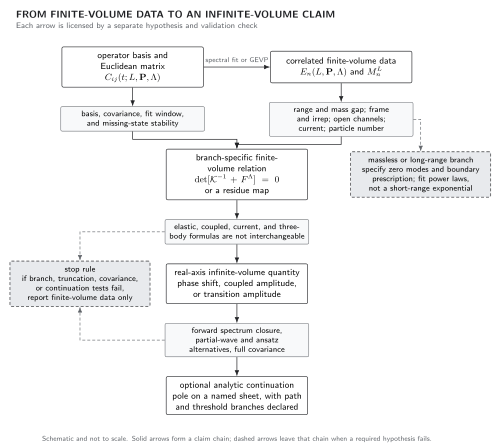
Finite-volume information reaches an infinite-volume claim only through a branch-specific map. Solid arrows show the controlled chain; dashed arrows show the long-range alternative and the stop rule. The image is schematic, not to scale, and the displayed determinant is structural: its channel, irrep, partial-wave, normalization, and sign conventions must be fixed locally.
Observable-level validation
Section titled “Observable-level validation”Before accepting an elastic amplitude, check that:
- both constituents are stable and lies below every omitted on-shell channel throughout the fit;
- , the massive exponential remainder, , , and all included partial waves are recorded;
- the zeta function is reproduced at free poles and at one independently known value, and the branch integer varies continuously;
- masses, energies, scale setting, and their cross-covariance are propagated jointly;
- a higher-partial-wave and alternative elastic parametrization do not move the observable beyond the stated uncertainty; and
- the fitted amplitude reproduces the correlated input spectrum and a held-out finite-volume level.
What you can now do
Section titled “What you can now do”You can now (1) evaluate the rest-frame quantization condition with its state normalization, branch, threshold, and exponential remainder explicit, and (2) invert correlated synthetic levels to a phase shift and verify them by solving the same condition forward.
Moving Frames, Cubic Irreducible Representations, and Partial-Wave Mixing generalizes the symmetry block. Scattering Amplitudes and Resonance Poles from Finite-Volume Spectra treats correlated parametrization and analytic continuation. Coupled channels belong to Coupled-Channel Quantization and Inference.
Exercises
Section titled “Exercises”1. Check the sign convention. A weakly repulsive level has . What is the sign of in this page’s convention?
Solution
At leading order , so . A source using would quote the opposite sign.
2. Branch continuity. Why does replacing by independently for every level fail near a free pole?
Solution
The principal arctangent discards the integer . When a level crosses a pole of the finite-volume function, the continuous pseudo-phase changes branch; the principal value jumps by . The physical phase shift must instead be unwrapped continuously, with the same branch used in the forward spectrum.
References
Section titled “References”- Lüscher, Martin. “Two-Particle States on a Torus and Their Relation to the Scattering Matrix.” Nuclear Physics B 354 (1991): 531–578. DOI.
- Lüscher, Martin. “Volume Dependence of the Energy Spectrum in Massive Quantum Field Theories. II. Scattering States.” Communications in Mathematical Physics 105 (1986): 153–188. DOI.
Original QFT.org content:CC BY 4.0, unless an item supplies different terms. Third-party material retains its own terms.