

Naive Fermions and Species Doubling
The symmetric nearest-neighbor discretization of the Dirac operator is local, translation invariant, and exactly chirally symmetric at zero mass, but its momentum symbol vanishes at every corner of the Brillouin zone. In even Euclidean dimension , those zeros become relativistic continuum species with alternating chirality signs. Expanding only about therefore gives a locally correct dispersion relation and a globally wrong particle count.
Required background. Lattice Momentum, Propagators, and Cutoff Dispersion supplies the Brillouin zone and discrete Fourier transform used to locate poles. Grassmann Functional Integrals for Free Fermions supplies the quadratic fermion action and matrix-valued propagator.
Helpful background. Weyl Fields and Chirality supplies the continuum chirality operator whose sign is compared between lattice zeros.
The naive Dirac operator on the full Brillouin zone
Section titled “The naive Dirac operator on the full Brillouin zone”Local regulator and convention card. We use a -dimensional Euclidean hypercubic lattice , , with Hermitian matrices . The free benchmark has periodic boundaries and momenta in . For even , is Hermitian, squares to one, and anticommutes with every . Masses and momenta below are dimensionful. These choices extend the site’s global conventions; an interacting covariant difference is introduced only after the free zero count is fixed.
The centered difference
gives the Euclidean action
With , a translation by contributes . The exact finite-spacing symbol is therefore
and its inverse away from a zero is
The denominator is a useful independent check: every term is nonnegative for real and , so a massless pole occurs precisely when every vanishes. The symmetric derivative has the correct small- limit because , but that local expansion says nothing about other points in the compact zone.
Every corner is a relativistic species
Section titled “Every corner is a relativistic species”At , label a Brillouin-zone corner by a bit vector ,
There are such momenta. Put with . Since
the operator linearizes as
The matrices obey the same Euclidean Clifford algebra, so each corner is not merely a zero: it has the linear Dirac dispersion of a continuum fermion. Its chirality matrix is
Consequently half the corners have the original chirality orientation and half have the opposite orientation. The total signed chirality is
This cancellation is the concrete free-field precursor of the Nielsen–Ninomiya obstruction; the homotopy and topological-current arguments are developed in Nielsen and Ninomiya 1981, Nuclear Physics B 185, pp. 20–40 and Nielsen and Ninomiya 1981, Nuclear Physics B 193, pp. 173–194. The general theorem needs hypotheses beyond this particular nearest-neighbor action; the calculation here establishes the example, not the theorem.
An exactly checkable corner count
Section titled “An exactly checkable corner count”In two dimensions the entire calculation fits in four rows:
| Corner | Effective matrices | Chirality sign |
|---|---|---|
Thus has four species, two of each chirality sign. In there are sixteen corners: the number with exactly components equal to is , giving eight positive and eight negative signs. A periodic even- lattice contains both and on its discrete momentum grid, so the free fixtures all reproduce the same four zeros in two dimensions. This ladder tests the finite-volume momentum grid; because is held fixed, it is not a continuum extrapolation.
Antiperiodic temporal boundary conditions move the allowed temporal momenta away from both temporal corners. They can remove exact finite-volume zero eigenvalues without removing the doubled continuum branches. Counting only exact zeros after changing boundary conditions is therefore not a species test.
Chiral symmetry does not remove the extra modes
Section titled “Chiral symmetry does not remove the extra modes”For ,
so the action is invariant under the global axial rotation
The same anticommutation holds at every corner. Exact naive chiral symmetry therefore protects all doublers together; it does not select the mode near the origin. This is why “exact chiral symmetry at nonzero ” and “one light fermion” cannot be treated as independent checkboxes for this operator.
In this page, species means the distinct relativistic poles of the full lattice propagator. Taste is reserved for the internal multiplicity obtained after the staggered reorganization. The two words can count related low-energy degrees of freedom, but they refer to different descriptions and should not be exchanged before the reconstruction is specified.
Gauge covariance replaces the two shifts by link transporters,
This preserves the local centered structure, but it removes momentum as a configuration-by-configuration quantum number. The free corner count remains the analytic benchmark; interacting claims require spectra, Ward identities, and continuum tests rather than a literal corner plot.
The obstruction map below turns the corner calculation into a topological statement. Inspect the alternating charges of the four two-dimensional zeros and the lower branches: every practical formulation changes a named finite-regulator premise rather than simply deleting unwanted modes.
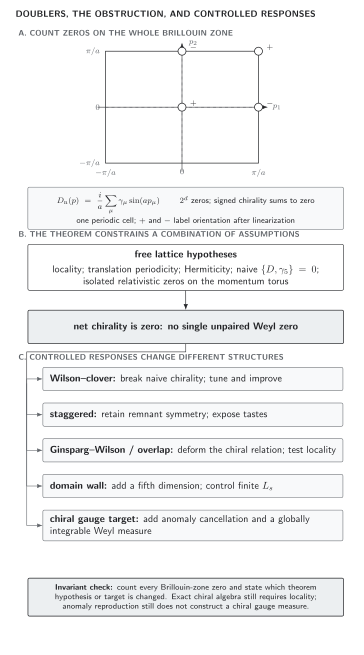
The two-dimensional free symbol has four zeros with charges , so the signed sum vanishes. Wilson, staggered, Ginsparg–Wilson, and domain-wall formulations alter different finite-regulator premises; a chiral-gauge target additionally requires anomaly cancellation and a globally integrable Weyl measure. The diagram is schematic and is not a cost or accuracy ranking.
Observable-level validation checklist
Section titled “Observable-level validation checklist”A calculation that claims to reproduce the naive free theory should pass all of the following observable-level checks:
- enumerate the full discrete Brillouin zone, not only , and recover massless branches for periodic even extents;
- fit the dispersion about every corner and recover unit slope after the sign redefinition ;
- verify the binomial multiplicities and the vanishing signed chirality sum;
- distinguish a boundary-condition shift of exact eigenvalues from removal of a low-energy branch;
- show that a nonzero mass opens the same mass gap at every naive corner; and
- for an interacting use, match the free limit and report which spectral or Ward-identity observable replaces momentum-space zero counting.
Adversarial failure. Suppose a code samples only and finds one linear pole. Every value in that restricted window can agree with the continuum expansion while fifteen four-dimensional species remain outside it. The cure is not a finer fit at the origin; it is a zone-wide zero and degeneracy search.
You should now be able to (1) locate and linearize every zero of in arbitrary even dimension and (2) explain, using the compact Brillouin zone, why a correct small-momentum propagator does not establish the intended flavor content.
Exercises
Section titled “Exercises”Count corners with a fixed chirality sign
Section titled “Count corners with a fixed chirality sign”Show directly that a dimensional naive fermion has corners of each chirality sign.
Solution
Choose the first bits of freely. There is exactly one choice of the last bit that makes even and exactly one that makes it odd. Hence each sign occurs times. Equivalently, the even and odd binomial sums are both because and .
Diagnose an odd lattice extent
Section titled “Diagnose an odd lattice extent”For a periodic one-dimensional lattice with odd , the allowed momenta are . Explain why is absent but a second continuum branch still appears as .
Solution
No integer solves when is odd, so there is no exact finite- zero at the zone edge. The nearest allowed momenta differ from by . Their eigenvalues scale as and therefore approach zero as the physical extent grows. The branch was shifted by the grid, not removed from the operator.
Where the calculation goes next
Section titled “Where the calculation goes next”The Nielsen–Ninomiya theorem turns this example into an assumption-by-assumption obstruction. Wilson and Clover Fermions lift the corners by breaking the naive chiral anticommutation, while Staggered Fermions and Taste reorganize rather than eliminate the multiplicity.
References
Section titled “References”- Nielsen, Holger Bech, and Masao Ninomiya. “Absence of Neutrinos on a Lattice. I. Proof by Homotopy Theory.” Nuclear Physics B 185 (1981): 20–40; erratum 195 (1982): 541. DOI.
- Nielsen, Holger Bech, and Masao Ninomiya. “Absence of Neutrinos on a Lattice. II. Intuitive Topological Proof.” Nuclear Physics B 193 (1981): 173–194. DOI.
Original QFT.org content:CC BY 4.0, unless an item supplies different terms. Third-party material retains its own terms.