

The Nielsen–Ninomiya Obstruction
For a free fermion on an even-dimensional lattice, a smooth periodic Dirac symbol cannot be simultaneously local, translation invariant, Hermitian in the appropriate sense, exactly anticommuting with chirality, and singly chiral at its relativistic zeros. Under the Nielsen–Ninomiya hypotheses, the total chirality of all isolated zeros on the Brillouin torus is zero. A viable formulation must therefore change a hypothesis, change the finite-spacing realization of chirality, retain a controlled multiplicity, or enlarge the regulated system.
Required background. Naive Fermions and Species Doubling supplies the exact corner count, linearized gamma matrices, and chirality signs that motivate the theorem.
Helpful background. Fredholm and Dirac Index Theorems and Zero-Mode Counting supplies the index language behind the rigorous handoff. What Is an Anomaly? distinguishes a quantum obstruction from explicit regulator breaking.
The no-go statement and its hypotheses
Section titled “The no-go statement and its hypotheses”Local regulator and convention card. We work with a free, massless fermion on an infinite or periodically boxed Euclidean hypercubic lattice in even dimension . Translation invariance gives a matrix symbol on the Brillouin torus . Exponential locality means the position-space kernel is bounded by with finite in lattice units, which makes analytic in a strip around real momentum. Gamma matrices are Hermitian and is the Euclidean chirality matrix. These local choices extend the global conventions.
One useful theorem form is the following.
Nielsen–Ninomiya theorem, free isolated-zero form. Let be a periodic, sufficiently smooth lattice Dirac symbol in even dimension. Assume:
- translation invariance: depends on one momentum ;
- locality: the kernel is exponentially local, so the symbol has the regularity needed for its topological charge to be defined;
- gamma-five Hermiticity: ;
- naive exact chirality: ;
- relativistic isolated zeros: near each zero , the leading symbol is a nonsingular linear Dirac operator with a well-defined chirality orientation; and
- no singular extra structure: the propagator has no compensating poles, discontinuities, or nonlocal branches elsewhere on .
Then the sum of the orientation numbers of all zeros vanishes. In particular, a single Weyl zero of nonzero chirality cannot occur.
The original theorem has several equivalent Hamiltonian and Euclidean formulations, and the exact regularity assumptions vary with the formulation. The invariant content is not the phrase “lattices double fermions.” It is the incompatibility of the declared collection of hypotheses with a net chiral spectrum. The primary homotopy and differential-topology proofs are given in Nielsen and Ninomiya 1981, Nuclear Physics B 185, pp. 20–40 and Nielsen and Ninomiya 1981, Nuclear Physics B 193, pp. 173–194; a compact no-go formulation appears in Nielsen and Ninomiya 1981, Physics Letters B 105, pp. 219–223.
Why the signed zero count vanishes
Section titled “Why the signed zero count vanishes”The proof is global even though every species is identified locally. In the common vector-symbol case
the zeros are the points where . Around an isolated simple zero ,
The sign is the orientation, or local degree, of the map from a small momentum sphere around the zero to the unit vector . It is also the sign by which the effective chirality matrix differs from the reference one.
Remove small balls around all zeros from the Brillouin torus. The winding current built from is closed on the remaining region. Stokes’ theorem makes its total boundary flux zero because the torus has no outer boundary. Each small sphere contributes , with the orientation inherited from the punctured torus, so
This is a proof roadmap, not a replacement for the theorem-level treatment of general symbols and bundles. Its value is diagnostic: it identifies exactly where a proposed counterexample must violate a hypothesis.
Exact two-dimensional benchmark
Section titled “Exact two-dimensional benchmark”For the naive operator, . At the four corners,
The charges are , whose sum is zero. This exact fixture checks both the local linearization and the global theorem. Missing even one corner gives a nonzero sum and must fail the test.
The obstruction map below combines that benchmark with the assumption changes used by the main formulation families. Inspect the solid path from smooth periodic locality to zero net chirality, and the labeled departures rather than interpreting any method as simply “evading” topology.
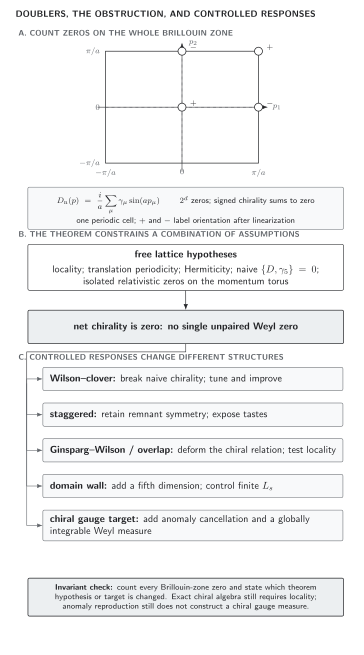
The two-dimensional free symbol has four zeros with charges , so the signed sum vanishes. The lower response section states which finite-regulator premise is changed: Wilson breaks the naive anticommutation, staggered retains controlled taste multiplicity, Ginsparg–Wilson modifies the chiral relation, and domain-wall fermions add a fifth-dimensional regulator with a finite- residual. A chiral-gauge target additionally requires anomaly cancellation and a globally integrable Weyl measure. The diagram is schematic and not a cost or accuracy ranking.
The figure’s structured equivalent is the hypothesis table in the next section; every arrow is a logical change of premise, not a claim of numerical superiority.
What each formulation changes
Section titled “What each formulation changes”| Strategy | No-go input or target changed | What remains to be demonstrated |
|---|---|---|
| Wilson or clover | Breaks at nonzero with an irrelevant Wilson term | Critical-mass tuning, operator improvement, Ward identities, and the continuum limit |
| Twisted-mass Wilson | Uses the Wilson change and rotates the mass in flavor space | Maximal-twist tuning, finite- flavor/parity breaking, and the scope of automatic improvement |
| Staggered | Reduces spin components but retains continuum tastes | Taste restoration, taste splittings, and any determinant-root locality assumptions |
| Ginsparg–Wilson | Replaces naive anticommutation by | Exponential locality, index and Jacobian normalization, and continuum matching |
| Overlap | Realizes Ginsparg–Wilson with a sign function of a Wilson kernel | Kernel gap, sign approximation, topology handling, and locality range |
| Domain wall | Adds a regulated fifth direction; finite only approximates exact chirality | Boundary-mode isolation, residual mass, bulk cancellation, and the relation to overlap |
| Nonlocal derivative | Drops locality, for example through a discontinuous periodic symbol | Whether the nonlocality destroys the intended interacting QFT |
| Chiral-gauge construction | Changes the problem from a free Dirac zero count to a Weyl measure over gauge-field space | Anomaly cancellation, gauge covariance, locality, global integrability, and mirror-sector tests |
The Ginsparg–Wilson exact transformation is not the naive transformation assumed above. Lüscher showed explicitly that the modified relation supports an exact finite-spacing symmetry without contradicting the theorem Lüscher 1998, pp. 342–345. Likewise, an overlap kernel may be exponentially local without being ultralocal; locality is a measured or proved decay property, not the number of stencil points.
Non-implications and adversarial tests
Section titled “Non-implications and adversarial tests”The theorem is strongest when its scope is kept narrow.
- It does not say that every lattice fermion has sixteen physically degenerate flavors. That number belongs to the four-dimensional naive nearest-neighbor operator.
- It does not forbid exact modified lattice chiral symmetry or a finite-spacing index.
- It does not prove that an interacting rooted, overlap, domain-wall, or mirror-decoupling construction has the desired continuum limit.
- It does not identify the sign of a determinant or Pfaffian.
- It does not by itself construct a nonperturbative chiral gauge theory; the fermion measure over gauge-field space is an additional problem.
Adversarial failure. Consider a proposed periodic symbol with one Weyl zero and a jump discontinuity at the Brillouin-zone boundary. A plot with finite resolution can make the discontinuity look harmless, but its Fourier kernel has long-range tails. The construction has not disproved the theorem; it has abandoned the locality hypothesis.
Observable-level validation checklist. An assumption check should verify:
- exponential decay of uniformly in the regulator range being claimed;
- periodicity and smoothness of away from declared zeros;
- the exact Hermiticity and chiral relation actually used, not the continuum relation one hopes to recover;
- every zero or singularity on the full Brillouin torus and its orientation number;
- stability of the count under volume and momentum-grid changes;
- the observable by which symmetry restoration is tested as ; and
- separate determinant, anomaly, and gauge-measure checks whenever the claim extends beyond a free vectorlike operator.
You should now be able to (1) state a dimension-qualified no-go theorem with its locality, periodicity, Hermiticity, chirality, and zero hypotheses explicit and (2) classify a proposed formulation by the premise or target it changes, rather than by its name.
Exercises
Section titled “Exercises”Remove the periodicity hypothesis
Section titled “Remove the periodicity hypothesis”In one dimension, define on and identify the values at the endpoints periodically. Why does this symbol have one zero but fail the theorem’s regularity assumptions?
Solution
The values approach and on opposite sides of the identified endpoint, so the periodic symbol is discontinuous. Fourier coefficients of a jump decay algebraically rather than exponentially. The position-space derivative is therefore nonlocal, which is exactly the hypothesis that has been removed.
Check the Ginsparg–Wilson relation
Section titled “Check the Ginsparg–Wilson relation”Explain in one line why does not satisfy the naive chiral hypothesis at nonzero regulator spacing.
Solution
The theorem assumes the left-hand side vanishes exactly. For a nontrivial Ginsparg–Wilson operator it equals the finite-spacing contact term , which vanishes only on zero modes or in the continuum limit on fixed physical momenta. The exact lattice transformation is correspondingly modified.
Precise continuations
Section titled “Precise continuations”Wilson and Clover Fermions work out explicit chiral breaking, mass tuning, and improvement. Staggered Fermions and Taste works out the controlled residual multiplicity. Ginsparg–Wilson Symmetry and the Lattice Index derives the modified exact symmetry and index. The theorem-first index, locality, and chiral-gauge construction boundary belongs to Chiral Gauge Theories and Standard Model Construction.
References
Section titled “References”- Lüscher, Martin. “Exact Chiral Symmetry on the Lattice and the Ginsparg–Wilson Relation.” Physics Letters B 428 (1998): 342–345. DOI. Open PDF.
- Nielsen, Holger Bech, and Masao Ninomiya. “Absence of Neutrinos on a Lattice. I. Proof by Homotopy Theory.” Nuclear Physics B 185 (1981): 20–40; erratum 195 (1982): 541. DOI.
- Nielsen, Holger Bech, and Masao Ninomiya. “Absence of Neutrinos on a Lattice. II. Intuitive Topological Proof.” Nuclear Physics B 193 (1981): 173–194. DOI.
- Nielsen, Holger Bech, and Masao Ninomiya. “A No-Go Theorem for Regularizing Chiral Fermions.” Physics Letters B 105 (1981): 219–223. DOI.
Original QFT.org content:CC BY 4.0, unless an item supplies different terms. Third-party material retains its own terms.