

Strong-Coupling and Character Expansions
At small Wilson coupling , compact-group character expansions turn the lattice path integral into a convergent organization by representations and tiled surfaces. Haar integration then makes selection rules exact. This yields analytic area laws and mass estimates near the strong-coupling lattice point, but the expansion supports a continuum claim only if its convergence domain connects to the target trajectory and the relevant limits are controlled independently.
Required background. The Wilson gauge action supplies the plaquette Boltzmann factor.
Helpful background. Compact groups, roots, and weights supply the character language; confinement definitions and diagnostics delimit the physical claim.
Character expansion of one plaquette
Section titled “Character expansion of one plaquette”Local convention and regulator card. Use a finite lattice with compact group , normalized Haar measure, a stated Wilson-action and trace normalization, and explicit boundary sectors. Expand each plaquette Boltzmann factor in irreducible characters and count powers of the normalized coefficients ; plaquette area is dimensionless until a separately determined spacing is attached.
For a compact group , any square-integrable class function has an expansion
Here runs over irreducible representations, is their dimension, and normalized Haar measure obeys
Dividing by the trivial coefficient writes the partition function as a sum over representation labels on plaquettes. Link integrals require the representations incident on each link to combine to a singlet. The resulting surfaces can therefore close, end on an inserted Wilson loop, or meet at allowed intertwiners.
For compact with plaquette angle ,
Integrating each link angle enforces integer flux conservation. This simple example displays the general mechanism without non-Abelian recoupling coefficients.
Character orthogonality, link saturation, and the resulting strong-coupling surfaces are reviewed in Kogut 1979, pp. 659–713 and Drouffe and Itzykson 1978, pp. 133–175.
Minimal surfaces and the leading Wilson loop
Section titled “Minimal surfaces and the leading Wilson loop”Insert a fundamental Wilson loop along a contractible contour . At leading nonzero order, plaquettes must tile a surface whose boundary is so that every link matrix is paired by Haar integration. If is the minimal area in plaquette units, then for in two dimensions
exactly on an infinite plane, up to global-flux qualifications on a torus. Since ,
This is an area law with lattice string tension
For with the standard fundamental Wilson action, the leading fundamental-loop contribution is
has a different leading coefficient because its fundamental representation is pseudoreal and ; with it is at leading order. Quoting the group and action normalization is therefore essential.
This minimal-surface mechanism is the strong-coupling confinement construction of Wilson 1974, pp. 2445–2459.
Correlation masses from polymers
Section titled “Correlation masses from polymers”For two separated gauge-invariant operators, the connected correlator is built from connected surfaces or polymers joining their supports. If the least-cost polymer adds plaquettes per lattice step, then schematically
where is a normalized fundamental character coefficient. Higher-order decorations correct both the amplitude and mass. The result is controlled where the polymer expansion converges; it is not reliable merely because a low-order polynomial can be evaluated at larger .
Convergence, phases, and continuum interpretation
Section titled “Convergence, phases, and continuum interpretation”Cluster-expansion arguments establish analyticity in a neighborhood of strong coupling for many compact lattice gauge systems. Within that neighborhood, a nonzero string tension and mass gap are genuine properties of the regulated theory. Three additional questions govern extrapolation:
- Does the series converge, or is a resummation accompanied by quantitative truncation tests?
- Is there a bulk phase transition between this domain and the continuum trajectory?
- Along the target trajectory, does a physical scale remain fixed while and ?
The strong-coupling and continuum limits lie at opposite ends of bare-coupling space for asymptotically free four-dimensional gauge theories. Analytic continuity can be informative, but a finite-order strong-coupling area law alone is not a theorem about the continuum theory.
The regime map makes that boundary explicit: the character-series branch must pass its own convergence and phase-continuity tests before it can join the common continuum-analysis stage.
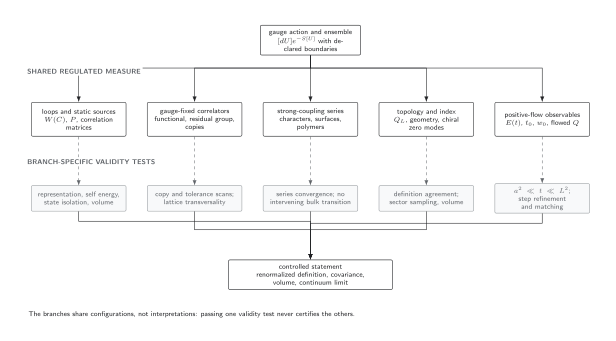
Strong-coupling surfaces provide controlled regulated results only inside their justified series domain. Connection to a continuum statement additionally requires phase and scaling evidence. The diagram is schematic and not to scale.
A practical series check
Section titled “A practical series check”| Check | Evidence | Named failure |
|---|---|---|
| Group convention | , representation, character normalization | Coefficients silently imported from another convention |
| Leading graph | Explicit link saturation on the minimal surface | A boundary link has no conjugate partner |
| Order counting | Powers of normalized | Plaquette count confused with physical area |
| Truncation | Successive orders or controlled remainder | One low order evaluated outside its stable region |
| Volume | Winding polymers and boundary sectors tested | Contractible result generalized to a torus blindly |
| Continuum | Matched physical scale and independent fine lattices | Lattice area law relabeled continuum confinement |
Adversarial failure: a truncated coefficient violates a loop bound
Section titled “Adversarial failure: a truncated coefficient violates a loop bound”For the exactly solvable two-dimensional compact- loop, unitarity and positivity imply
for every finite , so and . If the strong-coupling approximation is extrapolated to , it predicts a factor per plaquette and hence . The analytic expression remains easy to evaluate, but it has left its validity domain and violates an exact observable bound. This failure must be caught before any resummation is interpreted physically.
Observable-level validation checklist
Section titled “Observable-level validation checklist”- Reproduce the one-plaquette group integral and the trivial coefficient in the declared normalization.
- For each leading Wilson-loop graph, verify that every contour link is saturated and that the plaquettes form a surface with the correct boundary.
- Check the first omitted series orders, exact positivity or unitarity bounds, and any available exact low-dimensional result in an overlap region.
- Repeat the counting on the actual finite geometry, including winding surfaces and boundary-flux sectors.
- Before a continuum claim, locate bulk transitions and compare the series with scale-matched simulations along the intended trajectory.
Common pitfalls
Section titled “Common pitfalls”Dropping the trivial character coefficient. It cancels in normalized expectation values only after numerator and partition function are treated consistently.
Using counting for . Pseudoreality changes which terms can saturate a link integral and hence changes leading coefficients.
Equating lattice and physical string tensions. is dimensionless and generally changes with . A continuum string tension requires scale setting and .
Learning outcomes
Section titled “Learning outcomes”- Expand a compact-group plaquette weight in characters and use Haar orthogonality to determine the leading nonzero order and coefficient of a specified Wilson loop.
- Given a finite strong-coupling series, test exact bounds, order stability, volume sectors, and phase continuity and reject a continuum inference unsupported by those checks.
Exercises
Section titled “Exercises”- Use to expand the lattice string tension through beyond its logarithm.
Solution
, so .
- Why must a Wilson-loop insertion be tiled by plaquettes at leading order?
Solution
Haar integration makes an unpaired nontrivial representation matrix vanish. Plaquette factors supply conjugate matrices on every contour link; flux conservation forces them to form a surface bounded by the loop.
References
Section titled “References”- Drouffe, J.-M., and Itzykson, C. (1978). Statistical field theory. I. Physics Reports, 38(3), 133–175. DOI.
- Kogut, J. B. (1979). An introduction to lattice gauge theory and spin systems. Reviews of Modern Physics, 51, 659–713. DOI.
- Wilson, K. G. (1974). Confinement of quarks. Physical Review D, 10, 2445–2459. DOI.
Original QFT.org content:CC BY 4.0, unless an item supplies different terms. Third-party material retains its own terms.