

Gauge Fixing, Gribov Copies, and Gauge-Dependent Correlators
Gauge-invariant observables need no gauge fixing, but gluon and ghost propagators do. On a finite lattice, fixing Landau gauge means selecting extrema of a functional along each gauge orbit. The functional generally has many local extrema—Gribov copies—so a reported gauge-dependent correlator is defined only after the functional, residual symmetry, optimization algorithm, stopping criterion, and copy-selection prescription are all specified.
Required background. The Wilson gauge action supplies the gauge ensemble; Gribov copies and limits of local gauge fixing supply the conceptual obstruction.
Helpful background. Gauge fixing, BRST, and Gribov effects in functional methods help interpret, but do not remove, the finite-lattice representative-selection problem.
Lattice Landau gauge as an extremization problem
Section titled “Lattice Landau gauge as an extremization problem”Local convention and regulator card. Use a finite periodic lattice and maximize the normalized fundamental-link functional over periodic site transformations. The link field is the traceless anti-Hermitian part divided by , placed at the link midpoint; transversality is tested with . A result must also state the residual global treatment, copy prescription, restart count, precision, and stopping residual.
For links in the fundamental representation, a common lattice Landau condition maximizes
over periodic site transformations . The normalization is conventional. For , stationarity gives a discrete divergence condition,
up to the chosen link-to-algebra definition and lattice artifacts. The Hessian of is the lattice Faddeev–Popov operator. At a local maximum it should be nonnegative apart from exact residual-gauge zero modes.
Constant remains unfixed on a periodic lattice. Depending on matter, boundaries, and the observable, additional residual transformations can survive. A color-nonsinglet one-point function, for example, is meaningless unless that residual freedom is treated.
Why a stationary point is not a unique gauge
Section titled “Why a stationary point is not a unique gauge”The gauge orbit can intersect the lattice Landau condition more than once. Numerical maximization from different random gauge transforms of the same configuration can therefore converge to distinct local maxima. Let be a propagator obtained from copy . Useful diagnostics include
Neither quantity is universal, but together they reveal whether the observable is sensitive to the selection rule. A small does not force a small in the infrared, where near-zero Faddeev–Popov modes can amplify differences.
Three prescriptions answer different questions:
- first copy: one specified start and algorithm, cheap but algorithm dependent;
- best of copies: the largest functional value among starts, still dependent;
- copy average: an explicitly weighted average over found extrema, dependent on the search measure.
Calling all three simply “Landau gauge” suppresses a material part of the observable definition.
The nonuniqueness of transverse representatives is the central obstruction identified by Gribov 1978, pp. 1–19; selecting the fundamental modular region is a stronger, global prescription, not a consequence of satisfying the local condition Zwanziger 1994, pp. 657–730.
Constructing a gauge-dependent propagator
Section titled “Constructing a gauge-dependent propagator”Define a midpoint algebra field, for example,
Its Fourier transform needs the midpoint phase. A color-averaged gluon propagator is
Use lattice momentum when testing transversality,
The residual should be compared with the gauge-fixing tolerance and propagated into low-momentum results. Hypercubic orbit selection, finite volume, link-field definition, wave-function renormalization, and copy prescription must be held fixed or translated before datasets are compared.
A reproducibility protocol
Section titled “A reproducibility protocol”For each ensemble, retain the following checks:
| Layer | Record | Failure test |
|---|---|---|
| Gauge functional | Exact and normalization | Stationarity residual exceeds tolerance |
| Residual group | Transformations not fixed by | Correlator changes under an unfixed transformation |
| Search | Algorithm, starts, seed policy, precision | Results drift with restart count |
| Faddeev–Popov diagnostic | Zero modes and smallest nontrivial eigenvalue | Negative mode at a claimed maximum |
| Field definition | Map , midpoint phase | Transversality uses the wrong momentum |
| Copy sensitivity | First/best/average comparison | Copy effect exceeds quoted uncertainty |
| Physical limits | Volume, spacing, renormalization scheme | Infrared conclusion moves under or |
The regime map places gauge fixing on a separate branch: it changes the representative used for a gauge-dependent correlator, not the underlying gauge-invariant ensemble weight. Inspect the copy-and-tolerance test before comparing this branch with invariant observables.
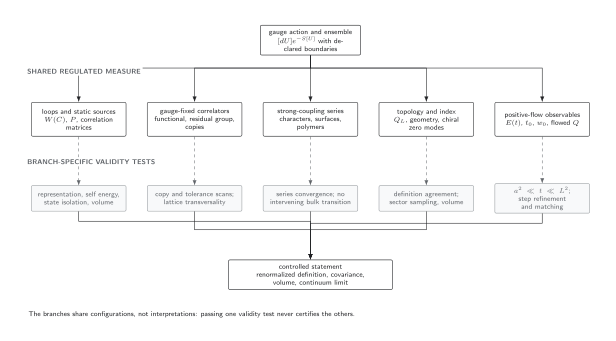
Gauge-fixed correlators inherit the ensemble measure but add representative selection, residual-gauge, copy, and transversality tests. Passing the loop or topology branch does not resolve those choices. The diagram is schematic and not to scale.
Adversarial failure: indistinguishable functionals, different infrared inverses
Section titled “Adversarial failure: indistinguishable functionals, different infrared inverses”Suppose two accepted copies have and equally small divergence residuals, but their smallest nontrivial Faddeev–Popov eigenvalues are and . An observable dominated by the inverse operator, such as the lowest-momentum ghost channel, can then shift by
even though the functional values agree to ten decimal places. Thus neither optimizer convergence nor a small bounds copy sensitivity of an infrared correlator; the observable itself must be repeated across copies.
Observable-level validation checklist
Section titled “Observable-level validation checklist”- Measure the lattice divergence and require its norm to scale with the declared stopping tolerance on every accepted configuration.
- Verify nonnegativity of the Faddeev–Popov operator after removing the known residual zero modes, and monitor its smallest nontrivial eigenvalues.
- Repeat the full correlator analysis with first-copy, increasing best-of-, or stated copy-average prescriptions and compare the lowest momentum bins.
- Test , including the midpoint phase, rather than substituting continuum momentum.
- Repeat the infrared conclusion at another volume, spacing, and residual-global treatment in the same renormalization scheme.
Common pitfalls
Section titled “Common pitfalls”Treating convergence as uniqueness. A small local gradient proves only that the algorithm found a stationary point. Restart and copy tests address the distinct question of nonuniqueness.
Using continuum momentum in a lattice condition. The finite-difference divergence is transverse to , not exactly to at nonzero spacing.
Giving a gauge-dependent pole a gauge-invariant interpretation. Gauge-fixed correlators can be valuable structural diagnostics. Their spectral and particle interpretations require additional theoretical justification.
Learning outcomes
Section titled “Learning outcomes”- Starting from , derive the lattice stationarity condition, identify residual transformations and Faddeev–Popov zero modes, and specify a reproducible representative-selection rule.
- Given several gauge copies, quantify copy and stopping sensitivity of a propagator and reject an infrared claim that fails transversality, restart, volume, or spacing tests.
Exercises
Section titled “Exercises”- Show that is invariant under a common constant left multiplication .
Solution
Each transformed link is conjugated by . Cyclicity of the trace removes and , displaying the residual global symmetry.
- Two copy prescriptions differ by at the lowest momentum while statistical errors are . Can the copy effect be omitted from the result?
Solution
No. It is a definition or systematic effect larger than the statistical uncertainty. One must specify a prescription and include a sensitivity estimate, or restrict the conclusion to a copy-insensitive range.
References
Section titled “References”- Gribov, V. N. (1978). Quantization of non-Abelian gauge theories. Nuclear Physics B, 139, 1–19. DOI.
- Zwanziger, D. (1994). Fundamental modular region, Boltzmann factor and area law in lattice gauge theory. Nuclear Physics B, 412, 657–730. DOI.
Further reading
Section titled “Further reading”- Cucchieri, A., and Mendes, T. (2008). Constraints on the infrared behavior of the gluon propagator in Yang–Mills theories. Physical Review Letters, 100, 241601. DOI.
Original QFT.org content:CC BY 4.0, unless an item supplies different terms. Third-party material retains its own terms.