

Conformal and Hamiltonian Truncation
Conformal and Hamiltonian truncation use the known eigenstates of a solvable ultraviolet Hamiltonian as a regulated basis for a deformation. The method is controlled only when the UV state data, deformation matrix elements, null states, volume, symmetry sectors, cutoff dependence, and induced operators are all specified. A high scaling-dimension cutoff is not innocuous: it removes short-distance intermediate states and therefore acts as a regulator that must be renormalized and tested.
Required background. Hilbert-Space Truncation as a Regulator supplies the split and limit criteria. Basis Construction, Symmetry Sectors, and Matrix Elements supplies Gram matrices, null removal, sector resolution, and sparse assembly.
Helpful background. Free-Field OPE Preview supplies the operator-product logic used to organize high-energy tails. Full conformal state–operator correspondence and OPE data belong to Conformal Correlators, OPE Data, and the Bootstrap, not to this method page.
A solvable ultraviolet Hamiltonian defines the basis
Section titled “A solvable ultraviolet Hamiltonian defines the basis”UV-basis and deformation contract. State the ultraviolet theory, spatial manifold and radius , vacuum-energy convention, state inner product and null quotient, exact sectors, deformation and coupling normalization, cutoff rule, finite-volume target, induced counterterms, and observables. Scaling dimension , cylinder energy , and matrix dimension are distinct quantities unless an explicit relation is given.
Let a CFT in spacetime dimensions be quantized on . Up to the declared Casimir-energy convention, radial quantization maps a CFT state of scaling dimension to a cylinder energy
Deform by a scalar operator of dimension :
The coupling has mass dimension , so spectra at fixed conventions depend on the dimensionless combination . A dimension cutoff retains CFT states with in a chosen symmetry sector. The general-dimensional construction, including its basis, Gram matrix, deformation matrix, and cutoff dependence, is developed in Hogervorst, Rychkov, and van Rees 2015, §§ 2–5.
The original two-dimensional truncated conformal space approach (TCSA) used exact UV conformal data to study relevant perturbations of minimal models Yurov and Zamolodchikov 1990, §§ 2–3. The method is broader than CFT bases: any solvable with computable states and deformation matrix elements defines Hamiltonian truncation. What changes is the organization of the high-energy tail.
The finite problem may be generalized, not ordinary
Section titled “The finite problem may be generalized, not ordinary”Choose retained states and define
The truncated spectrum solves
where contains the chosen cutoff-dependent corrections. Descendant relations, equations of motion, and special dimensions can make singular. One must factor or diagonalize , discard null directions at a stated tolerance justified by exact algebra, and transform all operators consistently. An arbitrary numerical cutoff on small eigenvalues of is itself another regulator and requires stability tests. For a unitary CFT the surviving metric is positive definite. A nonunitary TCSA benchmark requires its declared indefinite bilinear form and does not support Rayleigh–Ritz positivity claims.
Rotational invariance on the sphere, internal charges, parity, and other exact symmetries split the matrix. If the cutoff includes complete multiplets, forbidden blocks vanish. Cutting through a multiplet explicitly breaks the symmetry and contaminates degeneracy tests.
A relevant deformation supplies an exact dimensional check
Section titled “A relevant deformation supplies an exact dimensional check”Rescale the cylinder Hamiltonian by :
where is the dilatation operator and the dimensionless matrix includes the unit-sphere integral and the chosen operator normalization. Every entry of must be dimensionless. If a code uses or omits the measure factor, spectra at two radii fail this exact scaling relation even before a continuum comparison.
First application: the thermal Ising deformation
Section titled “First application: the thermal Ising deformation”The two-dimensional critical Ising CFT has an energy operator with scaling dimension . The thermal deformation
therefore has and is equivalent, with a convention-dependent mass normalization, to a free massive Majorana theory. The exact massive finite-volume spectrum gives an external benchmark for state counting, sector assignments, radius scaling, and cutoff extrapolation. It should be used as a prediction test after fixing the normalization convention, not as unrecorded tuning data. TCSA was applied to relevant deformations of minimal models, including integrable cases with independent spectral information, in Yurov and Zamolodchikov 1990, §§ 3–4.
For a nonintegrable first target, two-dimensional Hamiltonian truncation supplies the same structure with a massive free-boson UV basis. Its finite-volume Fock basis, cutoff, and renormalization prescription are defined before the spectrum is extracted in Rychkov and Vitale 2015, §§ 2–4.
High-dimension states control the cutoff tail
Section titled “High-dimension states control the cutoff tail”For , the leading omitted-state correction to a retained state has the spectral form
At large , the products of deformation matrix elements are governed by short-distance products of . An OPE expansion can therefore sort the tail into local operators with cutoff-dependent coefficients, plus remainder terms whose nonlocality or state dependence must be estimated. An early renormalization-group treatment of TCSA cutoff dependence is given in Giokas and Watts 2011, §§ 2–6, while modern effective-Hamiltonian constructions retain systematically more of the energy-dependent tail Elias Miró and Ingoldby 2023, §§ 2–5.
The OPE is not a license to fit every drift. Operator content, symmetry, and power counting determine the counterterm basis. Coefficients fixed from one or more observables must be recorded; different observables remain held out. The next page develops this matching problem independently of the UV basis.
The convergence map separates UV data from certification
Section titled “The convergence map separates UV data from certification”The UV CFT determines a particularly structured retained basis, but the omitted high-dimension states still generate both Hamiltonian and observable corrections. Inspect where the cross-basis and held-out branches enter after matching, not before it.
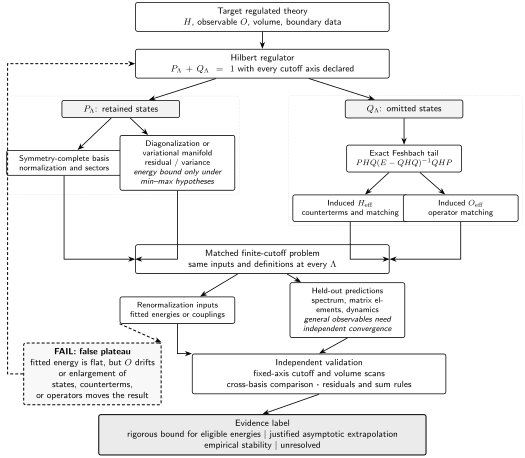
A conformal basis organizes retained and omitted states by ultraviolet data, but high-dimension states still induce cutoff-dependent Hamiltonians and observables. Certification requires multi-cutoff, held-out, and cross-basis tests; a variational energy trend does not by itself control general observables. The diagram is schematic and not to scale.
Minimum truncation certification record
Section titled “Minimum truncation certification record”| Field | Required declaration | Independent test | Failure signal |
|---|---|---|---|
| Target | Hamiltonian, prior regulator, volume, boundary data, observable | Units and free or exact limit | Changing target across cutoff points |
| Projectors | PΛ, QΛ, all cutoff axes, limit order | State counts and nestedness | Unidentified omitted states |
| Basis and sectors | Normalization, Gram matrix, null removal, exact charges | Hermiticity and selection rules | Duplicates or broken constraints |
| Induced Hamiltonian | Derived operator basis and approximation order | Omitted-state toy model or perturbative coefficient | Drift incompatible with the declared tail |
| Counterterms | Inputs, running coefficients, and no-double-counting rule | Refit protocol at every cutoff | A fitted datum presented as a prediction |
| Variational status | Manifold, optimizer, symmetry, bound hypotheses | Residual, variance, and ansatz enlargement | Energy plateau with a large residual |
| Effective observables | Projected and induced operator terms | Sum rule or matched matrix element | Spectrum stable while the observable drifts |
| Cutoff sequence | Independent basis, volume, counterterm, time, and state scans | Fixed-axis and cross-term fits | Only one diagonal sequence |
| Extrapolation | Asymptotic form, fit window, covariance, alternatives | Window and model stability | Exponent chosen from the desired answer |
| Held-out tests | Unused spectrum, matrix element, dynamics, and second basis | Blind comparison after choices freeze | All tests participated in tuning |
| Adversarial enlargement | Larger state and operator bases | Repeat the full match and prediction | Former plateau moves beyond its error |
| Claim | Bound, asymptotic evidence, empirical stability, or unresolved | Error and cost reproduced independently | Precision exceeds the weakest test |
Adversarial failure: a cutoff slices through multiplets
Section titled “Adversarial failure: a cutoff slices through multiplets”Suppose a program retains the first operator states after sorting only by a floating-point estimate of dimension. At a degenerate level, it keeps some descendants or irrep components but not their partners. The matrix remains finite and can be Hermitian, yet the cutoff no longer commutes with the exact symmetry. A small apparent splitting can then be mistaken for physical symmetry breaking.
The repair is to retain complete exact multiplets, build sectors from algebraic labels, and repeat the calculation at cutoff values that include whole levels. If a noninvariant cutoff is deliberate, all symmetry-restoring counterterms and residual splittings are part of the regulator record.
Observable-level validation checklist
Section titled “Observable-level validation checklist”- Reproduce CFT dimensions, degeneracies, Gram matrices, and null relations sector by sector before adding the deformation.
- Verify the dimensionless cylinder combination by repeating at two radii.
- Include whole symmetry multiplets and test every forbidden matrix block.
- Reproduce an exactly solvable deformation, such as the thermal Ising flow, without using its held-out levels to choose the extrapolation.
- Derive the expected leading cutoff powers from high-energy/OPE data and test subleading alternatives.
- Match Hamiltonian and effective-observable counterterms consistently, then inspect at least one matrix element or spectral weight.
- Compare with a nonconformal basis or an independently regulated method after translating the same finite-volume observable.
You should now be able to (1) construct the generalized finite-dimensional problem for a relevant UV deformation, including dimensions, Gram matrix, null states, sectors, units, and cutoff, and (2) identify which high-energy data determine the leading omitted-state correction. Renormalizing a Truncated Hamiltonian turns that tail into matched effective terms; Convergence, Extrapolation, and Error Certification tests the cutoff sequence. Full CFT data remain in Conformal Correlators, OPE Data, and the Bootstrap, and current large-scale applications belong to Research.
Exercises
Section titled “Exercises”Restore the radius dependence
Section titled “Restore the radius dependence”A code diagonalizes for a scalar deformation of dimension in dimensions. Express in terms of the dimensionful coupling and radius , and determine how a dimensionless eigenvalue becomes a physical energy.
Solution
Because , the dimensionless coupling is . If , then , plus any separately declared common Casimir-energy convention. The physical gap is , so the common vacuum shift cancels.
Solve a generalized two-state problem
Section titled “Solve a generalized two-state problem”Let and . Find the generalized eigenvalues and show how to transform to an orthonormal basis.
Solution
The equation gives
so . With , the orthonormal Hamiltonian is , which has the same eigenvalues. Solving would give the wrong answer.
References
Section titled “References”- Elias Miró, Joan, and James Ingoldby. “Effective Hamiltonians and Counterterms for Hamiltonian Truncation.” Journal of High Energy Physics 2023, 052 (2023). DOI. Open PDF.
- Giokas, Paul, and Gérard M. T. Watts. “The Renormalisation Group for the Truncated Conformal Space Approach on the Cylinder.” arXiv:1106.2448 [hep-th] (2011). arXiv record.
- Hogervorst, Matthijs, Slava Rychkov, and Balt C. van Rees. “Truncated Conformal Space Approach in Dimensions: A Cheap Alternative to Lattice Field Theory?” Physical Review D 91, 025005 (2015). DOI.
- Rychkov, Slava, and Lorenzo G. Vitale. “Hamiltonian Truncation Study of the Theory in Two Dimensions.” Physical Review D 91, 085011 (2015). DOI.
- Yurov, V. P., and A. B. Zamolodchikov. “Truncated Conformal Space Approach to Scaling Lee–Yang Model.” International Journal of Modern Physics A 5, no. 16 (1990): 3221–3246. DOI.
Original QFT.org content:CC BY 4.0, unless an item supplies different terms. Third-party material retains its own terms.