

Anomalies, Ward Identities, and Chiral Diagnostics
No single observable demonstrates lattice chirality. A credible claim combines a normalized axial Ward identity, a topology–index comparison, and an independent spectral or cross-formulation test, each extrapolated in the limits relevant to the claim. The Ward identity detects symmetry breaking and contact terms; the index detects exact zero-mode chirality; the spectrum probes spontaneous breaking. Agreement among them is evidence, while disagreement diagnoses normalization, cutoff, finite-volume, topology-freezing, or measure errors.
Required background. Use fermion determinants and Pfaffians for the regulated measure, Ginsparg–Wilson symmetry and the lattice index for the exact trace relation, and regulated Jacobians for the anomalous measure variation.
Helpful background. Localized Ward–Takahashi identities organize contact terms, while topological susceptibility explains the vacuum observable used beyond the fixed-background tests here.
A finite-spacing axial Ward identity
Section titled “A finite-spacing axial Ward identity”Regulator and diagnostic card. Work on a finite four-dimensional Euclidean lattice of spacing , with a declared fermion formulation, current discretization, boundary conditions, renormalization scheme, and gauge ensemble. The backward lattice derivative is . Flavor generators satisfy . The Ginsparg–Wilson index convention is , matching the preceding page. A residual is meaningful only after contact terms and all operator normalizations have been fixed.
Perform a localized nonsinglet axial change of variables in the finite Grassmann integral. For an inserted observable , the regulated identity can be organized as
Here is the explicit finite-spacing breaking induced by the action and current definition. The last term is a contact variation: it does not disappear merely because differs from the nominal source coordinate if the operator is extended. For an improved Wilson current, one commonly defines
and tunes or extrapolates the corresponding residual rather than setting by assertion. The partially conserved axial-current mass provides an observable ratio,
to be tested for a source-independent plateau, volume stability, and the predicted approach to the renormalized mass. Sheikholeslami and Wohlert derived the on-shell improvement logic underlying the clover term and improved currents Sheikholeslami and Wohlert 1985, §§ 2–3.
For a singlet axial rotation the Grassmann Jacobian adds the anomaly. With an exact Ginsparg–Wilson operator, define
The singlet identity contains in the convention where the axial variation of the mass term is . Lüscher showed that the Ginsparg–Wilson relation supplies an exact finite-cutoff chiral transformation whose measure variation yields this anomaly Lüscher 1998, Eqs. (4)–(7). A sign change in the definition of or of the axial generator changes both the index and Ward-identity signs; it is not a physical disagreement if translated consistently.
What each formulation must expose
Section titled “What each formulation must expose”The residual has a formulation-specific origin, so a universal “chiral residual” number is not enough.
| Formulation | Finite-spacing identity to test | Additional observable |
|---|---|---|
| Wilson–clover | Improved nonsinglet PCAC relation after critical-mass tuning | , current-normalization test, and -scaling of residual breaking |
| Staggered | Exact taste-nonsinglet identity | Taste splittings and the separately reconstructed singlet anomaly |
| Exact Ginsparg–Wilson or overlap | Modified exact chiral identity and Jacobian | Trace index, zero-mode chirality, and operator locality |
| Finite- domain wall | Five-dimensional conserved-current identity with mid-plane term | Residual mass versus , topology, and volume |
The domain-wall residual mass is often extracted from a ratio of mid-plane to boundary pseudoscalar correlators. It must be reported as a measured function, not used as a generic name for Wilson breaking or taste splitting. Furman and Shamir derive the corresponding finite-fifth-dimension Ward identities Furman and Shamir 1995, §§ 3–5.
Index, topology, and an exactly soluble background
Section titled “Index, topology, and an exactly soluble background”For a sufficiently smooth periodic field on an lattice, define links
and
With the positively oriented plaquette , every principal plaquette angle is . Therefore
exactly. This is a sharp background-level benchmark: an exact overlap implementation in the admissible, local regime should return an integer trace index with the conventionally matched sign and one net chiral zero mode. Hasenfratz, Laliena, and Niedermayer establish the finite-cutoff index relation for Ginsparg–Wilson operators Hasenfratz, Laliena, and Niedermayer 1998, pp. 125–131.
Agreement of and the fermionic index is not sufficient on a rough ensemble. One must also state the smoothness or flow prescription used to define gauge-field topology, test stability under small deformations, and verify overlap locality. A topological charge that changes under harmless smoothing while the operator becomes nonlocal is not a controlled continuum diagnostic.
Spectral and continuum triangulation
Section titled “Spectral and continuum triangulation”For anti-Hermitian continuum-like Dirac spectra , define the finite-volume spectral density
The Banks–Casher relation requires the ordered limits
Taking at fixed finite volume instead can force the condensate to vanish by symmetry. Banks and Casher derive the spectral relation and its limit order Banks and Casher 1980, pp. 103–125. For Ginsparg–Wilson spectra, map the spectral circle to an imaginary-axis variable or use a correspondingly transformed density, and state the map and Jacobian.
A strong anomaly or restoration analysis should therefore triangulate:
- a renormalized Ward-identity residual, including contact terms;
- the integer index and zero-mode chiralities in controlled backgrounds;
- a spectral observable such as the near-zero density or mode number;
- a gauge-field topology estimator with a specified flow or smoothness scale;
- at least two lattice spacings and a finite-volume study, with matched physical parameters.
Cross-formulation agreement is especially valuable because Wilson breaking, staggered taste mixing, overlap locality, and domain-wall residual mass generate different cutoff patterns. It does not remove the need to extrapolate each formulation correctly.
The formulation map below prevents one diagnostic from being transferred unchanged across discretizations. Follow each branch to its own chirality, index, taste, residual-mass, locality, Pfaffian, or measure test before using a Ward residual as continuum evidence.
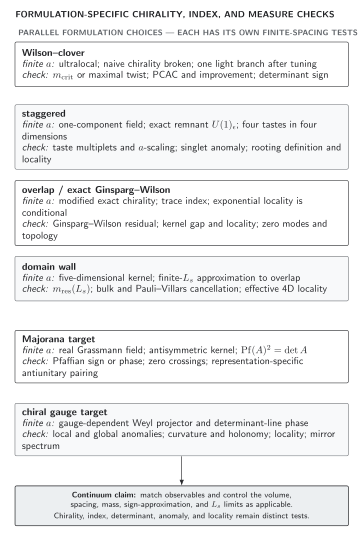
Lattice-fermion formulations trade different finite-regulator structures. Wilson methods require tuning and improvement; staggered methods require taste restoration and a separately qualified rooting step; exact Ginsparg–Wilson and overlap methods require locality and index checks; finite- domain-wall methods add a residual-mass test; Majorana and chiral-gauge targets add Pfaffian or Weyl-measure phases. The map is schematic, not to scale, and does not rank cost or accuracy.
Observable-level validation checklist
Section titled “Observable-level validation checklist”- Give the complete Ward identity used in code, including current improvement, renormalization constants, mass term, Jacobian or mid-plane term, and contact variations of the source.
- Plot the normalized residual and its covariance over a fit window; quote its dependence on , volume, mass, topology, and source choice.
- Compare , counted zero-mode chirality, and an independently defined gauge charge configuration by configuration where feasible.
- Report the low-mode cutoff, spectral transformation, volume normalization, unfolding or binning choice, and the order of the , , , and limits.
- Verify that topology sampling is mobile enough for the claimed ensemble average; otherwise report fixed-sector or freezing systematics.
- Repeat at least one diagnostic with a second current, topology definition, or fermion formulation whose leading artifact differs.
Adversarial failure case: a perfect ratio with a missing contact term
Section titled “Adversarial failure case: a perfect ratio with a missing contact term”A PCAC ratio can show a long, precise plateau even if the source lies inside the support of a smeared operator whose axial variation was omitted. The same missing contact term appears in numerator and fitted normalization, so statistical precision conceals a biased identity. Move the source, shrink and enlarge its support, and test the identity at separated points with the explicit term. A plateau is evidence only after this locality test.
What you should now be able to do
Section titled “What you should now be able to do”- Derive a declared lattice axial Ward identity with its mass, current-normalization, contact, Jacobian, improvement, and residual terms, then specify a numerical residual with a controlled zero target.
- Test a chiral-symmetry or anomaly claim by combining an index/zero-mode check with an independently normalized spectrum, topology observable, or second formulation and by stating the required limit order.
Exercises
Section titled “Exercises”Unit-flux benchmark
Section titled “Unit-flux benchmark”Verify directly that the links above give the same plaquette at the boundary row as in the interior, taking coordinates modulo .
Solution
For , the two factors are unity and
At , periodicity sets . The boundary links contribute , while . Their product is . There are plaquettes, so the summed principal angle is and .
Why the limit order matters
Section titled “Why the limit order matters”Assume an exactly symmetric finite-volume theory has at . Explain why this does not contradict a nonzero Banks–Casher condensate.
Solution
At finite volume the path integral cannot select one of continuously many symmetry-related vacua, so the order parameter vanishes when the source mass is removed first. Spontaneous breaking is defined by taking at nonzero , allowing vacuum selection, and only then sending . Banks–Casher uses this ordered limit, with the near-zero level density becoming continuous only after the volume limit.
Where the result goes next
Section titled “Where the result goes next”The QCD interpretation of these diagnostics belongs to the gauge-theory volume; the vacuum-energy response belongs to topological susceptibility; and theorem-level index statements belong to Fredholm and Dirac index theory. Chiral gauge theories on the lattice adds the Weyl-measure integrability problem, which is not solved by a vectorlike Ward identity.
References
Section titled “References”- Banks, T., and Casher, A. (1980). “Chiral symmetry breaking in confining theories.” Nuclear Physics B 169, 103–125. doi:10.1016/0550-3213(80)90255-2.
- Furman, V., and Shamir, Y. (1995). “Axial symmetries in lattice QCD with Kaplan fermions.” Nuclear Physics B 439, 54–78. doi:10.1016/0550-3213(95)00031-M.
- Hasenfratz, P., Laliena, V., and Niedermayer, F. (1998). “The index theorem in QCD with a finite cutoff.” Physics Letters B 427, 125–131. doi:10.1016/S0370-2693(98)00315-3.
- Lüscher, M. (1998). “Exact chiral symmetry on the lattice and the Ginsparg–Wilson relation.” Physics Letters B 428, 342–345. doi:10.1016/S0370-2693(98)00423-7; arXiv:hep-lat/9802011.
- Sheikholeslami, B., and Wohlert, R. (1985). “Improved continuum limit lattice action for QCD with Wilson fermions.” Nuclear Physics B 259, 572–596. doi:10.1016/0550-3213(85)90002-1.
Original QFT.org content:CC BY 4.0, unless an item supplies different terms. Third-party material retains its own terms.