

Topology and Lattice Index Diagnostics
Continuum gauge fields separate into topological sectors under smoothness and boundary assumptions. At nonzero lattice spacing, generic links do not carry a unique integer topological charge: local discretizations, geometric definitions, and fermionic indices agree only within stated smoothness regimes and toward a controlled continuum limit. Reliable topology measurements must distinguish ultraviolet dislocations, definition dependence, slow sector tunneling, and finite-volume sampling.
Required background. The Wilson gauge action supplies the regulated ensemble; large gauge transformations and topological sectors supply the continuum classification.
Helpful background. Review topological susceptibility and the Dirac index and zero modes. Gradient flow gives one controlled smoothing framework.
Continuum target and lattice definitions
Section titled “Continuum target and lattice definitions”Local convention and regulator card. Work in four-dimensional Euclidean space with Hermitian generators, , unrestricted repeated Lorentz-index sums, and . The continuum charge and the overlap index are oriented so that for a self-dual unit instanton and . Every lattice result must state its charge definition, admissibility or flow condition, boundary condition, volume, and sector-sampling history.
For smooth four-dimensional fields with the chapter’s Hermitian generators,
is integer under suitable finite-action boundary conditions. The factor in the epsilon form is required because both index pairs are summed and already contains . As a unit check, a self-dual instanton obeys , so the first expression gives ; an anti-self-dual instanton gives .
A field-theoretic lattice estimator replaces by a clover or improved loop combination,
On a rough configuration, need not be integer and may require multiplicative renormalization and additive contact-term subtraction in . The continuum-looking formula does not by itself confer topology.
A geometric construction can assign an integer by interpolating links within cells, but only after branch and admissibility conditions are fixed. Different constructions can disagree on dislocations whose size is comparable with .
The smoothness domain needed for a geometric integer and its stability is constructed in Lüscher 1982, pp. 39–48.
Fermionic index diagnostics
Section titled “Fermionic index diagnostics”If a -Hermitian lattice Dirac operator satisfies the Ginsparg–Wilson relation
then the index can be written
in this volume’s sign convention. Here count exact zero modes with . Authors who define the index as must reverse both this trace formula and the associated topological-charge sign. The index is an exact integer for a suitable finite operator, but its stability under continuous changes of the gauge field requires locality and a smoothness or admissibility domain. A near-zero eigenvalue of an approximate chiral operator is not automatically an exact index mode.
An explicit overlap operator with exact lattice chirality and zero-mode structure is given in Neuberger 1998, pp. 141–144.
The strongest check compares a fermionic index, a geometric definition, and a suitably improved field-theoretic charge on increasingly fine ensembles. Agreement after controlled smoothing is evidence for a shared continuum observable; disagreement identifies a cutoff or sampling problem.
Susceptibility and sector sampling
Section titled “Susceptibility and sector sampling”At vacuum angle zero,
Because is global and often evolves slowly as decreases, the effective number of independent sectors can be far smaller than the number of stored configurations. Monitor the history of , its integrated autocorrelation time, transition counts, and results in subvolumes or at open temporal boundaries where appropriate.
A chain frozen in one sector can produce apparently precise local observables. If fixed-topology corrections are used, their expansion assumes large and knowledge of sector dependence; it cannot manufacture missing information when the volume is too small.
Resampling must respect the Markov chain. Blocks shorter than the topological autocorrelation time underestimate uncertainty, while a histogram with several sectors does not establish equilibrium weights unless repeated starts or independent streams agree.
Smoothing without changing the question
Section titled “Smoothing without changing the question”Cooling, stout smearing, and gradient flow suppress ultraviolet fluctuations. They can reveal integer-like plateaus, but the smoothing prescription introduces a scale. A controlled study records a physical smoothing radius, checks that it is well separated from both and , and takes at fixed physical flow time before any optional interpretation.
An admissible continuous flow cannot change an integer topological sector without crossing a rough configuration where the definition becomes ambiguous. Thus a sudden change in while every plaquette remains inside the stated admissibility bound is an implementation or orientation error.
A finite-lattice diagnostic protocol
Section titled “A finite-lattice diagnostic protocol”| Question | Minimum evidence | Failure mode isolated |
|---|---|---|
| Is the charge definition valid? | Formula, orientation, normalization, smoothness domain | Noninteger rough-field estimator called topological |
| Do definitions agree? | Geometric, field, or index comparison versus | Dislocations or normalization error |
| Are sectors sampled? | Histories, transitions, , streams | Topological freezing |
| Is susceptibility controlled? | Connected variance, volume sequence, contact treatment | Finite-volume or ultraviolet bias |
| Is smoothing controlled? | Fixed physical , discretization comparison, flow window | Arbitrary smoothing dependence |
| Is the continuum claim justified? | Agreement and scaling along constant physics | One-spacing integer plateau overinterpreted |
The regime map deliberately keeps topological and gradient-flow checks connected but distinct: flow can define renormalized observables and improve a charge estimator, yet correct sector sampling remains an ensemble property.
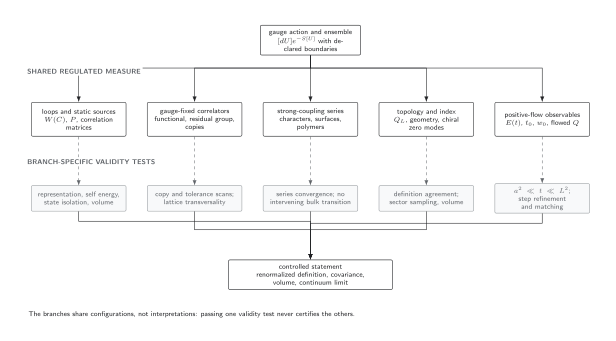
Topology requires agreement among definitions plus verified sector sampling and volume control. Positive flow can assist the definition test, but it cannot supply missing tunneling. The diagram is schematic and not to scale.
Adversarial failure: a precise susceptibility from a frozen sector
Section titled “Adversarial failure: a precise susceptibility from a frozen sector”Consider stored configurations whose flowed charge is stably integer-valued but remains throughout. Two improved field definitions and the overlap index can agree on every configuration, and bootstrap errors can become arbitrarily small. Nevertheless the connected estimator gives
because the chain never sampled the equilibrium sector weights. Agreement among charge definitions tests the observable on sampled fields; it does not test ergodicity. Independent streams, transitions, autocorrelation analysis, or a controlled fixed-topology treatment are therefore indispensable.
Observable-level validation checklist
Section titled “Observable-level validation checklist”- On a smooth oriented test field, verify the epsilon normalization, for a self-dual unit instanton, and the corresponding overlap-index sign.
- Measure the Ginsparg–Wilson residual, isolate exact chiral zero modes, and confirm that .
- Compare field-theoretic, geometric, and fermionic charges versus spacing at fixed physical smoothing radius rather than merely rounding one estimator.
- Inspect charge histories, sector transitions, independent streams, and before estimating .
- Repeat the susceptibility at another four-volume and smoothing window, including contact-term or boundary corrections appropriate to the definition.
Common pitfalls
Section titled “Common pitfalls”Rounding to the nearest integer. Rounding hides definition dependence and biases . Establish a plateau and continuum agreement before interpreting clusters near integers.
Using the plaquette autocorrelation time. Topological modes can be orders of magnitude slower. Diagnose itself and observables coupled to it.
Letting flow time drift in physical units. Holding fixed sends the physical smoothing radius to zero as . Decide which limit is intended and state it.
Learning outcomes
Section titled “Learning outcomes”- Given a lattice gauge field and charge prescription, translate its orientation and normalization, compute the fermionic index sign, and test agreement with an independent definition on smooth fields.
- Given a topological-charge time series, distinguish dislocations, smoothing dependence, sector freezing, and finite-volume bias and determine whether a susceptibility estimate is supportable.
Exercises
Section titled “Exercises”- A run remains in throughout. What value does the naive connected estimator of give, and why is it unreliable?
Solution
It gives . This reflects absence of sector fluctuations in the chain, not the equilibrium susceptibility.
- Show that the Ginsparg–Wilson trace receives contributions only from special real modes and reduces to the chiral zero-mode difference.
Solution
Nonreal eigenvalues occur in paired sectors whose contributions to cancel. The mode at the opposite real endpoint is removed by the factor , leaving zero modes weighted by chirality and hence with the stated sign convention. If the index is instead defined as , both sides of the trace identity and the associated topological-charge sign reverse.
References
Section titled “References”- Lüscher, M. (1982). Topology of lattice gauge fields. Communications in Mathematical Physics, 85, 39–48. DOI.
- Neuberger, H. (1998). Exactly massless quarks on the lattice. Physics Letters B, 417, 141–144. DOI.
Further reading
Section titled “Further reading”- Atiyah, M. F., and Singer, I. M. (1968). The index of elliptic operators: I. Annals of Mathematics, 87, 484–530. DOI.
Original QFT.org content:CC BY 4.0, unless an item supplies different terms. Third-party material retains its own terms.