

Lattice Gauge Hamiltonians and Gauss’s Law
A Hamiltonian lattice gauge theory places a group-valued transporter and its conjugate electric field on each oriented spatial link. The electric term is kinetic energy on the group, plaquettes supply magnetic energy, and local Gauss generators implement gauge transformations. Gauge invariance is exact when every term commutes with every Gauss generator, including matter and boundary-charge contributions.
Required background. Regulated Hamiltonian field theory fixes the algebra–representation contract; links and plaquettes fix orientation; gauge orbits and Gauss constraints fix the physical meaning of the constraint.
Helpful background. Representations, intertwiners, and invariants organize non-Abelian link states and gauge-invariant vertices.
Link algebra and electric fields
Section titled “Link algebra and electric fields”Gauge-Hamiltonian convention card. Links are oriented from to , reversal sends , and generators are Hermitian. Compact-group Haar measure is normalized. Left and right electric actions belong to opposite endpoints with the displayed signs; boundary flux and external charge are part of the declared Gauss sector.
For compact , a link Hilbert space is . In the angle basis,
The electric eigenstates , , obey and . Reversing a link sends and changes which endpoint sees outgoing rather than incoming electric flux.
For a non-Abelian group, left and right electric generators act on the two link endpoints. With Hermitian generators,
up to the declared sign convention. Their quadratic Casimirs agree on a link. The Peter–Weyl basis makes the representation label and endpoint indices explicit.
Kogut–Susskind Hamiltonian
Section titled “Kogut–Susskind Hamiltonian”In three spatial dimensions for , one common normalization is
The first term is diagonal in electric representations; the second changes flux around a plaquette. Additive constants may be dropped. Other spatial dimensions and anisotropic conventions carry different powers of , so this displayed formula should not be transplanted without dimensional translation.
This electric-Casimir plus magnetic-plaquette structure is the canonical Hamiltonian construction of Kogut and Susskind 1975, pp. 395–408.
For staggered matter, a representative hopping term is
It is invariant because the link transports the charge between the endpoint fields.
Gauss’s law including matter and boundaries
Section titled “Gauss’s law including matter and boundaries”For oriented links, define
Physical states in a prescribed charge sector obey
On a closed lattice, summing cancels every internal link flux, so total dynamical plus external charge must satisfy the global consistency condition. With open boundaries, the uncancelled flux equals the boundary charge; imposing zero at every boundary site would incorrectly discard charged sectors.
The electric energy commutes with because it is a function of flux. In a plaquette, raising the outgoing flux at a vertex is accompanied by lowering the adjacent incoming flux, so the divergence is unchanged. The matter hopping simultaneously moves charge and changes link flux. Hence
for all . This term-by-term proof is stronger than observing small drift in one state. The operator algebra and its strong- and weak-coupling checks are reviewed in Kogut 1979, pp. 659–713.
The shared diagram locates Gauss’s law between the regulated tensor product and all physical observables.
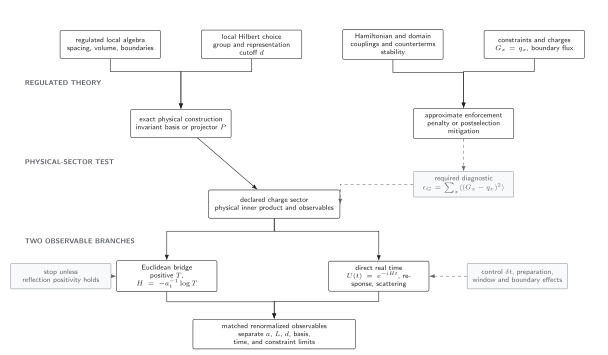
Gauss generators and boundary charges define the sector before either Euclidean or real-time observables are interpreted. Exact commutation preserves that sector; penalty enforcement remains approximate until leakage is quantified. The diagram is schematic.
Electric and magnetic regimes
Section titled “Electric and magnetic regimes”At large , electric flux costs dominate and strong-coupling perturbation theory begins from local Casimir eigenstates. At small , plaquette alignment favors smooth magnetic fields, but many representations contribute and a local representation cutoff becomes demanding. These limits are useful checks, not two separate target theories.
For compact , a one-link electric eigenstate gives . A plaquette operator shifts the four oriented link fluxes while preserving Gauss’s law at each vertex. Explicitly checking the four divergences is a compact implementation test.
Adversarial failure case
Section titled “Adversarial failure case”Replace by in one matter-hopping term but retain its Hermitian conjugate. The resulting Hamiltonian is still Hermitian, preserves norm, and can even conserve the total charge, yet its commutator with the two endpoint Gauss generators is nonzero because charge and flux now move with incompatible orientations. Starting from a physical basis state therefore produces local leakage. Evaluate term by term—or evolve that state for a short time and measure —to expose the error.
Observable-level validation
Section titled “Observable-level validation”- Check the link commutators and the left/right transformation law on a complete one-link basis, including the cutoff boundary when present.
- Evaluate , , and separately at every affected vertex.
- Reverse every link orientation and verify that a plaquette trace and the spectrum are unchanged after translating the basis.
- Sum Gauss’s law over a closed lattice, or match the uncancelled flux to the declared open-boundary charge.
- Reproduce a one-link Casimir energy and a one-plaquette flux transition before interpreting larger-volume observables.
Common pitfalls
Section titled “Common pitfalls”Using one electric generator at both endpoints. Non-Abelian links carry left and right actions related by the link. Confusing them breaks the local transformation law.
Miscounting dependent constraints. On a closed connected Abelian lattice, the local Gauss constraints obey one global relation. Normalized group averaging remains an idempotent projector; independent-constraint counts and orbit-volume formulas must account for the relation. For a non-Abelian gauge action, identify its actual kernel or common-center action rather than assuming the same one-relation rule.
Calling a penalty term gauge invariant enforcement. A gauge-invariant penalty can energetically separate sectors, but finite-energy states can still contain unphysical weight. Measure it.
Learning outcomes
Section titled “Learning outcomes”- Starting from oriented link and matter transformation laws, derive every term in and verify including boundary and external-charge contributions.
- For a stated gauge group and normalization, compute one electric and one plaquette benchmark and identify the lattice-spacing and representation factors needed for its continuum interpretation.
Exercises
Section titled “Exercises”- Show directly that the plaquette operator commutes with every .
Solution
At each plaquette vertex, the ordered product raises one oriented outgoing flux and raises the adjacent path flux that is incoming with the opposite sign in the divergence. Their changes cancel. Sites away from the plaquette are untouched.
- On a closed lattice with no external charge, sum Gauss’s law over all sites.
Solution
Every internal appears once outgoing and once incoming, so the flux terms telescope to zero. Thus physical states require total matter charge .
References
Section titled “References”- Kogut, J. B. (1979). An introduction to lattice gauge theory and spin systems. Reviews of Modern Physics, 51, 659–713. DOI.
- Kogut, J. B., and Susskind, L. (1975). Hamiltonian formulation of Wilson’s lattice gauge theories. Physical Review D, 11, 395–408. DOI.
Further reading
Section titled “Further reading”- Zohar, E., Cirac, J. I., and Reznik, B. (2016). Quantum simulations of lattice gauge theories using ultracold atoms in optical lattices. Reports on Progress in Physics, 79, 014401. DOI.
Original QFT.org content:CC BY 4.0, unless an item supplies different terms. Third-party material retains its own terms.