

Verification, Error Mitigation, and Observable Certification
Beyond classically exact sizes, verification must become layered rather than disappear. A credible quantum-QFT result anchors small systems to exact answers, tests algebra and conservation identities at target size, crosses encodings or algorithms with different failure modes, withholds predictions, and propagates every mitigation assumption into the observable uncertainty. Error mitigation can reduce a modeled bias; it does not certify the model or the QFT map.
Required background. Real-time evolution and observable extraction supplies the estimator to be certified. Algorithm validation and ensemble provenance supplies positive and negative controls. Complete lattice error budgets supplies covariance and shared-input propagation.
Helpful background. Hamiltonian continuum limits and Euclidean cross-validation supplies independent regulator and formulation tests.
A verification ladder
Section titled “A verification ladder”Convention and regulator card. Certification concerns a declared estimator at fixed regulator , preparation protocol, circuit family, and noise/mitigation model. “Agreement” always names a tolerance, covariance treatment, and domain. A check used to tune the calculation is not held out. Device characterization is an input to the noise model, not a substitute for QFT observable validation.
Use the following ladder; each rung remains active after the next becomes available.
- Algebraic tests: encoded commutators, group laws, Hermiticity, normalization, and dimensional analysis.
- Exact limits: free theory, zero coupling, one site, short time, and exactly diagonalizable small volumes.
- Internal identities: energy or charge conservation, Gauss constraints, Ward identities, positivity where applicable, and causal or Hermiticity relations.
- Cross-implementation tests: different product order, step sequence, encoding, compiler, observable decomposition, or mitigation scale.
- Independent classical overlap: exact diagonalization, tensor networks, truncation, or Euclidean calculations in a regime where their errors are controlled.
- Held-out predictions: observables, times, sectors, or regulator points frozen before unblinding.
- Cross-regulator evidence: agreement after separately controlled local-dimension, volume, time, and lattice-spacing limits.
Agreement between methods that share a wrong operator normalization or input ensemble is correlated evidence, not independence. List shared code, coefficients, calibration data, renormalization factors, and fit assumptions.
Conditional error mitigation
Section titled “Conditional error mitigation”Suppose a controllable noise scale gives
Using scales and with , first-order Richardson extrapolation gives
The cancellation is valid only if scaling changes the modeled noise while leaving the ideal Hamiltonian, time, state, and measurement operator fixed, and if the expansion is valid over the fitted range. The two measurements are combined with amplified variance,
Zero-noise extrapolation and quasiprobability cancellation were derived with explicit noise-model and sampling assumptions by Temme, Bravyi, and Gambetta 2017. A smoother extrapolated curve is not evidence that those assumptions hold. Postselection similarly conditions the state and changes sampling; it must be validated against a symmetry-preserving reference and reported with acceptance overhead.
Mitigation uncertainty includes scale calibration, ansatz order, omitted nonanalytic behavior, drift, shot covariance, and model discrepancy. Certification adds independent physics evidence; it is not the extrapolated error bar alone.
What evidence belongs where
Section titled “What evidence belongs where”The boundary figure separates durable scientific claims from implementation and dated comparative claims. Inspect the two gates: continuum accuracy requires regulator evidence, while advantage requires a separately matched and time-stamped baseline.
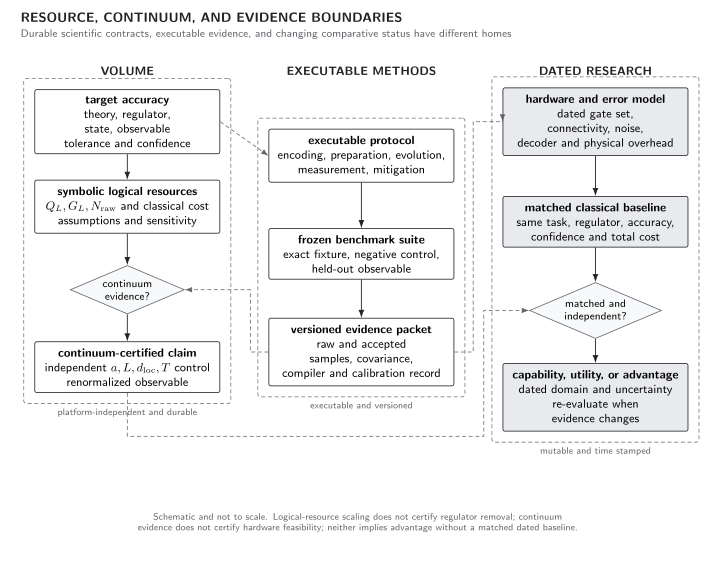
This Volume defines platform-independent error contracts, exact and cross-method checks, regulator removal, and symbolic logical resources. Executable benchmark and mitigation protocols require reproducible records. Current hardware capability, scientific utility on a device, and matched advantage status require dated Research records. The map is schematic and makes no current performance claim.
The canonical claim–resource–evidence record shows which baseline and evidence ceiling accompany each claim tier.
Analytic benchmark: a falsifiable mitigation test
Section titled “Analytic benchmark: a falsifiable mitigation test”Use the exactly solvable two-level Hamiltonian and target . Inject a known depolarizing channel after each of steps such that
Generate statistically independent data at and , apply , and verify the residual changes from to over a resolved range. Then inject a coherent over-rotation that also changes the simulated Hamiltonian when the “noise” is scaled. Richardson extrapolation should fail the held-out time series even if it improves a tuned time point. This negative control tests the central assumption.
For the free scalar chain, verify mode frequencies, , energy conservation, and the exact correlator. At an interacting small size, compare exact diagonalization, two product orders, and two field cutoffs. Reserve later times and a second operator. At larger size, the same identities and cross-implementation differences remain measurable even when the full state is not classically available.
Adversarial failures
Section titled “Adversarial failures”Two methods, one shared bug. Circuit and tensor calculations use the same incorrectly normalized field operator. Their agreement is strong evidence for neither. Re-derive the operator and include an independently normalized observable.
Postselection improves everything. Acceptance falls exponentially, and surviving events are correlated with a particular noise history. Report raw and conditional results, acceptance, and an invariant-encoding comparison.
Extrapolation through a regime change. Noise scaling alters pulse duration or effective Hamiltonian, so is not an expansion about the same ideal circuit. Use process-level controls and reject the extrapolation.
Exact-size tuning consumes the test. Parameters are adjusted until the small-system observable agrees, then the same point is called validation. Freeze a separate operator, time, sector, or volume before tuning.
Observable-level validation checklist
Section titled “Observable-level validation checklist”- Declare which checks were used for development and which were frozen as held-out predictions.
- Test algebra, exact limits, conservation and Ward identities, constraint leakage, and small-system time series.
- Cross at least one encoding, product ordering, compiler, or classical method and enumerate shared inputs.
- For mitigation, state noise scaling, expansion ansatz, scale calibration, fit range, covariance, acceptance, and sampling overhead.
- Inject a failure that violates the mitigation assumption and require the diagnostic to reject it.
- Carry finite-regulator and mitigation uncertainty into the continuum fit; route current device and comparative claims to dated Research evidence.
Exercises
Section titled “Exercises”1. Richardson variance
Section titled “1. Richardson variance”For , independent estimates at the two noise scales each have variance . What is the variance of ?
Solution
. Independence gives . Canceling the leading bias costs a factor of five in variance in this simple allocation.
2. Shared bias
Section titled “2. Shared bias”Two methods give and . What does their difference test?
Solution
; the shared bias cancels. Agreement tests only method-specific discrepancies and statistical noise. An independent normalization, input, or formulation is needed to test .
Learning outcomes
Section titled “Learning outcomes”After working this page, you should be able to:
- Build a verification ladder that connects exact finite systems to target-size identities, cross-implementation checks, controlled classical overlap, held-out observables, and cross-regulator evidence.
- Derive a mitigation extrapolator with its covariance, state the assumptions that license it, and design negative controls for noise scaling, postselection, and shared-compilation bias.
Handoff
Section titled “Handoff”Resource and continuum certification converts this verified error model into a conditional resource estimate. A benchmark ladder for quantum field simulators turns the evidence rungs into claim ceilings. Current device evidence belongs in Research.
References
Section titled “References”- Temme, Kristan, Sergey Bravyi, and Jay M. Gambetta. “Error Mitigation for Short-Depth Quantum Circuits.” Physical Review Letters 119 (2017): 180509. doi:10.1103/PhysRevLett.119.180509.
Original QFT.org content:CC BY 4.0, unless an item supplies different terms. Third-party material retains its own terms.