

Tensor Renormalization of Euclidean Path Integrals
Euclidean tensor renormalization begins with an exact local factorization of a finite-lattice partition function and then approximates its contraction by repeated blocking and bond truncation. The exact tensorization, the truncation at each blocking step, normalization factors, symmetry sectors, impurity insertions, volume, and lattice spacing must remain separately visible.
Required background. Entanglement structure and tensor-network ansätze supplies tensor graphs, bonds, and gauge redundancy. Lattice regulators and target continuum theories supplies the finite Euclidean regulator and target contract.
Helpful background. Wilsonian coarse graining and theory space supplies the RG interpretation; tensor blocking below is a concrete contraction algorithm, not automatically an exact Wilsonian action flow.
Exact local tensorization
Section titled “Exact local tensorization”For the two-dimensional Ising model on a square lattice,
in a dimensionless convention. Factor each bond as
Summing the spin at a site produces a rank-four tensor
and the exact finite-volume identity is
The even-parity rule is a local symmetry constraint. Character expansions generalize this construction to compact groups, while quadrature or local-basis decompositions treat continuous fields; each introduces its own finite character or quadrature control if the decomposition is truncated. Tensor-lattice formulations of spin, gauge, and field theories and their renormalization applications are reviewed by Meurice, Sakai, and Unmuth-Yockey 2022.
Regulator and convention box. Record the Euclidean action, lattice and boundary conditions, spacing , volume, tensorization identity, initial index ranges, symmetry sectors, blocking geometry, retained bond dimension , tensor normalization convention, number of steps, contraction termination, impurity definition, and observable renormalization. A local SVD discarded norm is not by itself a global free-energy or correlator bound.
The geometry map places this construction on the partition-function branch. Unlike an MPS or PEPS, the physical variables have already been summed into a closed network before blocking begins.
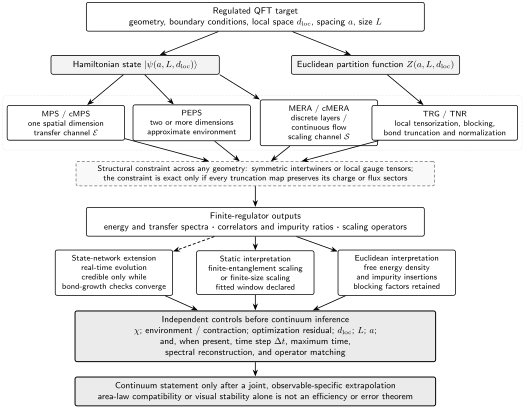
Euclidean tensor renormalization approximates the contraction of a closed finite-lattice network. The diagram is schematic: exact tensorization precedes bond truncation, and continuum inference still requires symmetry, normalization, volume, spacing, and observable-matching checks.
Blocking and truncation contract
Section titled “Blocking and truncation contract”A typical blocking step reshapes a tensor into a matrix , computes
and retains the largest singular values. For that isolated matrix in the Frobenius norm,
The equality is exact but local. Subsequent nonlinear blocking, tensor gauges, and impurity insertions can amplify or redirect the discarded components. Plain tensor renormalization can also retain short-range structures that obscure a critical fixed point; tensor-network renormalization introduces disentangling operations to remove such correlations Evenbly and Vidal 2015, pp. 1–4. The original tensor renormalization construction is given by Levin and Nave 2007.
Numerical stability requires extracting scale factors. If
then the multiplicity of tensors at level contributes
Dropping any can leave normalized local tensors looking converged while shifting the free-energy density. A valid implementation tests the identity with and without normalization on a small network.
Impurity tensors and observable normalization
Section titled “Impurity tensors and observable normalization”For an observable obtained by differentiating a coupling ,
replace one or more local tensors by and coarse-grain the numerator consistently with the denominator. The impurity generally requires a larger effective bond support than the partition function. Reusing the bulk discarded spectrum without testing the impurity can therefore yield an accurate free energy and an inaccurate susceptibility.
For separated insertions, preserve their relative positions until their causal blocking cones merge. After merging, the composite impurity and its normalization must be tracked. Operator mixing and continuum renormalization are additional to the tensor contraction.
Exactly checkable limits
Section titled “Exactly checkable limits”At , and only survives. On sites,
Every blocking and normalization scheme must reproduce this result exactly with . The first derivative vanishes, , because independent spins have zero nearest-neighbor correlation. This pair checks the partition function and a derivative insertion without Monte Carlo or extrapolation.
The full finite-lattice tensor contraction can also be compared with direct enumeration on a periodic lattice, provided the convention for repeated bonds is fixed. Such a check detects orientation and multiplicity mistakes that the limit cannot.
Adversarial failure: a converged free energy, wrong susceptibility
Section titled “Adversarial failure: a converged free energy, wrong susceptibility”Suppose the bulk free energy is stable across , but the susceptibility uses an impurity truncated by the bulk isometries. Near criticality the impurity may couple strongly to directions negligible in the bulk norm. The free-energy plateau does not certify the derivative. Repeat the blocking with impurity-aware subspaces, compare finite differences of , and scan for the susceptibility itself.
The chapter-wide tensor-network regulator and error record provides the common fields for the tensorization, bond flow, observable, and continuum claim.
Observable-level validation checklist
Section titled “Observable-level validation checklist”- Verify the local factorization entry by entry or by an independent character identity.
- Recover and an exactly enumerable small lattice.
- Preserve symmetry blocks and test forbidden tensor entries after every truncation.
- Retain every blocking normalization and reconstruct independently.
- Scan bond dimension for the actual impurity observable, not only the bulk tensor.
- Compare derivatives of with impurity contractions.
- Separate volume, initial quadrature or character cutoff, blocking bond dimension, and lattice spacing.
- Compare a selected point with Monte Carlo or exact transfer-matrix data whose systematics are independent.
What you should be able to do
Section titled “What you should be able to do”After this page, you should be able to:
- derive a local tensor representation of a regulated partition function and insert an observable with all normalization factors explicit; and
- track symmetry, bond truncation, blocking normalization, volume, and lattice spacing as distinct controls through a Euclidean tensor flow.
Exercises
Section titled “Exercises”1. Parity rule. Show that the Ising local tensor vanishes when is odd.
Solution
The spin sum contains . It equals two for an even exponent and zero for an odd exponent, giving the displayed Kronecker constraint.
2. Normalization multiplicity. A network is blocked to and then . If tensors are divided by before the first contraction and by before the second, what is the contribution to ?
Solution
There are 16 original tensors and 4 tensors after the first block, so the extracted contribution is . The final normalized contraction supplies the remaining term.
References
Section titled “References”- Evenbly, Glen, and Guifré Vidal. “Tensor Network Renormalization.” Physical Review Letters 115 (2015): 180405. DOI.
- Levin, Michael, and Cody P. Nave. “Tensor Renormalization Group Approach to Two-Dimensional Classical Lattice Models.” Physical Review Letters 99 (2007): 120601. DOI.
- Meurice, Yannick, Ryo Sakai, and Judah Unmuth-Yockey. “Tensor Lattice Field Theory with Applications to the Renormalization Group and Quantum Computing.” Reviews of Modern Physics 94 (2022): 025005. DOI.
Original QFT.org content:CC BY 4.0, unless an item supplies different terms. Third-party material retains its own terms.