

Exact Symmetries, Broken Spacetime Symmetries, and Restoration
A lattice action preserves only transformations that map its regulated variables, measure, boundaries, and couplings into themselves. Internal symmetries can often remain exact, while continuous translations and rotations are reduced to a discrete space group. Continuum restoration is demonstrated by tuning every relevant symmetry-breaking coupling allowed by the regulator and by showing that several untuned, renormalized observables approach the target Ward identities and representation degeneracies with the predicted cutoff scaling. Agreement at one spacing is never sufficient.
Required background. Lattice Regulators and Target Continuum Theories supplies the finite-regulator specification. What Is a Symmetry of a QFT? distinguishes physical symmetry actions from redundancies and accidental invariance.
Helpful background. Relevant, Marginal, and Irrelevant Directions explains why some breaking operators require tuning. Symmetry-Protected Operators, Currents, and Improvement supplies the operator-mixing and current-renormalization framework.
Exact regulator symmetries and reduced spacetime groups
Section titled “Exact regulator symmetries and reduced spacetime groups”For an isotropic infinite hypercubic lattice, the spacetime symmetry is the semidirect product of discrete translations with the hypercubic point group . Its elements are signed permutation matrices; the determinant- elements form the orientation-preserving subgroup. A finite box or open boundary reduces the group further. The classification must therefore be performed for the actual geometry rather than for an ideal infinite lattice.
For the nearest-neighbor scalar,
the following transformations are exact on a periodic isotropic box:
- translations by integer lattice vectors;
- hypercubic rotations and reflections compatible with the box;
- the internal transformation .
Generic continuous translations and transformations are not defined as maps of the site set. If one uses labels instead, reflection parity must be recorded separately. An anisotropic lattice distinguishes time and space; unequal spatial spacings can reduce the point group again. Boundary conditions can break translations while leaving a subgroup of reflections intact.
Symmetry and regulator conventions. The page uses a flat Euclidean hypercubic lattice and the site-wide conventions. “Exact” means exact for the action, measure, domain, and boundary data at finite ; “restored” means a target symmetry emerges in specified renormalized observables along a continuum trajectory. Gauge redundancy, anomalies, and target supersymmetry require their own definitions and are not inferred from this terminology.
The distinction is operational. If a transformation is exact, then for an invariant measure
at every spacing, up to statistical and numerical error. For a target rotation outside the exact point group of the actual box, one may take and compare with the continuum theory in that same finite geometry. Equality representing infinite-volume symmetry additionally requires , or a quantified correction for the box.
Regulator symmetry determines operator mixing
Section titled “Regulator symmetry determines operator mixing”Renormalization can mix local operators that share all exact regulator quantum numbers. Continuum spin is therefore not the correct finite- label. A continuum representation—or an representation supplemented by parity data when reflections are exact—generally decomposes, or subduces, into irreducible representations of the applicable lattice point group. Distinct continuum spins may contain the same lattice representation and can mix until rotational symmetry is restored. The four-dimensional cubic rotation–reflection representations are classified explicitly by Mandula, Zweig, and Govaerts 1983, pp. 91–108.
Schematically, for a set of lattice operators in one lattice irrep ,
Exact symmetries force to be block diagonal between inequivalent irreps; they do not generally diagonalize mixing within a block. If a lower-dimension operator lies in the same block, its coefficient may carry a power divergence and require explicit subtraction Martinelli et al. 1995, §2 and §3.3. Classifying only by the desired continuum spin can therefore miss the most dangerous allowed mixing.
The tuning problem and the Symanzik cutoff expansion are related but distinct. First enumerate the relevant and target-defining marginal symmetry-breaking scaling fields and fix them by independent renormalized conditions. Along the resulting trajectory near a Gaussian or asymptotically free fixed point, the post-tuning effective action is organized by irrelevant operators,
Every must respect the exact lattice symmetries, not the symmetries one hopes to recover, and logarithmic mixing can multiply the displayed powers. At an interacting fixed point, RG eigenvalues rather than unqualified engineering dimensions control the scaling. The allowed set and coefficient scaling, rather than the elegance of the lattice action, determine the restoration program Symanzik 1983, Part I, §§2–4.
A rotational-restoration benchmark
Section titled “A rotational-restoration benchmark”The free scalar inverse propagator has the expansion
is rotationally invariant, while is only hypercubic invariant. Two momenta with equal but different therefore have different propagators at finite . For an exactly realizable comparison on a periodic square, let and use sites per direction so that the following modes lie strictly inside the first Brillouin zone:
Then
and
This splitting is an exactly checkable restoration observable. At fixed physical momenta and matched renormalized mass, the free nearest-neighbor result vanishes as . Interacting observables can carry times logarithms and contributions from several allowed Symanzik operators. At fixed finite , the extrapolated result must be compared with the continuum theory in the same box; an infinite-volume rotation claim also requires or controlled finite-volume corrections. A comparison at one spacing proves only that the splitting is small there. A fit across several spacings tests the scaling law, while a second action with a different leading artifact tests whether the common continuum value is formulation independent.
Position-space data provide a distinct check. Compare a renormalized two-point function at on-axis and near-diagonal separations matched to the same physical . At finite volume this tests approach to the continuum result for that geometry; full equality additionally requires or a regime with quantified image corrections. Interpolation and differing lattice vectors introduce their own errors, so the momentum- and position-space tests are not identical repetitions.
Ward identities, spectra, and restoration evidence
Section titled “Ward identities, spectra, and restoration evidence”A convincing program uses at least two observables sensitive to different possible failures.
| Target structure | Finite- test | Continuum evidence | Main confounder |
|---|---|---|---|
| Rotation symmetry | Equal- directional splitting | Approach to the continuum finite-volume benchmark, followed by for an infinite-volume claim | Unequal physical momenta, anisotropy mistuning, or box anisotropy |
| Continuous translations | Exact integer-site translations and momentum conservation modulo reciprocal vectors | Renormalized energy–momentum-tensor Ward identities are restored and fixed-physical-momentum Umklapp artifacts disappear | Boundary terms, contact terms, and momentum mismatch |
| Internal current symmetry | Exact or broken lattice Ward identity | Renormalized current identity and charge normalization agree | Contact terms and current mixing |
| Multiplet degeneracy | Energies in lattice irreps | Continuum finite-volume multiplets match, and infinite-volume partners become degenerate as | Finite volume and accidental crossings |
| Supersymmetric target | Exact lattice subalgebra when present; broken Ward identities | Multiple Ward identities, boson–fermion relations, and tuned continuum agreement | Sign problem, flat directions, mistuned relevant operators |
For a transformation , use the convention . Changing variables in the regulated integral gives
If the measure Jacobian and action are invariant, this is an exact finite-regulator Ward identity. If the target transformation is broken, contains breaking operators whose matrix elements should scale according to their tuned coefficients. Contact terms, boundary terms, and operator renormalization remain part of the identity; dropping them can manufacture apparent restoration. The lattice chiral analysis of Bochicchio et al. 1985, §§2–3, pp. 331–355 gives a primary example in which breaking insertions, contact terms, and renormalized operators must be handled together.
Spectral degeneracy offers an independent route because it probes transfer eigenvalues rather than only local correlation identities. The comparison must use states assigned to the correct lattice irreps and control avoided crossings, finite-volume shifts, and operator-basis overlap.
Restoration, emergence, and accidental agreement
Section titled “Restoration, emergence, and accidental agreement”Three claims should remain distinct.
Restoration along a known target trajectory. The regulator was designed for a declared target symmetry; all allowed relevant breakings are tuned; multiple observables approach the target relations.
Emergent symmetry. The infrared fixed point has a larger symmetry than the microscopic regulator. Establishing this requires the RG and operator-spectrum evidence appropriate to Critical Surfaces, Crossover, and Corrections to Scaling, not merely small lattice anisotropy.
Accidental finite-spacing agreement. One ratio or degeneracy is small because coefficients cancel at a particular bare coupling. A second observable or another spacing can expose the accident.
The distinction is especially important for supersymmetric lattice constructions. A lattice formulation with an exact scalar supersymmetry but additional continuum-restoration obligations provides a concrete example Catterall 2005; the allowed counterterms and residual tuning must be analyzed separately Catterall et al. 2011. This volume treats the finite-regulator subalgebra, allowed breaking terms, tuning, Ward identities, and continuum diagnostics. The target supersymmetry algebra, component multiplets, closure, protected observables, and duality consequences belong to Component Multiplets and Closure Conditions and the rest of the supersymmetry volume. A restored lattice Ward identity alone does not establish a protected-sector or duality claim.
Adversarial failure cases
Section titled “Adversarial failure cases”Tuning with the same observable later used as validation. The tuned observable is guaranteed to agree by construction. Reserve at least one Ward identity, directional splitting, or spectral relation as a held-out test.
A symmetry channel omitted from the mixing basis. If the regulator allows a lower-dimension operator, setting its coefficient to zero in a fit is not evidence that it is absent. Enumerate operators from exact lattice quantum numbers.
Restoration inferred at fixed lattice momentum index. Holding the integer mode fixed while changing both and need not hold physical fixed. Match physical momenta before comparing directional splittings.
Boundary breaking mistaken for bulk cutoff breaking. Open boundaries break translations at every . Move operators away from the boundary and vary the physical distance to distinguish boundary-state contamination from bulk restoration.
Exact subgroup mistaken for the full target group. Preserving one scalar supercharge, a discrete chiral subgroup, or the hypercubic group is valuable but does not imply restoration of the complete continuum algebra.
The map below locates symmetry restoration in the complete finite-regulator chain. Exact lattice transformations constrain the action and operator basis; directional dispersion and correlator comparisons test, rather than define, the recovered continuum spacetime symmetry.
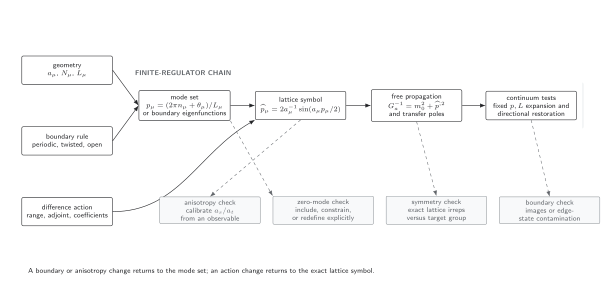
Geometry and action data jointly determine finite-regulator propagation. Periodic or twisted translation-invariant problems use lattice momenta, whereas open problems use boundary eigenmodes and their operator eigenvalues. Changing the anisotropy or action recomputes the poles. The continuum expansion is a tested limit, not an identification at finite spacing. The diagram is schematic and not to scale.
Observable-level validation checklist
Section titled “Observable-level validation checklist”For a restoration claim, require:
- the exact symmetry group of the action, measure, constraints, and boundaries;
- a complete list of target-defining relevant, marginally relevant, and exactly marginal breaking directions allowed by that group;
- independent renormalized conditions for every required tuning;
- at least two held-out tests with different operator content;
- several lattice spacings at matched physical volume and renormalized parameters, followed by a finite-volume study when the target symmetry is an infinite-volume statement;
- a fit form justified by the allowed Symanzik operators, including logarithms when relevant;
- finite-volume, boundary, and anisotropy effects varied separately;
- representation assignments made in lattice irreps before continuum interpretation; and
- agreement with a second discretization or formulation when the claim is consequential.
Exercises
Section titled “Exercises”1. Hypercubic invariants. Show that is invariant under signed permutations but not under a generic rotation. On a periodic cubic lattice with at least seven sites per direction, construct two nonzero momenta with equal and unequal .
Solution
Signed permutations only reorder the fourth powers, so their sum is fixed. With , the allowed momenta and both have norm squared , while their values are and . Because two nonzero vectors of equal norm are related by an rotation, this unequal result explicitly shows that is not invariant under generic rotations.
2. Design two independent tests. For a scalar lattice with but equal spatial spacings, propose one test of the tuned time–space anisotropy using an independently calibrated conversion between temporal and spatial units, and one position-space test of spatial rotational restoration. If the dispersion relation itself is used to tune the anisotropy, name a different held-out check. Give a distinct confounder for each test.
Solution
Using an anisotropy determined from a separate observable, fit the low-momentum form ; the tuned speed should approach one. Excited-state contamination or momentum calibration can bias the slope. If this dispersion is the tuning condition, a screening-mass aspect ratio or a separately defined potential scale can be held out. Independently compare renormalized spatial correlators at matched physical distances along on-axis and off-axis lattice vectors; interpolation and unequal boundary distance are distinct confounders. Agreement after these independent controls is stronger than either test alone.
What you can now do
Section titled “What you can now do”You should now be able to classify observables by exact lattice symmetries, identify allowed mixing and tuning terms, and design multiple held-out tests of continuum restoration. Continue with Reflection Positivity and Transfer-Matrix Criteria to determine when a Euclidean discretization also supports a positive-state transfer interpretation.
References
Section titled “References”- Bochicchio, Marco, Luciano Maiani, Guido Martinelli, Giancarlo Rossi, and Massimo Testa. “Chiral Symmetry on the Lattice with Wilson Fermions.” Nuclear Physics B 262, no. 2 (1985): 331–355. doi:10.1016/0550-3213(85)90290-1.
- Catterall, Simon. “Lattice Formulation of Super Yang–Mills Theory.” Journal of High Energy Physics 2005, no. 06 (2005): 027. doi:10.1088/1126-6708/2005/06/027.
- Catterall, Simon, Eric Dzienkowski, Joel Giedt, Anosh Joseph, and Robert Wells. “Perturbative Renormalization of Lattice Super Yang–Mills Theory.” Journal of High Energy Physics 2011, no. 04 (2011): 074. doi:10.1007/JHEP04(2011)074.
- Mandula, Jeffrey E., George Zweig, and James Govaerts. “Representations of the Rotation Reflection Symmetry Group of the Four-Dimensional Cubic Lattice.” Nuclear Physics B 228, no. 1 (1983): 91–108. doi:10.1016/0550-3213(83)90399-1.
- Martinelli, Guido, Carlotta Pittori, Christopher T. Sachrajda, Massimo Testa, and Anastassios Vladikas. “A General Method for Non-Perturbative Renormalization of Lattice Operators.” Nuclear Physics B 445, no. 1 (1995): 81–108. doi:10.1016/0550-3213(95)00126-D.
- Symanzik, Kurt. “Continuum Limit and Improved Action in Lattice Theories. I. Principles and Theory.” Nuclear Physics B 226, no. 1 (1983): 187–204. doi:10.1016/0550-3213(83)90468-6.
Further reading
Section titled “Further reading”- Wilson, Kenneth G. “Confinement of Quarks.” Physical Review D 10, no. 8 (1974): 2445–2459. doi:10.1103/PhysRevD.10.2445.
Original QFT.org content:CC BY 4.0, unless an item supplies different terms. Third-party material retains its own terms.