

Dual Variables, Worldlines, and Tensor Reformulations
Dual variables can eliminate a complex action when an exact expansion turns fields into integer fluxes, loops, surfaces, bags, or tensor indices with nonnegative local factors. The gain is model specific. Every accepted reformulation must preserve the partition function, boundary sectors, constraints, and target observables; positivity obtained after dropping a fermion-loop sign or a winding sector is a change of theory, not a cure.
Required background. Anatomy and severity of a sign problem supplies phase and overlap diagnostics. Strong-coupling and character expansions supplies group-character expansions.
Helpful background. Direct sums, tensor products, and index structure supplies the tensor-contraction language.
Exact flux representation of a finite-density rotor
Section titled “Exact flux representation of a finite-density rotor”Convention and regulator card. On a periodic -dimensional hypercubic lattice, let and orient links from to . The dimensionless chemical potential lies on temporal links . Integer flux follows the chosen orientation. All sums and integrals are finite at fixed lattice size.
Consider
For real the action is complex. Apply the exact Fourier–Bessel identity
on each link. Then
where
The site integrals impose integer charge conservation:
Because for and for real , every allowed flux configuration has nonnegative weight. Chemical potential couples to net temporal winding: summing over the lattice gives times the conserved winding number. Exact flux formulations of finite-density scalar theories exploit this structure Kloiber and Gattringer 2013, § 2, Eqs. (2.4)–(2.5).
Observables become defects and derivatives
Section titled “Observables become defects and derivatives”Differentiating the dual partition function gives the conserved density,
A charged two-point function inserts . The phase integrations now require
Thus the observable is an open flux line from one defect to the other, not the same estimator used in the vacuum sector. Worm algorithms use precisely these defect sectors to update constrained flux. Failure to normalize the enlarged ensemble or to include winding-changing moves biases the correlator despite positive weights.
The transformation is exact at infinite integer range. A practical cutoff is an additional regulator. Its error can be bounded from Bessel tails,
relative to a suitable retained normalization. The cutoff must grow when shifts weight toward large temporal flux.
Worldlines, fermion bags, and tensors
Section titled “Worldlines, fermion bags, and tensors”The same logic has several realizations.
- Worldlines and surfaces: hopping or character expansions integrate the original fields and leave conserved matter flux bounded by gauge-flux surfaces.
- Fermion bags: Grassmann variables are integrated in connected regions so that determinants or Pfaffians of submatrices replace individual fermion permutations. Positivity depends on the model and bag decomposition.
- Tensor networks: local Boltzmann factors are factorized into tensors and contracted over shared indices. Exactness holds before bond truncation; singular-value or variational truncation introduces a controlled approximation only if discarded weight and observable stability are monitored.
- Partial dualization: only a sector or expansion order is transformed. Residual signs must be measured in the resulting variables; they do not vanish by nomenclature.
Dual methods have removed complex-action problems for several finite-density bosonic and effective models, while leaving spectroscopy and algorithm design as separate tasks Gattringer 2014, § 1, pp. 1–3. Fermionic loops can carry permutation signs, staggered phases, or geometry-dependent factors. Pairing or resumming loops may help a particular action, but there is no general positivity theorem for arbitrary gauge theories and fermion content.
Exactness and sampling contract
Section titled “Exactness and sampling contract”A dual claim is licensed only if the following map is explicit:
Check equality term by term or by independent enumeration on a small lattice. Then test algorithmic ergodicity: local constraint-preserving moves may never change a topological winding sector. Positive weights do not prevent exponentially slow tunneling or tensor-contraction hardness.
For the one-angle fixture, expansion of the two bracket factors gives only charge modes ,
Multiplying by and integrating enforces total Fourier charge zero. The three surviving contributions are
Omitting the charge sector still produces a positive expression and a smooth density, but violates . This is a compact negative control for sector completeness.
Adversarial failure cases
Section titled “Adversarial failure cases”Positive but incomplete sectors. A worm update preserves winding and is initialized at zero winding. Local observables equilibrate, but density is identically zero. Compare sector weights by exact enumeration and add proven winding-changing updates.
A hidden determinant sign. A fermion-bag determinant is replaced by its absolute value because negative bags are rare on small lattices. Measure the residual sign versus volume and verify the algebraic pairing that would be needed for exact positivity.
Tensor truncation mistaken for a duality. Bond dimension is fixed while volume or grows. Extrapolate in bond dimension at every physical parameter and include discarded-weight effects in the observable, not only in the free energy.
Boundary mismatch. A dual mapping derived on an infinite or open lattice is applied with thermal periodicity. Check winding fugacity and fermion antiperiodicity explicitly.
The correctness map below locates the dual branch among methods with different failure mechanisms. Follow it through exact change-of-variables identities, constraints, sectors, Jacobians, and observable reconstruction; a positive dual weight is not sufficient if any of those data are lost.
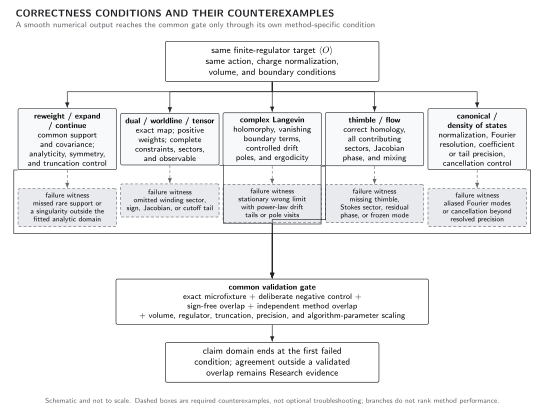
Each reformulation has a different correctness condition and a characteristic counterexample. Apparent numerical convergence is insufficient when overlap is absent, a dual sector or Jacobian is missing, complex-Langevin boundary terms survive, a contributing thimble is omitted, or canonical and density-of-states cancellations exceed resolved precision. The map is schematic and does not rank current algorithms.
Observable-level validation checklist
Section titled “Observable-level validation checklist”- Derive all local weights, constraints, Jacobians, degeneracies, and boundary sectors from the original finite integral.
- Translate the actual observable, including defect-sector normalization and contact terms.
- Enumerate a small lattice in both representations and compare partition functions and several nontrivial observables.
- Test winding/flux-sector ergodicity and autocorrelation as volume grows.
- Vary integer or tensor cutoffs and bound the omitted tail at the largest used.
- Measure any residual sign and compare cost scaling with the original variables; positivity alone is not an efficiency theorem.
Exercises
Section titled “Exercises”1. Charge conservation from phase integration
Section titled “1. Charge conservation from phase integration”Derive the site constraint in the rotor model.
Solution
Every outgoing link contributes and every incoming link contributes . Their product is . Since the divergence is integer,
2. A correlator defect
Section titled “2. A correlator defect”Show how changes the constraint.
Solution
At the phase exponent gains , so integration requires . At it gains , requiring . Hence : flux runs from to in the chosen orientation.
Learning outcomes
Section titled “Learning outcomes”After working this page, you should be able to:
- Derive an exact flux partition function and a charged correlator from a character expansion, including winding weights and boundary constraints.
- Decide whether a claimed dual cure is exact and nonnegative after checking sector completeness, observable translation, truncation, ergodicity, and residual cost.
Handoff
Section titled “Handoff”When no positive exact representation is known, complex Langevin complexifies variables and Lefschetz-thimble methods deform contours. Both replace positivity by stricter correctness conditions. The finite-density method reliability matrix keeps those conditions distinct from the exact-duality checks used here.
References
Section titled “References”- Gattringer, Christof. “New Developments for Dual Methods in Lattice Field Theory at Non-Zero Density.” Proceedings of Science LATTICE2013 (2014): 002. arXiv:1401.7788.
- Kloiber, Thomas, and Christof Gattringer. “Dual Methods for Lattice Field Theories at Finite Density.” Proceedings of Science LATTICE2013 (2014): 206. arXiv:1310.8535.
Original QFT.org content:CC BY 4.0, unless an item supplies different terms. Third-party material retains its own terms.