

Preparing Interacting QFT States
Preparing a QFT state means approximating a specified regulated vacuum, thermal state, wave packet, or scattering state in the correct symmetry sector with an error tied to later observables. Adiabatic, variational, imaginary-time-inspired, and perturbative protocols have different guarantees. A low measured energy is not by itself a fidelity certificate, and a ramp that crosses a small gap can dominate the entire computation.
Required background. Digital Hamiltonian simulation and algorithmic error supplies controlled evolution primitives.
Helpful background. Enforcing gauge symmetry and constraints supplies sector preparation and leakage diagnostics. Variational principles and field-theory ansätze supplies ansatz bias and energy principles. Vacua, states, and representations supplies the continuum state distinctions.
State targets and fidelity witnesses
Section titled “State targets and fidelity witnesses”Convention and regulator card. Fix a finite regulator , a symmetry and charge sector, and a normalized target state or density matrix . Fidelity is for a pure target. Observable adequacy is stated for a declared set ; it is not inferred from a device-wide state metric that was not measured.
For a unique ground state with gap , any normalized trial state obeys
and therefore
This is useful only if and a lower bound on the relevant sector gap are known. Energy variance
detects non-eigenstates but cannot identify which eigenstate was prepared. A wrong excited eigenstate has zero variance. Held-out correlators and symmetry quantum numbers are therefore essential.
For mixed or thermal targets, specify the ensemble and preparation map. A purification, stochastic mixture, or imaginary-time approximation can represent the same density matrix only after normalization and trace-distance or observable tests. “Thermal-looking” occupation numbers are not a Gibbs-state definition.
Adiabatic and variational routes
Section titled “Adiabatic and variational routes”Choose a path , , from an easily prepared ground state to the interacting Hamiltonian. In the simplest nondegenerate setting, transition amplitudes are suppressed parametrically by
with rigorous statements depending on smoothness, endpoint conditions, degeneracy, and higher derivatives Jansen, Ruskai, and Seiler 2007. The minimum gap must be taken in the intended sector. Crossing a phase transition or an avoided crossing whose gap shrinks rapidly with volume can make the ramp impractical even when each evolution step is accurate.
A variational protocol prepares and minimizes an objective. It must report ansatz family, sector enforcement, optimizer and stopping rule, measurement covariance, repeated initializations, and held-out quantities. Optimization success and representational adequacy are distinct: a reproducible minimum can still be the best state in an inadequate ansatz.
Perturbative dressing and wave-packet preparation can be efficient near a controlled free or weak-coupling point. Their control parameter and particle-content contamination must be measured. The scalar-scattering construction of Jordan, Lee, and Preskill 2012 explicitly separates vacuum preparation from localized incoming wave packets; that separation is a general correctness lesson, not a universal resource guarantee.
Preparation in the end-to-end flow
Section titled “Preparation in the end-to-end flow”The shared map shows state preparation after encoding and constraints but before real-time evolution. Inspect the independent arrows for sector leakage, energy or overlap evidence, and held-out observables.
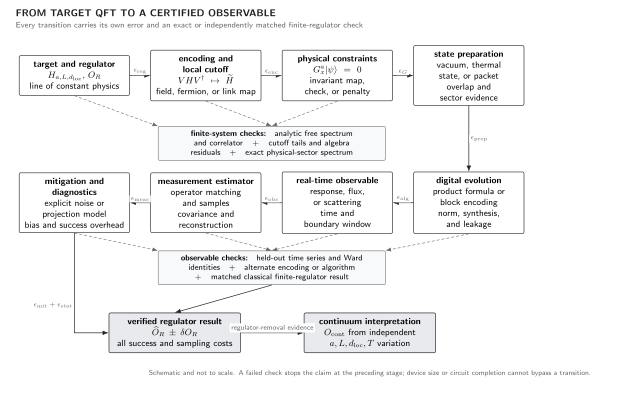
Preparation is a falsifiable link in the quantum-QFT chain. Adiabatic gap control, variational adequacy, sector leakage, wave-packet shape, and held-out correlators test different failures. The schematic flow requires these checks before later dynamics can be interpreted as evolution from the intended QFT state.
The minimum claim–resource–evidence record keeps preparation success probability and fidelity evidence beside evolution and measurement costs.
Analytic benchmark: free vacuum and an interacting ramp
Section titled “Analytic benchmark: free vacuum and an interacting ramp”For and a unitary site Fourier transform, the free periodic scalar chain is a product of normal-mode vacua with
where . These two covariances, the energy variance, and two position-space correlators give independent preparation checks.
For a small interacting benchmark use
Exact diagonalization supplies , the final overlap, and held-out correlators. Run several values, verify the predicted adiabatic trend only where is large, and repeat at a larger . For a wave packet, prepare
and check normalization, mean momentum, spatial width, negative-frequency contamination, and separation from its periodic image before scattering.
Adversarial failures
Section titled “Adversarial failures”Zero variance, wrong eigenstate. A protocol converges reproducibly to the first excited state. Its energy variance vanishes, but the target overlap is zero. Sector labels, energy ordering, and correlators expose the error.
Hidden small gap. A ramp appears smooth in its parameter, but a finite-volume avoided crossing gives . Scan the gap on exact small systems and vary the path and volume.
Variational agreement on trained observables. The energy and one fitted correlator agree because both enter the objective. Reserve at least two noncommuting or longer-distance observables as held-out tests.
Packet reaches the boundary first. The prepared profile is correct at but overlaps its periodic image before interaction. The later signal is a finite-volume collision, not the intended scattering event.
Observable-level validation checklist
Section titled “Observable-level validation checklist”- Name the target state, regulator, sector, normalization, and observable test set.
- For adiabatic preparation, report path, minimum-gap evidence, schedule, total time, and diabatic scaling.
- For variational preparation, report ansatz, optimizer, initializations, stopping rule, covariance, and held-out tests.
- Measure energy, variance, constraint leakage, boundary-cutoff occupation, and at least two held-out correlators.
- Compare exact diagonalization on a small interacting system and vary local dimension independently.
- For wave packets, verify momentum and position profiles, particle content, separation, and boundary-reflection time.
Exercises
Section titled “Exercises”1. Fidelity from an energy excess
Section titled “1. Fidelity from an energy excess”A finite-sector Hamiltonian has , gap , and a trial energy . What ground-state fidelity is guaranteed?
Solution
, so . The conclusion relies on the correct sector and on the stated lower bound for the gap.
2. Why variance is insufficient
Section titled “2. Why variance is insufficient”Construct a normalized state with zero energy variance and zero overlap with a nondegenerate ground state.
Solution
Choose any normalized excited eigenstate , . Then , while .
Learning outcomes
Section titled “Learning outcomes”After working this page, you should be able to:
- Specify an interacting-vacuum, thermal-state, or wave-packet preparation protocol with its sector, path or ansatz, gap or overlap evidence, stopping rule, success probability, and observable-level fidelity tests.
- Diagnose diabatic transitions, ansatz bias, wrong-eigenstate convergence, gauge leakage, local-cutoff support, and finite-volume packet contamination as distinct preparation failures.
Handoff
Section titled “Handoff”Real-time evolution and observable extraction turns the certified state into response, scattering, and spectral estimators. Verification, error mitigation, and observable certification combines preparation witnesses with independent evidence.
References
Section titled “References”- Jansen, Sabine, Mary-Beth Ruskai, and Ruedi Seiler. “Bounds for the Adiabatic Approximation with Applications to Quantum Computation.” Journal of Mathematical Physics 48 (2007): 102111. doi:10.1063/1.2798382.
- Jordan, Stephen P., Keith S. M. Lee, and John Preskill. “Quantum Algorithms for Quantum Field Theories.” Science 336 (2012): 1130–1133. doi:10.1126/science.1217069.
Original QFT.org content:CC BY 4.0, unless an item supplies different terms. Third-party material retains its own terms.