

Gauge Orbit Geometry, Global Obstructions, and Measures
Mathematical gauge theory begins by fixing a principal bundle, connection regularity, boundary conditions, and the gauge group that is actually quotiented. The resulting configuration object is an action groupoid, stratified by stabilizers and bundle topology. Elliptic complexes and Coulomb slices control local deformation theory; Gribov–Singer topology obstructs their global continuation; derived stacks and determinant lines retain automorphisms, obstructions, and fermionic phases; and a nonperturbative quantum measure requires a separate constructive limit. None of these geometric structures alone proves an interacting four-dimensional gauge QFT.
Helpful background. Gauge orbits, Gauss constraints, and stabilizers supplies the physical quotient. Gribov copies and limits of local gauge fixing supplies the local-versus-global distinction. Lattice gauge fixing and gauge-dependent correlators supplies a finite regulator where representative dependence can be tested.
From gauge groupoids to constructive limits
Section titled “From gauge groupoids to constructive limits”For a fixed bundle , the affine connection space is acted on by . The action groupoid retains stabilizers; the coarse quotient generally has orbit-type strata rather than one manifold structure. A local slice at is obtained only after the stabilizer kernel of is removed or retained as isotropy. An elliptic deformation complex then makes tangent and obstruction spaces finite-dimensional, but says nothing about a remote second intersection of the same orbit with the slice.
The global obstruction is topological. After using based transformations to make the action free, is a universal principal gauge-group bundle. When is noncontractible it has no section, so no continuous gauge condition chooses one representative everywhere. Singer proves this phenomenon for compact non-Abelian gauge fields over in Singer 1978, pp. 7–12. Local perturbative gauge fixing is therefore an atlas construction, not a failed approximation to a nonexistent universal coordinate.
Fermions add another global layer. A family of chiral Dirac operators produces a determinant or Pfaffian line over field space. Local anomaly cancellation controls its curvature; global consistency also demands appropriate trivial holonomy and equivariant trivialization. Finally, replacing the formal symbol by a measure requires a probability or algebraic construction plus regulator-removal estimates. The two-dimensional heat-kernel theory provides such a construction, while finite four-dimensional Wilson measures do not by themselves establish a continuum theory.
The dependency diagram records these one-way implications. Inspect the split after local linearization: one branch follows bundle and orbit topology to global obstructions, while the other follows Fredholm families to anomaly lines; both must be kept separate from the constructive-measure endpoint.
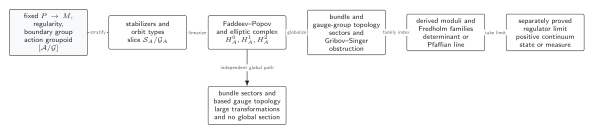
Configuration data determine the gauge groupoid and its strata; elliptic slices license local deformation statements; bundle and gauge-group topology constrain global representatives; determinant or Pfaffian lines test fermion consistency; and a continuum measure requires independent probabilistic and reconstruction estimates. The diagram is schematic and not to scale. Structured description and source data (JSON)
Hypotheses and licensed conclusions
Section titled “Hypotheses and licensed conclusions”The table places each object beside the hypotheses that make its conclusion valid. Its fourth column is deliberately negative: it records the converse or extension that the theorem does not supply.
| Object and domain | Essential hypotheses | Licensed conclusion | Excluded converse or extension | Adversarial check |
|---|---|---|---|---|
| Connection action groupoid | Fixed principal bundle, Sobolev index above the multiplication threshold, and a declared based or boundary gauge group. | Gauge arrows, stabilizers, and families are retained; gauge-invariant functions descend to the coarse orbit space. | The coarse orbit set does not recover automorphisms, boundary symmetries, or gluing data. | On $U(1)$ connections over $S^1$, replace the groupoid by holonomy values and observe that constant $U(1)$ isotropy disappears. |
| Orbit-type stratum | Proper action or gauge-theoretic slice hypotheses, with stabilizer conjugacy type held fixed. | A neighborhood is modeled by a stabilizer quotient of a slice, and orbit dimension includes the stabilizer dimension. | A free-action manifold formula cannot be continued across reducible points where isotropy jumps. | Apply the free quotient formula at $U=\pm\mathbf1$ under $SU(2)$ conjugation; it predicts a nonzero orbit although the orbit is a point. |
| Bundle sector and allowed gauge group | Bundle classification, faithful global form, matter representations, boundary conditions, and allowed components of the gauge group. | Configuration space is a disjoint union over admitted bundle classes, quotiented within each class by the declared transformations. | A large transformation need not change bundle class, and a Lie algebra does not determine the sector set. | Put $c_1=1$ on $S^2$ and demand one global potential, or quotient by a transformation forbidden at the boundary. |
| Coulomb slice and Faddeev–Popov operator | Closed base or elliptic boundary domain, controlled stabilizer, $k>d/2+1$, and invertibility of $d_A^*d_A$ on the chosen gauge algebra. | A unique small transformation carries nearby fields to a local slice, modulo the stabilizer. | Local invertibility does not give one representative on every orbit or exclude distant copies. | Insert $0\neq\xi\in\ker d_A$ at a reducible connection and watch the inverse-function hypothesis fail. |
| Elliptic deformation complex and global gauge bundle | Field equation making a complex, elliptic symbol, Fredholm domains, and separately the topology of the based gauge group. | Stabilizer, tangent, and obstruction groups are finite-dimensional; nontrivial universal-bundle topology can forbid a global section. | Ellipticity and a Fredholm index do not imply unobstructedness, compactness, or global gauge uniqueness. | Promote the perturbative slice on $S^3$ globally despite $\pi_0\operatorname{Map}_*(S^3,SU(2))\cong\mathbb Z$. |
| Derived moduli and determinant or Pfaffian line | Derived mapping-stack hypotheses or a smooth Fredholm family; for a Pfaffian, the required real structure and dimension; gauge-equivariant gluing. | Automorphisms and obstructions occupy separate tangent degrees, while curvature and holonomy locate local and global fermion anomalies. | Derived structure does not remove obstructions, and cancellation of a local anomaly polynomial does not trivialize line holonomy. | Keep only closed points at a reducible representation, or transport one $SU(2)$ doublet around the nontrivial large-gauge loop. |
| Regulated or continuum gauge measure | At finite cutoff, compact integration domain and positive action; for a continuum result, uniform tightness, observable convergence, Euclidean axioms, and reconstruction. | A finite lattice gives a positive gauge-invariant probability law; a continuum QFT follows only when the additional limit theorems are proved. | Finite-cutoff positivity, formal gauge fixing, or a determinant symbol does not imply a regulator-independent interacting measure. | Present one Wilson lattice law as the continuum theory and demand the missing topology, tightness, renormalization, and reconstruction estimates. |
Structured table data (JSON) preserves the caption, scoped headers, row order, and boundary tests.
The failure diagram is a diagnostic map, not a theorem that every upper checkpoint implies the next. Each downward edge removes one hypothesis and identifies the first conclusion that must be withdrawn.
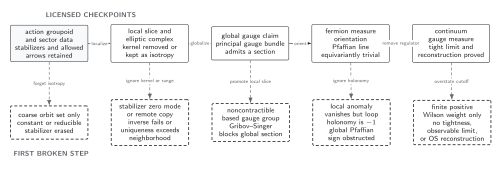
Coarse quotients forget stabilizers; reducible configurations invalidate free local coordinates; Gribov–Singer topology blocks a global continuation of local slices; flat anomaly lines can retain nontrivial holonomy; and finite-dimensional positivity does not supply a continuum limit. The diagram is schematic and not to scale. Structured description and source data (JSON)
Reading sequence
Section titled “Reading sequence”- Gauge Configuration Groupoids and Moduli defines connections, arrows, stabilizers, and the information lost in a coarse quotient.
- Orbit Spaces, Stabilizers, and Stratified Quotients derives local slice quotients and tests stabilizer jumps with conjugation.
- Principal-Bundle Sectors and Large Gauge Transformations separates bundle classes, disconnected automorphisms, faithful global form, and boundary symmetry.
- Local Slices, Gauge Fixing, and Faddeev–Popov Geometry proves the local Coulomb construction and locates its stabilizer kernel.
- Elliptic Gauge Complexes and Gribov Obstructions separates , , and in the anti-self-dual deformation problem.
- The Gribov–Singer Global Gauge-Fixing Obstruction turns global gauge fixing into a section problem and tests it on based transformations over .
- Moduli Stacks and Derived Geometry of Gauge Fields retains automorphisms and obstruction cohomology for surface character stacks.
- Determinant Lines, Global Obstructions, and Orientations distinguishes local curvature anomalies from Pfaffian holonomy.
- Nonperturbative Gauge Measures: Positivity and Configuration-Space Limits compares rigorous two-dimensional heat-kernel measures with the still-separate obligations of a four-dimensional Wilson continuum limit.
The order is mathematical rather than historical: define the quotient object and its strata, separate bundle topology from gauge components, establish local elliptic geometry, identify global obstructions, retain derived and fermionic family data, and only then ask for a positive continuum quantum construction.
References
Section titled “References”- Atiyah, Michael F., and Raoul Bott. “The Yang–Mills Equations over Riemann Surfaces.” Philosophical Transactions of the Royal Society of London A 308 (1983): 523–615. DOI; Open PDF.
- Driver, Bruce K. “YM2: Continuum Expectations, Lattice Convergence, and Lassos.” Communications in Mathematical Physics 123 (1989): 575–616. DOI; Open PDF.
- Freed, Daniel S. “On Determinant Line Bundles.” In Mathematical Aspects of String Theory, edited by Shing-Tung Yau, 189–238. Singapore: World Scientific, 1987. Open PDF.
- Singer, Isadore M. “Some Remarks on the Gribov Ambiguity.” Communications in Mathematical Physics 60 (1978): 7–12. DOI; Open PDF.
Original QFT.org content:CC BY 4.0, unless an item supplies different terms. Third-party material retains its own terms.