

Defects, Generalized Symmetry, and Categorical QFT
A categorical-QFT claim is defined by more than a fusion table. One must specify the stratified spacetime, labels on every codimension, the higher category in which they compose, associators and duals, the action on states or operators, and any algebra object used for gauging or condensation. A theorem then has a declared equivalence notion and realization domain. These data can control topological defects, generalized charges, anomaly inflow, and finite topological phases; they do not by themselves reconstruct a local QFT or its dynamics.
Helpful background. Non-Invertible Topological Defects and Fusion supplies the physical defect operators. Constructions from Gauging, Duality, and Condensation distinguishes the physical operations. Fusion, Junctions, and Endpoints supplies the geometry that the categorical maps encode.
Enter this chapter
Section titled “Enter this chapter”There are two useful entry points. Readers beginning from a defect network should identify its phases, oriented defect labels, junction spaces, and links of strata before writing any fusion rule. They then add coherent associators, units, and duals and finally ask whether a module action is realized by the intended QFT. Readers beginning from gauging should first specify the symmetry action or condensable algebra, then check anomaly, separability, locality, and the equivalence relation under which the output is compared.
The recurring finite setting is a fusion category , a module category , and an action
The fusion coefficients record dimensions of junction spaces, while the associator identifies different parenthesizations. Module coherence makes the action compatible with fusion. An invertible -form symmetry is the group-like special case; a noninvertible symmetry allows fusion into direct sums. Gauging and condensation require additional data, and a symmetry TFT packages topological symmetry and anomaly information as a relative bulk–boundary system.
This chapter works mainly with finite semisimple tensor categories, pivotal bicategories, and extended topological field theories. Whenever it crosses into finite nonsemisimple categories, logarithmic theories, or a non-topological QFT, the replacement hypotheses are stated explicitly. The physical construction and dynamics of generalized-symmetry operators remain with the symmetry and conformal-field-theory volumes.
Carqueville and Runkel develop defect bicategories and orbifold completion in Carqueville and Runkel 2016, §§2–5, printed pp. 8–36 (PDF). Ostrik gives module categories and their Morita theory in Ostrik 2003, §§2–3, printed pp. 2–14 (PDF). Gaiotto, Kapustin, Seiberg, and Willett give the higher-form defect and background formulation in Gaiotto et al. 2015, §§3–4, printed pp. 7–18 (PDF).
Read the dependency map from left to right. Each arrow adds a hypothesis; no arrow is a converse. In particular, a coherent fusion category does not guarantee an action on a chosen QFT, and an anomaly-free categorical gauging does not establish a positive continuum realization.
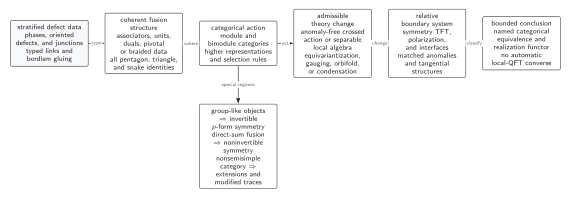
Stratified source–target data make defect composition meaningful. Associators, units, duals, and pivotal or braided structure make it coherent. A module category then defines an action and selection rules. Gauging or condensation additionally needs crossed coherence or a separable local algebra and anomaly cancellation; symmetry-TFT and interface statements need compatible relative boundary data. The final conclusion is only the named equivalence or realization result. The diagram is schematic and not to scale. Structured description and source data (JSON)
The chapter sequence
Section titled “The chapter sequence”The pages are ordered from stratified geometry through finite categorical structures and actions to realization and classification limits.
- Defects on Stratified Spacetimes and Higher-Categorical Composition types phases, defects, and junctions by links of strata and derives composition from gluing.
- Fusion Categories, Module Categories, and Bimodule Defects adds finite semisimplicity, rigidity, module actions, relative tensor products, and Morita equivalence.
- Invertible p-Form Symmetries and Topological Defects identifies group-like codimension- defects and computes their linking action.
- Noninvertible Symmetries, Fusion, and Junction Data adds junction spaces and -symbols, using the Ising duality line as the coherence test.
- Categorical Symmetries, Higher Representations, and Charges treats actions as module categories and derives categorical selection rules.
- Gauging, Equivariantization, Orbifolds, and Condensation separates four constructions and states their anomaly, separability, and locality hypotheses.
- Symmetry TFTs, Anomaly Inflow, and Boundary Realizations packages topological symmetry and anomaly data in a relative bulk–boundary theory without claiming boundary dynamics.
- Boundary Conditions and Interfaces in Functorial Field Theory represents walls by bimodule categories, composes them, and tests adjoints and invertibility.
- Generalized-Symmetry Sectors, Selection Rules, and Reconstruction reconstructs allowed transitions from an action and identifies the kernel of the inverse problem.
- Semisimple, Nonsemisimple, and Unitarity Boundaries shows which decomposition and dimension formulas fail in finite nonsemisimple categories.
- Categorical Classification: Equivalence and Completeness Limits distinguishes fusion-ring, monoidal, Morita, center, extended-TQFT, and physical-QFT equivalence.
The first four pages form the structural core. The next four explain actions, changes of theory, and relative boundaries. The last three test sector completeness, hypothesis changes, and the precise strength of a classification.
Hypotheses and licensed conclusions
Section titled “Hypotheses and licensed conclusions”| Object and domain | Required hypotheses | Licensed result | Excluded converse or upgrade | Adversarial check |
|---|---|---|---|---|
| Defects on a stratified two-dimensional spacetime | Compatible phase labels on every link; typed line and point defects; gluing and isotopy data | A bicategory of phases, defects, and junctions with defined horizontal and vertical composition | A drawing of incident strata does not supply a junction or a field-theory amplitude | Mismatch the target phase of one wall with the source phase of the next |
| Fusion and module categories | Finite semisimplicity, rigidity, coherent associators and units; compatible module associator | Finite defect fusion, duals, boundary actions, bimodule composition, and a stated Morita relation | Fusion coefficients alone determine neither the associator nor a QFT realization | Keep the fusion table but violate a pentagon or snake identity |
| Invertible higher-form defect action | Topological codimension-$(p+1)$ support, group-like fusion, inverse, charge lattice, and global background data | A $p$-form symmetry action measured by oriented linking characters | A deformable noninvertible defect is not a group element | Fuse the candidate with every label and fail to obtain the transparent defect |
| Noninvertible categorical action | Junction spaces, all $F$-symbols, pentagon and triangle equations, duals, and a coherent module category | Allowed sector transitions and composition rules for topological defect endpoints | Eigenvalues of one fusion matrix are not complete generalized charges | Compare inequivalent module associators with identical action matrices |
| Gauging, equivariantization, or condensation | Anomaly-free crossed action; or a connected separable commutative algebra and local modules; retained global data | The corresponding equivariant, gauged, orbifold, or condensed category in the named finite setting | These constructions are not interchangeable and do not automatically preserve modularity | Condense a nonseparable or nonlocal algebra, or omit the crossed-sector obstruction |
| Symmetry TFT boundary or functorial interface | Specified bulk theory, polarization, tangential structure, anomaly matching, balanced actions, and adjunction data | Topological symmetry and inflow data, gauging interfaces, and coherent wall composition | The bulk topological theory does not determine boundary Hamiltonians or scaling dimensions | Hold the symmetry TFT fixed while changing boundary dynamics |
| Categorical classification or reconstruction | Named source class, target category, equivalence, realization functor, completeness assumptions, and semisimplicity or trace replacement | Exactly the stated fusion-ring, Morita, center, extended-TQFT, sector, or realization conclusion | Matching centers or Grothendieck rings does not imply physical QFT equivalence | Change associator, symmetry enrichment, local observables, or extension data while preserving the chosen invariant |
Structured table data (JSON) preserves the caption, scoped headers, rows, and reading order.
The table separates data internal to a category from a theorem that realizes the category in QFT. The same abstract object may support several actions or boundary theories. Conversely, a physical realization can impose positivity, locality, or analytic sewing conditions invisible to the finite algebraic input.
The failure map starts at the first missing condition. Its lower row gives a concrete wrong inference and the strongest conclusion that remains valid.
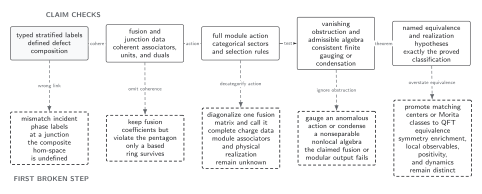
Each dashed branch removes a named hypothesis. A source–target mismatch leaves defects uncomposed; a failed pentagon leaves only a based fusion ring; a single matrix spectrum leaves only decategorified multiplicities; anomaly, nonseparability, or failed locality blocks the proposed gauging or condensation; and matching a center or Morita class leaves local dynamics and symmetry enrichment undetermined. The diagram is schematic and not to scale. Structured description and source data (JSON)
Synthesis and stopping boundary
Section titled “Synthesis and stopping boundary”The chapter’s central logic is directional. A stratification provides the geometry on which defects may be placed. Typed links make their composition meaningful. Higher coherence turns fusion and junction data into a category. A module category turns that category into an action. A crossed extension or condensable algebra can change the theory only after its obstruction tests pass. A symmetry TFT or functorial interface records topological boundary information. Classification is then taken under one explicitly chosen equivalence.
Three near-neighbors must remain distinct. Dualizability supplies an orientation reverse and evaluation maps; invertibility requires fusion with the reverse to be transparent. Morita equivalence identifies bulk centers but need not preserve a chosen boundary or enrichment. A topological symmetry sector is part of a QFT, not a substitute for its local net, correlators, or Hamiltonian.
Nonsemisimple examples make the final warning unavoidable. Grothendieck classes can agree while extensions and nilpotent maps differ. Modified traces can restore nonzero invariants on projectives, but they do not restore semisimplicity or positivity. Every use of a quantum dimension, diagonal fusion basis, or modular formula must therefore name the precise hypothesis class.
Review the chapter
Section titled “Review the chapter”Before accepting a categorical-symmetry claim, answer the following.
- What labels each spacetime stratum, and are all source–target and link conditions satisfied?
- Which associators, unit maps, duals, pivotal maps, braidings, and junction bases are part of the data?
- Have every pentagon, triangle, and snake identity relevant to the claim been checked?
- What category carries the action, and what module coherence is retained beyond its fusion matrices?
- Is the symmetry invertible, higher-form, higher-group, or genuinely noninvertible?
- Does gauging require a crossed extension, and does condensation require a separable local algebra?
- Which anomaly class or failed locality condition could obstruct the construction?
- What does the symmetry TFT determine, and which boundary dynamics does it forget?
- Is a wall transparent, invertible, dualizable, or merely composable?
- Does the argument use semisimplicity, a positive dagger, or a modified trace?
- Which equivalence relation is claimed, and what realization theorem licenses any physical upgrade?
Synthesis exercise
Section titled “Synthesis exercise”A proposed two-dimensional defect system has the Ising fusion coefficients and positive dimensions . Its author diagonalizes , calls the eigenvalues complete charges, and then gauges without specifying -symbols or an algebra object. Which conclusions survive?
Solution
The fusion coefficients define a based ring and the positive vector solves its dimension equations. Without -symbols satisfying the pentagon, no fusion category has been established. Even after choosing a category, the spectrum of does not determine a module action or its junction intertwiners. Finally, a noninvertible object is not gauged by summing over a group; one needs an explicit anomaly-free categorical construction or a suitable separable algebra object. Thus only the decategorified fusion and dimension data survive.
References
Section titled “References”- Carqueville, Nils, and Ingo Runkel. “Orbifold Completion of Defect Bicategories.” Quantum Topology 7 (2016): 203–279. DOI; Open PDF.
- Etingof, Pavel, Dmitri Nikshych, and Victor Ostrik. “Fusion Categories and Homotopy Theory.” Quantum Topology 1 (2010): 209–273. DOI; Open PDF.
- Freed, Daniel S., and Constantin Teleman. “Relative Quantum Field Theory.” Communications in Mathematical Physics 326 (2014): 459–476. DOI; Open PDF.
- Gaiotto, Davide, Anton Kapustin, Nathan Seiberg, and Brian Willett. “Generalized Global Symmetries.” Journal of High Energy Physics 2015, no. 2 (2015): 172. DOI; Open PDF.
- Ostrik, Victor. “Module Categories, Weak Hopf Algebras and Modular Invariants.” Transformation Groups 8 (2003): 177–206. DOI; Open PDF.
Original QFT.org content:CC BY 4.0, unless an item supplies different terms. Third-party material retains its own terms.