

Euclidean Fields, Reflection Positivity, and OS Reconstruction
Euclidean reconstruction is a theorem chain: a compatible Euclidean hierarchy, reflection positivity, quotient completion, uniform growth, and controlled analytic continuation together produce a local positive-energy Lorentzian theory. Each hypothesis has a distinct job. This chapter makes those jobs—and the points at which the chain can fail—explicit.
Helpful background. Euclidean correlators and Schwinger functions supplies the physical correlator language. Reflection positivity and OS reconstruction gives the first-pass bridge to Lorentzian theory. Reflection positivity and transfer-matrix criteria gives the regulated lattice analogue.
Enter this chapter
Section titled “Enter this chapter”The primary input is a full family of Euclidean Schwinger distributions, or a Euclidean random-field law from which such distributions are obtained. The primary output of the corrected reconstruction theorem is a Wightman hierarchy and, up to unitary equivalence, its cyclic vacuum representation. Neither a formal path-integral symbol nor a single propagator supplies that complete input.
The Euclidean metric is positive definite and a Euclidean measure, when it exists, uses weight . Reconstructed Lorentzian formulas use the site’s metric convention. Analytic continuation is always stated through complex domains and distributional boundary values; the notation is only a coordinate mnemonic after the domain and ordering have been fixed.
The dependency map separates the positive-Hilbert-space construction from the later analytic continuation. Inspect in particular where uniform hierarchy growth enters: it is not a consequence of checking each fixed in isolation.
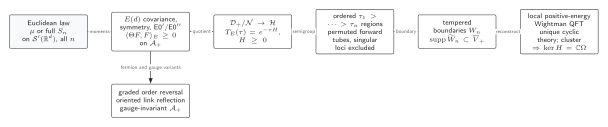
Reflection positivity constructs the quotient Hilbert space and the positive Euclidean-time semigroup; uniform E0′ or E0″ control and ordered-tube continuation are separate inputs that license tempered Lorentzian boundary values. Clustering sharpens the vacuum conclusion but does not by itself create an isolated particle pole. The fermionic and gauge branch changes the reflection operation and positive-time algebra, not the logical direction. The diagram is schematic and not to scale. Structured description and source data (JSON)
The reconstruction sequence
Section titled “The reconstruction sequence”Read the chapter in the following order.
- Euclidean random fields and Schwinger hierarchies passes from a law on generalized functions to moments and cumulants, while separating measure existence from the moment problem.
- Osterwalder–Schrader axioms and reflection positivity defines the positive-time reflected form and places it beside covariance, symmetry, regularity, and clustering.
- Reflection positivity and Hilbert-space reconstruction quotients null vectors, completes the physical space, and obtains with .
- Osterwalder–Schrader reconstruction states the corrected theorem, including the hierarchy-wide growth condition missing from an oversimplified E0–E4 slogan.
- Euclidean growth, regularity, and temperedness distinguishes fixed-order distributions, uniform hierarchy estimates, and tempered Lorentzian boundary values.
- Analytic continuation between Euclidean and Lorentzian domains tracks ordered tubes, singular loci, paths, and Wightman, opposite-order, and Feynman boundaries.
- Clustering, vacuum uniqueness, and mass-gap implications relates connected decay to the vacuum sector and Hamiltonian spectrum without turning a gap into a particle pole.
- Fermionic, gauge, and lattice reflection positivity replaces the scalar reflection by graded order reversal, oriented-link reflection, and a gauge-invariant positive algebra.
- OS–Wightman comparison directions and failure modes records the arrows, uniqueness notions, nonconverses, and the difference between two-point and all-order statements.
The sequence is cumulative but not circular. One may form the reflected quotient before proving the full analytic theorem. One may also have a Lorentzian Wightman theory whose Euclidean restrictions are obtained by spectral analyticity without first constructing a Euclidean probability measure.
What each hypothesis licenses
Section titled “What each hypothesis licenses”| Euclidean object and domain | OS hypotheses | Reconstruction or result | Excluded converse | Adversarial check |
|---|---|---|---|---|
| Random distribution or full Schwinger hierarchy on Schwartz test functions | Consistent cylinder laws or a continuous positive-definite characteristic functional; finite, jointly continuous moments when the hierarchy is used | A Euclidean probability law determines compatible moments, while Minlos extension constructs a law from a valid characteristic functional | A symmetric Euclidean-covariant moment list need not exist as, or uniquely determine, a probability law | Test every finite moment matrix; a negative variance or an indeterminate moment problem stops the claimed inference |
| Positive-time algebra with a fixed reflection across the time-zero plane | Euclidean covariance and symmetry, suitable regularity, and nonnegativity of the reflected form for every positive-time polynomial | Quotienting its null space and completing gives the physical Hilbert space and a contraction semigroup with nonnegative generator | Ordinary covariance positivity does not imply reflection positivity, locality, or a relativistic field theory | Use a positive rational Fourier multiplier with one negative partial-fraction residue and find a negative reflected direction |
| Complete hierarchy at all orders on Euclidean configuration space | Corrected E0′ or E0″ growth together with Euclidean invariance, reflection positivity, permutation symmetry, and clustering | The corrected reconstruction theorem yields a tempered local positive-energy Wightman hierarchy and its cyclic theory, unique up to unitary equivalence | A valid two-point kernel or fixed-order temperedness does not establish a complete reconstruction | Keep the free two-point function but set the four-point function to zero; polynomial positivity then becomes negative |
| Ordered imaginary-time regions and their permuted complex tubes | Spectral support, Euclidean symmetry, uniform growth, an unobstructed path inside the named tube, and a specified boundary approach | Analytic functions acquire Wightman, opposite-order, or time-ordered distributional boundary values according to the approach domain | The substitution t = −iτ does not choose an ordering, cross a singularity, or prove numerical stability | Move an energy contour through a pinch and verify that residues or a cut obstruct the proposed continuation |
| Clustered Euclidean state and connected semigroup correlations | Qualitative clustering on a dense observable set; for a gap, a uniform exponential rate in a sector that detects the full vacuum complement | Qualitative clustering selects a unique vacuum under the stated density assumptions; exponential decay locates a positive spectral threshold | A Hamiltonian gap need not contain an isolated one-particle mass shell, and one channel need not see every low-energy state | Choose a continuous positive spectral measure supported above a positive threshold; decay is exponential but there is no particle pole |
| Fermionic or gauge lattice algebra on one side of a site- or link-centered reflection | Antilinear graded order reversal, orientation reversal of crossing links, a gauge-invariant positive algebra, and a nonnegative crossing-action expansion | The null quotient gives the positive physical sector and, for the stated Wilson construction, a positive transfer operator at fixed lattice spacing | Gauge-fixed propagator positivity and continuum existence do not follow; an improved action is not automatically reflection positive | Omit fermionic order reversal or replace a reflected link adjoint by the original orientation and watch the square acquire the wrong sign |
Structured table data (JSON) preserves the same caption, headers, rows, and reading order.
This table is directional. For example, a Hamiltonian gap gives exponential Euclidean-time decay by the spectral theorem. The converse needs positive spectral measures and enough observables to see the whole orthogonal complement of the vacuum. Likewise, an isolated particle pole implies a spectral contribution with definite mass, while exponential decay alone can come from a continuum threshold.
The failure map tests four tempting shortcuts against concrete counterexamples. Once a lower dashed branch is reached, later arrows in the upper row are unavailable.
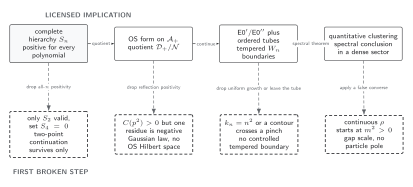
A valid covariance cannot repair an incompatible ; ordinary positivity of a rational covariance cannot repair a negative reflected residue; fixed-order temperedness cannot replace uniform OS growth; and a continuous spectral measure above a threshold gives decay without a one-particle pole. Dashed arrows encode the first broken hypothesis, not an alternative reconstruction. The diagram is schematic and not to scale. Structured description and source data (JSON)
The corrected theorem boundary
Section titled “The corrected theorem boundary”The 1973 OS paper introduced the Euclidean axioms and the reflected construction, but its original Euclidean-to-Wightman sufficiency proof had a gap. The 1975 paper explicitly corrected the result by adding stronger regularity alternatives, including the practical E0′ linear-growth condition Osterwalder and Schrader 1975, §§III–IV, pp. 285–289.
The chapter therefore uses the following disciplined conclusion:
with uniqueness understood at the hierarchy level and, after Wightman reconstruction, up to vacuum-preserving unitary equivalence. Removing clustering changes the vacuum conclusion. Removing the uniform growth condition leaves this particular reconstruction theorem unavailable. Removing reflection positivity removes the positive Hilbert-space metric.
Review the chapter
Section titled “Review the chapter”For any proposed Euclidean construction, answer these questions in order.
- What is the exact input: measure, characteristic functional, hierarchy, cutoff family, or numerical data?
- On which test space are all distributions defined, and which estimates are uniform in order, volume, and cutoff?
- What reflection and positive-time algebra are used, and is the reflected form nonnegative at every order?
- Has the null space been quotiented, and do translations preserve equivalence classes?
- Which analytic domain connects the ordered Euclidean region to the desired Lorentzian boundary value?
- Is clustering qualitative or exponential, and which observable sectors does it cover?
- For fermion or gauge fields, where do grading, orientation, and gauge invariance enter?
- Is the final claim a two-point relation, a full reconstructed theory, a continuum limit, a spectral gap, or a particle statement?
Synthesis exercise
Section titled “Synthesis exercise”A rotationally invariant Euclidean covariance is positive as a Fourier multiplier and decays exponentially, but its partial-fraction decomposition contains a negative residue. Which conclusions survive?
Solution
The covariance defines an ordinary positive Gaussian law if it is a continuous nonnegative quadratic form. Euclidean covariance and exponential decay can therefore survive. The negative spectral residue violates reflection positivity for the rational free covariance, so the reflected form has a negative direction. Consequently the positive physical Hilbert-space quotient, OS reconstruction, and any mass-gap conclusion about a reconstructed positive-metric theory do not follow. Ordinary covariance positivity and decay cannot replace reflection positivity.
References
Section titled “References”- Osterwalder, Konrad, and Robert Schrader. “Axioms for Euclidean Green’s Functions.” Communications in Mathematical Physics 31 (1973): 83–112. doi:10.1007/BF01645738. Open PDF.
- Osterwalder, Konrad, and Robert Schrader. “Axioms for Euclidean Green’s Functions II.” Communications in Mathematical Physics 42 (1975): 281–305. doi:10.1007/BF01608978. Open PDF.
Original QFT.org content:CC BY 4.0, unless an item supplies different terms. Third-party material retains its own terms.