

Vertex Operator Algebras and Direction-Specific Net Bridges
A vertex operator algebra and a conformal net encode chiral locality in different mathematical objects. A VOA begins with a graded state space and formal state–field correspondence; a net begins with interval-indexed von Neumann algebras on a positive-energy Hilbert space. Passing from the first to the second requires unitarity, polynomial energy bounds, closable smeared fields, and strong locality. Returning from a net to a VOA requires enough pointlike finite-energy fields and analytic control. Neither direction is automatic, and the strongest extension comparison theorems impose further categorical hypotheses.
Helpful background. Free Bosons and Vertex Operators supplies the Heisenberg model used to test every stage. Affine Current Algebras and WZW Models supplies non-Abelian positive-energy examples. Chiral Blocks, Sewing, and Modular Invariance supplies the analytic products, iterates, and modular transformations that tensor-category theorems must control.
From formal fields to interval algebras
Section titled “From formal fields to interval algebras”The formal starting point is a graded vector space with vacuum , conformal vector , and state–field map
Lower truncation, vacuum and creation identities, translation covariance, grading, and the Jacobi or equivalent locality identity define the VOA. These are coefficientwise formal identities. They do not supply convergence of matrix coefficients, a positive inner product, closed operators, or bounded local algebras.
The next layer is representation theory. Modules and intertwining operators become a tensor category only when products and iterates converge in complementary domains and analytically continue to the same multivalued functions. Associativity and braiding are extracted from that continuation and must satisfy coherence. Finiteness conditions then separate sharply: -cofiniteness controls a finite Poisson quotient and spanning sets; rationality supplies semisimplicity of admissible modules; regularity controls all weak modules. Zhu’s algebra records top levels, while modular transformation of trace functions needs its own convergence and finiteness hypotheses.
The operator-algebraic bridge begins only after is unitary. A positive invariant Hermitian form completes to a Hilbert space. Polynomial estimates of the form
turn smooth Fourier decay into closable smeared fields . Strong locality is the additional assertion that closures affiliated with disjoint intervals commute strongly, so that their spectral data generate commuting von Neumann algebras. Under these hypotheses the assignment
is an irreducible diffeomorphism-covariant conformal net. The construction and recovery theorem are proved in Carpi et al. 2018, Theorems 6.8 and 9.2, PDF pp. 52–53 and 67–68. Formal locality remains a necessary algebraic input, not a substitute for the closure-level theorem.
The dependency map displays this one-way chain. The lower branch is not a defect in logarithmic VOA theory: it records that -cofinite nonsemisimple theories require generalized modules, logarithmic intertwining operators, and pseudotraces rather than the rational semisimple conclusion.
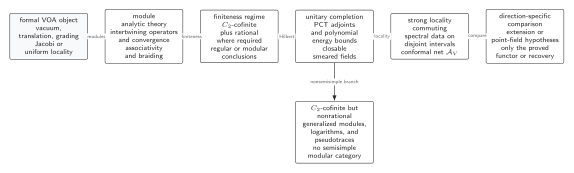
The main row separates formal algebra, analytic tensor-category structure, finiteness, Hilbert-space completion, strong locality, and net construction. The last comparison arrow is direction-specific: extension and recovery results require hypotheses beyond existence of either object. The logarithmic branch preserves meaningful -finite structure while rejecting semisimplicity. The diagram is schematic and not to scale. Structured description and source data (JSON)
Hypotheses and licensed conclusions
Section titled “Hypotheses and licensed conclusions”The table keeps algebraic, analytic, operator-algebraic, and comparison statements in their proper domains.
| Object and domain | Required hypotheses | Licensed conclusion | Excluded converse or upgrade | Adversarial check |
|---|---|---|---|---|
| Graded state–field correspondence | Vacuum and creation, translation, lower truncation, conformal grading, Jacobi or uniform formal locality | A vertex operator algebra with all mode identities | A finite mode table or several OPE coefficients do not establish the Jacobi identity | Alter a high mode while preserving every tested low mode and look for a missing locality exponent |
| Modules and intertwining operators | Closure under tensor products, convergence and extension of products and iterates, parallel transport, grading restrictions | Associativity, braiding, and a coherent tensor category in the stated module class | Fusion multiplicities alone do not determine associators, braiding, rigidity, or positivity | Supply an associative based ring but no analytic continuation of insertion points |
| Finiteness and semisimplicity | Declared CFT-type, $C_2$-cofiniteness, rationality, self-contragredience, and any rigidity hypotheses | Regularity or a finite modular tensor category at exactly the theorem's strength | $C_2$-cofiniteness alone does not imply rationality or regularity | Use a triplet VOA with logarithmic indecomposable modules |
| Zhu algebra and genus-one traces | Admissible top levels; rationality and $C_2$ control for ordinary modular traces, or generalized pseudotrace hypotheses | Simple top-level classification and finite-dimensional modular covariance of the appropriate trace space | A finite Zhu algebra need not be semisimple, and simple characters need not close in a logarithmic theory | Retain a nilpotent $L_0$ part and compare characters with pseudotraces |
| Unitary VOA on its Hilbert completion | Positive invariant form, PCT adjoints, polynomial mode bounds, common invariant smooth core | Closable smeared vertex operators with controlled adjoints and energy domains | Formal locality or a vanishing core commutator does not imply strong commutativity of closures | Choose symmetric operators commuting on one dense core but with noncommuting spectral resolutions |
| Strongly local simple unitary VOA | Energy bounds and strong locality for every interval, plus the vacuum and conformal-vector hypotheses | An irreducible diffeomorphism-covariant conformal net and recovery within the theorem's image | Not every unitary VOA is known to be strongly local, and the theorem is not a universal net–VOA equivalence | Remove energy bounds and show that the smeared series lacks a controlled closure |
| Extensions, orbifolds, cosets, and converse maps | Compatible algebra objects or subobjects, positivity and locality, integrability, finite-index or Condition-I/II hypotheses, matched equivalence notions | The specified extension comparison, sector functor, or partial net-to-VOA reconstruction | Matching modular data, characters, or sector branching do not establish equality of extensions or essential surjectivity | Keep the branching matrix but remove the multiplication, energy bounds, or point-field generation theorem |
Structured table data (JSON) preserves the caption, scoped headers, rows, and reading order.
The chapter sequence
Section titled “The chapter sequence”Read the pages in order; the analytic bridge uses the algebraic distinctions established first.
- Vertex Operator Algebras: Axioms, Grading, and Locality constructs the formal object and tests the rank-one Heisenberg current.
- Modules, Intertwining Operators, and Tensor Categories separates fusion multiplicities from analytic associativity and braiding.
- C₂-Cofiniteness, Rationality, and Regularity proves the correct finiteness implications and uses the triplet algebra as a nonconverse.
- Zhu Algebras, Characters, and Modular Invariance connects top levels and trace functions without conflating Zhu and quotients.
- VOA Extensions, Orbifolds, Cosets, and Commutants constructs algebraic extensions and includes twisted-sector and commutant checks.
- Unitary VOAs, Energy Bounds, and Strong Locality introduces the Hilbert completion, adjoints, and closure-level locality target.
- Energy Bounds, Strong Locality, and Smeared Vertex Operators derives concrete Virasoro estimates and the strong-commutativity upgrade.
- From VOAs to Conformal Nets states the construction theorem and recovers the U(1) current net.
- From Nets to VOAs: Partial Reconstructions and Limits compares Fredenhagen–Jörß and annulus-based recovery with their exact reach.
- Direction-Specific VOA–Net Extension Theorems and Open Converses matches selected extension constructions while preserving unresolved converses.
Where a bridge first fails
Section titled “Where a bridge first fails”The failure map should be read vertically. Each dashed arrow removes one concrete hypothesis and identifies the first lost conclusion; it does not erase weaker structures to its left.
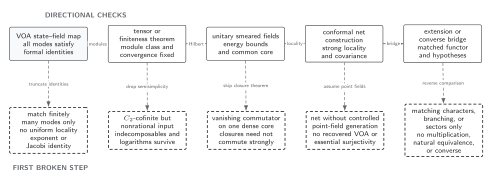
The first failure can be algebraic, categorical, analytic, operator-algebraic, or comparative. A triplet VOA remains a valid and highly structured nonsemisimple theory; it simply does not satisfy the rational conclusion. A unitary formal VOA can remain valid when strong locality is unproved. Matching characters or sector categories remain invariants when reconstruction or equivalence is unavailable. The diagram is schematic and not to scale. Structured description and source data (JSON)
Review the bridge
Section titled “Review the bridge”Before accepting a VOA–net statement, ask the following.
- Which module class is quantified: weak, admissible, ordinary, or generalized?
- Which convergence theorem constructs tensor products and their coherence maps?
- Is the finiteness input -cofiniteness, rationality, regularity, or a combination?
- Is the inner product positive and invariant, and which PCT operation gives adjoints?
- Which polynomial mode bounds define on a common core?
- Is locality formal, weak on a domain, or strong for closed operators and their spectral projections?
- Does the constructed net recover the VOA, its module category, or only selected fields?
- For an extension, which multiplication, positivity, locality, integrability, and finite-index data are matched?
- Is the claimed reverse direction actually proved, and at what equivalence strength?
The Heisenberg VOA passes the full construction chain: its oscillator modes give the formal algebra, Fock positivity supplies the Hilbert completion, explicit polynomial bounds permit smearing, Weyl relations prove strong locality, and the resulting net is the U(1) current net. The triplet algebras deliberately follow a different branch: -cofiniteness survives, but semisimple rational and positive-net conclusions do not follow.
References
Section titled “References”- Carpi, Sebastiano, Yasuyuki Kawahigashi, Roberto Longo, and Mihály Weiner. “From Vertex Operator Algebras to Conformal Nets and Back.” Communications in Mathematical Physics 364 (2018): 101–145. DOI; Open PDF.
- Frenkel, Igor B., Yi-Zhi Huang, and James Lepowsky. On Axiomatic Approaches to Vertex Operator Algebras and Modules. Memoirs of the American Mathematical Society 104, no. 494 (1993). DOI.
- Fredenhagen, Klaus, and Martin Jörß. “Conformal Haag–Kastler Nets, Pointlike Localized Fields and the Existence of Operator Product Expansions.” Communications in Mathematical Physics 176 (1996): 541–554. DOI.
- Huang, Yi-Zhi. “Vertex Operator Algebras and the Verlinde Conjecture.” Communications in Contemporary Mathematics 10 (2008): 103–154. DOI; Open PDF.
- Zhu, Yongchang. “Modular Invariance of Characters of Vertex Operator Algebras.” Journal of the American Mathematical Society 9 (1996): 237–302. DOI.
Original QFT.org content:CC BY 4.0, unless an item supplies different terms. Third-party material retains its own terms.