

Superselection Sectors, Statistics, and Gauge Reconstruction
Superselection theory begins by choosing what can be measured outside a proposed charge region. Double-cone localization leads to DHR endomorphisms and, for finite statistics in sufficiently high dimension, a symmetric rigid C*-tensor category and compact-gauge reconstruction. Spacelike cones retain stringlike massive charges and braid statistics; future light cones provide a coarser infrared charge notion; kinks interpolate different asymptotic vacua. No one criterion contains all of these cases, and no abstract fusion table by itself reconstructs a local quantum field theory.
Helpful background. Global Form, Matter Representations, and the Faithful Gauge Group distinguishes the reconstructed faithful group from a microscopic gauge presentation; Superselection Rules and Accessible Entanglement gives the operational meaning of charge blocks; Tunneling, Superselection, and the Infinite-Volume Limit explains how inequivalent vacuum phases arise.
Enter this chapter
Section titled “Enter this chapter”Start with the observable net , a vacuum representation , an admissible representation class, and a family of localization regions. A selection statement must specify all four. The central alternatives are
with a double cone and a spacelike cone. Long-range theories may require restriction to for a future light cone ; kink representations instead compare different vacua on opposite wedges. After selection, ask separately whether representatives are transportable, whether they act as endomorphisms of the quasilocal algebra, whether conjugates and finite dimensions exist, which exchange topology applies, and whether a reconstruction theorem’s category is complete.
The dependency diagram makes those logical branches explicit. Follow the solid arrows only after checking their labels; the cone, infrared, and kink branches are alternatives to compact DHR localization, not later stages of the same theorem.
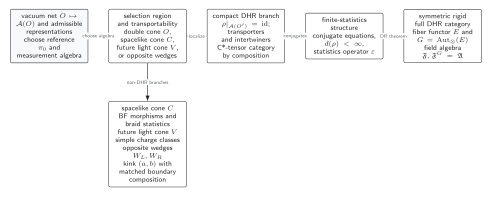
Selection region and transportability determine the categorical object. Finite statistics gives conjugates and dimensions, while symmetric exchange—not braiding alone—is the additional route to Doplicher–Roberts compact-group reconstruction. The diagram is schematic and not to scale. Structured description and source data (JSON)
A route through the results
Section titled “A route through the results”Read the chapter in the following order; each step either supplies data needed by the next or marks a distinct localization regime.
- Sector Selection, Localization, and Transportability defines vacuum-relative exterior equivalence and tests mobility.
- Superselection Sectors and DHR Reconstruction states the compact-localization theorem chain and its dimensional boundary.
- Endomorphisms, Intertwiners, and Tensor Products constructs the concrete C*-tensor category.
- Conjugates, Statistics Operators, and Statistical Dimension derives dual charge data, exchange, and dimension.
- Doplicher–Roberts Compact-Gauge Reconstruction identifies the hypotheses that recover a compact group and field algebra.
- Braided Sectors, Anyonic Statistics, and Low-Dimensional Nets retains oriented exchange when permutation symmetry fails.
- BF Sectors, Spacelike Cones, and Massive Charges treats massive charges with semi-infinite localization tails.
- Gauss-Law Infrasectors and Asymptotic Charge Classes separates global infrared sectors from future-light-cone charge classes.
- Solitonic, Topological, and Boundary Sectors replaces one-vacuum exterior equivalence by interpolation between asymptotic phases.
- Sector Completeness, Field Algebras, and Classification Limits distinguishes completeness, reconstruction, net classification, and stability under scaling limits.
Hypotheses and licensed conclusions
Section titled “Hypotheses and licensed conclusions”The table is a compact decision aid. “Excluded” does not mean the conclusion is always false; it means the hypotheses in that row do not prove it.
| Object and domain | Essential hypotheses | Licensed conclusion | Excluded converse or adversarial check |
|---|---|---|---|
| DHR representation on a Minkowski vacuum net | Local normality; vacuum equivalence on every double-cone exterior; transportability; Haag duality for endomorphism form | Transportable compactly localized endomorphism, up to unitary intertwiner | An infinite-volume KMS representation differs from the vacuum in arbitrarily remote regions |
| Concrete endomorphism category | Localized endomorphisms; coherent transporters; arrows satisfying the full intertwiner equation; closure under composition | Strict C*-tensor product by endomorphism composition and $S\otimes T=S\rho(T)$ | Fusion labels without transporters or local arrow spaces do not define a category acting on the net |
| Finite-statistics DHR sector | Conjugate equations; positive standard solution; sufficiently high dimension for symmetric exchange | Statistical dimension, canonical left inverse, and permutation statistics | A dimension-one anyon can have nontrivial monodromy, so dimension does not fix statistics |
| Compact-group field reconstruction | Full symmetric rigid C*-tensor category; simple unit; sums, subobjects, conjugates; concrete DHR action | A compact $G$, a complete normal field system, and fixed-point observables | A modular braided category violates symmetry; a compact action alone does not prove sector completeness |
| Cone-localized massive or topological charge | Exterior equivalence for spacelike cones; transportability; cone duality; controlled infinite-string limit | BF tensor category and topology-sensitive braiding | A loop linking the semi-infinite tail prevents shrinking the charge into a double cone |
| Infrared or interpolating representation | Specified restricted algebra and charge-class norm criterion, or specified left/right vacuum limits and positive energy | A relative infrared charge class, or a kink sector labeled by two vacua | Equal total charge does not fix a soft cloud; one vacuum cannot match both ends of a kink |
| Completeness and scale comparison | Quantified admissible class; full concrete sector action; all scaling-limit points or a uniqueness theorem; uniform charge control | Completeness or preservation only for the named class and scale relation | Fusion rules omit associators, braiding, local action, excluded sectors, and charges that emerge or disappear in a limit |
Structured table data (JSON) preserves the caption, scoped headers, rows, and reading order.
Where arguments first fail
Section titled “Where arguments first fail”Four tests resolve most overclaims. Move a distinguishing observable beyond every proposed compact region; preserve winding when transporting cone charges; compare the full tensor and braiding structure before reconstructing a group; and quantify which representations and scaling-limit points a completeness statement covers. The failure diagram pairs each omitted hypothesis with the strongest conclusion that survives.
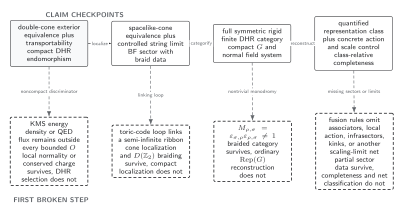
Each dashed branch removes one necessary hypothesis and names a counterexample: thermal or Gauss-law tails, a linked toric-code ribbon, nontrivial braided monodromy, or missing and scale-dependent sectors. The surviving result is narrower than the failed claim. The diagram is schematic and not to scale. Structured description and source data (JSON)
A reusable reconstruction check
Section titled “A reusable reconstruction check”For any proposed charge system, record the net and reference representation; the admissible representations; the localization regions and exact exterior algebra; transporters and their intertwining equations; tensor products and arrow products; conjugate solutions and dimensions; permutation, braid, or boundary composition law; the theorem that licenses a field extension; and the representations intentionally left outside the claim. Then run one hostile example through the same definitions. A thermal phase tests localization, QED tests Gauss-law tails, the toric code tests cone topology, a kink tests two-vacuum asymptotics, and a degenerate scaling limit tests stability across scales.
References
Section titled “References”- Buchholz, Detlev, and Klaus Fredenhagen. “Locality and the Structure of Particle States.” Communications in Mathematical Physics 84 (1982): 1–54. DOI.
- Doplicher, Sergio, Rudolf Haag, and John E. Roberts. “Local Observables and Particle Statistics I.” Communications in Mathematical Physics 23 (1971): 199–230. DOI.
- Doplicher, Sergio, and John E. Roberts. “Why There Is a Field Algebra with a Compact Gauge Group Describing the Superselection Structure in Particle Physics.” Communications in Mathematical Physics 131 (1990): 51–107. DOI.
- Fredenhagen, Klaus, Karl-Henning Rehren, and Bert Schroer. “Superselection Sectors with Braid Group Statistics and Exchange Algebras. I. General Theory.” Communications in Mathematical Physics 125 (1989): 201–226. DOI.
Original QFT.org content:CC BY 4.0, unless an item supplies different terms. Third-party material retains its own terms.