

Derived, Deformation, and Homotopical QFT
Derived and homotopical methods answer a precise question: what mathematical object retains equations, gauge symmetries, stabilizers, obstructions, boundary matching, and coherent composition without prematurely truncating them to sets? The answer is a collection of complexes, homotopy fiber products, shifted pairings, formal deformation problems, and higher morphisms. Each construction has a controlled domain. A quasi-isomorphism can identify formal neighborhoods, and a homotopy transfer can reproduce a tree-level effective theory, without establishing global equivalence, convergence, positivity, or a nonperturbative QFT.
Helpful background. Chain Homotopy, Quasi-Isomorphisms, and Derived Vocabulary supplies the complex-level equivalences. Derived, Higher, and Factorization Frameworks: a Boundary Map distinguishes the frameworks used here. Master Equations and BV Gauge Fixing supplies the field-theoretic master equation.
Enter the derived deformation problem
Section titled “Enter the derived deformation problem”Begin with a derived object, not a slogan. For a classical action, specify the field space, equation section, gauge complex, supports, regularity, and grading. The tangent complex should identify its degree-minus-one stabilizers, degree-zero deformations, and degree-one obstructions; finite-dimensional derived critical loci arise as homotopy intersections and carry a canonical shifted form under the stated smoothness assumptions Pantev–Toën–Vaquié–Vezzosi 2013, Corollary 2.11, pp. 39–40. For a nonlinear formal neighborhood, specify a nilpotent base or a complete filtration so the Maurer–Cartan series converges. A filtered quasi-isomorphism then preserves the Maurer–Cartan infinity-groupoid under the precise stagewise hypotheses Dolgushev–Rogers 2015, Theorem 2.2, p. 8. For a shifted symplectic claim, name the tangent and cotangent complexes and prove that the closed form induces a quasi-isomorphism between them. Boundary flux, zero modes, or an imperfect duality pairing can invalidate that step.
Quantization introduces another filtration, usually by powers of . An order- obstruction is a closed degree-one local cochain; vanishing in local cohomology licenses the next correction, while unrestricted nonlocal exactness does not. Deformation quantization of finite-dimensional Poisson manifolds supplies a formal associative product through formality Kontsevich 2003, Theorem 4.6.2, p. 173, but local QFT functionals require renormalized distributional extensions before the same formula is meaningful. Effective-theory comparison likewise needs a contraction , not only a projection of fields; the tree-level brackets are sums over propagator-decorated trees Arvanitakis–Hohm–Hull–Lekeu 2022, §§2.3 and 5.2, pp. 15–20 and 45–47.
The dependency diagram shows the one-way flow. The side branch separates boundary and defect composition from the perturbative quantization path. Both branches use the same derived complexes, but they require different additional hypotheses.
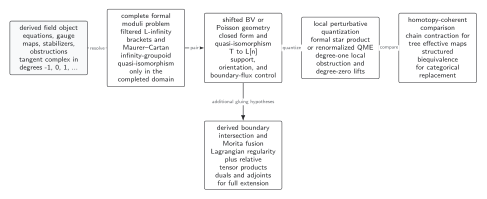
Derived equations and gauge quotients supply the deformation complex. Completion licenses the Maurer–Cartan infinity-groupoid; shifted nondegeneracy licenses brackets and derived intersections; locality controls quantization obstructions; contractions and structured equivalences control effective maps and categorical comparisons. Boundary gluing and Morita fusion form an additional branch rather than a consequence of perturbative quantization. The diagram is schematic and not to scale. Structured description and source data (JSON)
A route through the chapter
Section titled “A route through the chapter”Read the pages in order. The first three construct the derived field object and its geometry, the next two address formal quantization, the following two treat gluing and defects, and the last two state what homotopy transfer and strictification actually preserve.
- Derived Critical Loci and Derived Gauge Quotients retains stabilizers, identities among equations, and obstruction directions that an orbit set loses.
- L∞ Algebras, Formal Moduli, and Field Equations encodes nonlinear equations and gauge homotopies in a complete Maurer–Cartan problem.
- Shifted Symplectic, Poisson, and BV Geometry states nondegeneracy as a quasi-isomorphism and tests it against Maxwell boundary flux.
- Deformation Quantization, Formality, and Star Products derives the Moyal product and marks the coincident-point boundary of the formula.
- Obstruction–Deformation Complexes and Quantization Classes locates anomalies in local degree-one cohomology and classifies admissible lifts.
- Derived Intersections, Boundary Conditions, and Correspondences glues field complexes by homotopy fiber products so harmonic boundary modes survive.
- Higher Morita Categories and Theories as Objects organizes phases, interfaces, and junctions while making dualizability assumptions explicit.
- Homotopical Renormalization and Effective-Theory Maps transfers brackets along a contraction and matches the result to tree-level elimination of a heavy field.
- Strictification, Comparison, and Foundational Limits separates categorical coherence from preservation of analytic and physical structures.
Hypotheses and licensed conclusions
Section titled “Hypotheses and licensed conclusions”The table states the object, domain, essential assumptions, strongest conclusion, and the quickest countertest to an overclaim. An excluded converse is a warning about logical scope, not a claim that every special converse fails.
| Object and domain | Essential hypotheses | Licensed conclusion | Excluded converse or adversarial check |
|---|---|---|---|
| Derived critical locus or gauge quotient | Specified equation section and gauge complex; compatible grading; chosen smooth, algebraic, or elliptic category | A tangent complex whose cohomology records stabilizers, deformations, equations, and obstructions | An ordinary orbit set at a reducible flat connection deletes both stabilizer and obstruction groups |
| L∞ formal moduli problem | Nilpotent base or complete descending filtration; filtration-compatible brackets and morphisms; characteristic-zero comparison where invoked | A Maurer–Cartan infinity-groupoid invariant under the stated filtered quasi-isomorphism | A formal series evaluated at a finite unfiltered displacement need not converge or give a global moduli equivalence |
| Shifted BV or Poisson geometry | Perfect tangent and cotangent complexes; closed form; quasi-isomorphic nondegeneracy map; orientation and support pairing | A shifted bracket on derived functions and, for Lagrangian maps, shifted structure on a homotopy intersection | Unrestricted Maxwell boundary data produce nonzero symplectic flux, so the bulk pairing is not closed |
| Formal star product on observables | Poisson structure and formal parameter; for the direct free-field formula, regular functional derivatives and a defined propagator contraction | An associative formal deformation with first commutator $i\hbar$ times the Poisson bracket | Local nonlinear functionals put singular kernels on diagonals; associativity on regular functionals does not supply the missing extension |
| Perturbative BV quantization | Regulator and removal limit; local deformation complex; lower-order master equation; admissible symmetry and scaling conditions | A degree-one obstruction class; when it vanishes, lifts forming a degree-zero cohomological torsor | A Green-operator primitive can be nonlocal; vanishing at one order does not remove higher obstructions or framing dependence |
| Boundary gluing and Morita composition | Homotopy fiber products; Lagrangian regularity for shifted claims; existing relative tensor products; duals and adjoints for full extension | Zero-mode-preserving gluing and coherent fusion of algebras, bimodules, and intertwiners | An ordinary transverse intersection loses harmonic cokernels; a nondualizable infinite algebra does not define a fully extended theory |
| Effective transfer or categorical strictification | Chain contraction for transfer; convergence or formal filtration as stated; local equivalence and essential surjectivity for biequivalence; named extra structures | Transferred tree-level brackets or a strict two-category preserving the specified homotopy type | A non-chain projection fails at the unary identity; forgetting topology, domains, adjoints, or observables leaves only an algebraic surrogate |
Structured table data (JSON) preserves the caption, scoped headers, rows, and reading order.
Where the claims fail first
Section titled “Where the claims fail first”Most failures in this subject are truncation failures. Passing from a derived quotient to points erases automorphisms. Leaving a complete formal neighborhood makes the comparison series undefined. Ignoring boundary flux invalidates shifted closedness. Applying a finite-dimensional star product to diagonal-supported functional derivatives skips renormalization. A nonlocal primitive does not remove a local anomaly. Finally, a categorical replacement can preserve composition while forgetting the analytic structures that make the objects QFTs.
The failure map pairs each omitted hypothesis with the narrower conclusion that remains. At the categorical end, relative tensor products require the existence and preservation assumptions used to construct the Morita -category Haugseng 2017, Theorem 4.39, article p. 49, while bicategorical strictification establishes biequivalence and nothing stronger Leinster 2004, Theorem 1.5.15, p. 32. The map should be read downward: once a step fails, later conclusions depending on it are unavailable, even if their notation can still be written.
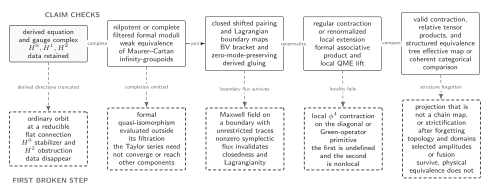
Each dashed branch removes one necessary hypothesis and records exactly what is lost: derived cohomology, convergence of the Maurer–Cartan map, closed shifted geometry, locality of quantization, or preservation of effective and physical structures. Agreement of truncations, selected amplitudes, or fusion rings does not reverse these implications. The diagram is schematic and not to scale. Structured description and source data (JSON)
A reusable derived-QFT check
Section titled “A reusable derived-QFT check”For any proposed result, write the field or observable object and its grading first. State the equation or square-zero operation, the completion or topology, and the cohomology groups that have physical meaning. If a shifted form is used, exhibit the map from tangent to shifted cotangent and test boundary terms. If quantization is claimed, identify the deformation parameter, regulator-removal procedure, local obstruction complex, and equivalence relation on lifts. If fields are integrated out, display , , and and verify the contraction identities. If categories are compared, name objects, all morphism levels, essential surjectivity, and every extra structure to be preserved.
Then perform a countertest at a reducible solution, a nontransverse boundary intersection, a local nonlinear functional, a zero mode in the discarded sector, and an unbounded or topological morphism forgotten by the comparison. These tests fail for different reasons; passing one does not replace the others. The final conclusion should say whether it concerns a tangent complex, a formal moduli problem, a classical shifted structure, a formal perturbative quantization, a tree-level effective theory, or a structured physical equivalence.
References
Section titled “References”- Arvanitakis, Alex S., Olaf Hohm, Chris Hull, and Victor Lekeu. “Homotopy Transfer and Effective Field Theory I: Tree-Level.” Fortschritte der Physik 70 (2022): 2200003. DOI. Open PDF.
- Dolgushev, Vasily A., and Christopher L. Rogers. “A Version of the Goldman–Millson Theorem for Filtered L∞-Algebras.” Journal of Algebra 430 (2015): 260–302. DOI. Open PDF.
- Haugseng, Rune. “The Higher Morita Category of Eₙ-Algebras.” Geometry & Topology 21 (2017): 1631–1730. DOI. Open PDF.
- Kontsevich, Maxim. “Deformation Quantization of Poisson Manifolds.” Letters in Mathematical Physics 66 (2003): 157–216. DOI. Open PDF.
- Leinster, Tom. Higher Operads, Higher Categories. London Mathematical Society Lecture Note Series 298. Cambridge University Press, 2004. DOI. Open PDF.
- Pantev, Tony, Bertrand Toën, Michel Vaquié, and Gabriele Vezzosi. “Shifted Symplectic Structures.” Publications Mathématiques de l’IHÉS 117 (2013): 271–328. DOI. Open PDF.
Original QFT.org content:CC BY 4.0, unless an item supplies different terms. Third-party material retains its own terms.