

Existence, Continuum Limits, and Classification Frontiers
An existence statement in mathematical quantum field theory specifies a model, spacetime dimension, regulator, limiting procedure, observable class, topology of convergence and positivity condition. A construction may select one controlled limiting object; uniqueness across constructions and universality across microscopic trajectories are further claims. A mass gap, confinement, scattering theory, comparison equivalence or classification also requires its own hypotheses. This chapter develops those distinctions for constructive models, four-dimensional scalar and Yang–Mills theories, chiral gauge theories, curved-spacetime interactions, continuum limits and categorical frameworks. The scalar and Yang–Mills source assessments below are current through 2026-09-07; the other dated frontier comparisons retain the 2026-08-10 cutoff.
Helpful background. The non-Abelian spectral formulation distinguishes a vacuum gap from confinement observables. Chiral gauge theories on the lattice supplies the regulator problem, and the rigorous-status guide separates theorem, construction, and evidence.
Enter this chapter
Section titled “Enter this chapter”A useful frontier claim has the form
Here is the model, the spacetime dimension, the regulator, the ordered collection of limits, the observables being controlled, the convergence topology, the positivity or Hilbert-space condition, the proposed reconstruction or comparison map, and the source cutoff. Omitting one entry can change a theorem into an analogy. For example, convergence of a projected lattice gauge field in the topology of distributions does not imply convergence of every gauge-invariant correlation function, while construction of a formal power series does not imply convergence at fixed coupling.
Follow the declared construction downward, keeping its model and topology fixed. The side paths within the stack distinguish problem settings and optional additional theorems; the continuing path can report a bounded existence result without proving those extra claims.
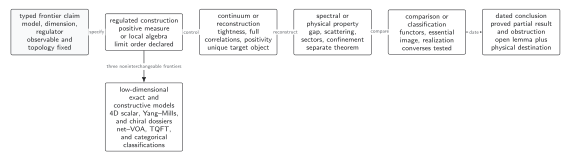
Existence may be established along one controlled trajectory or subsequence with sufficiently complete limiting observables and all required axioms. Uniqueness across trajectories is a separate claim. Additional gaps, scattering or confinement properties and comparison or classification theorems are optional further targets, not consequences of existence and not prerequisites for reporting it. The direct bypass retains that distinction. Schematic, not to scale. Structured description and source data (JSON)
In a continuum construction, a regulated family must satisfy the necessary estimates uniformly in the regulator. Compactness or convergence must then be proved in a named topology for a sufficiently complete set of observables. Euclidean data require full reflection positivity and the other reconstruction hypotheses before they define a relativistic Hilbert-space theory. A mass gap, scattering theory, confinement criterion, comparison equivalence, or classification completeness is an additional conclusion with its own hypotheses. A partial result remains mathematically valuable precisely when its stopping point is stated accurately.
The chapter sequence
Section titled “The chapter sequence”The twelve pages move from claim grammar through model-specific frontiers to a reproducible treatment of open status. Each page can be read independently after its background note, but the order makes the logical dependencies visible.
- Existence, Uniqueness, and Equivalence Claims separates the objects, quantifiers and topologies needed for existence from the additional maps and uniqueness relations asserted by a comparison theorem.
- Two- and Three-Dimensional Constructive Model Atlas compares genuinely constructed scalar, fermionic, gauge, and scaling models without transferring their results across dimensions.
- Four-Dimensional Scalar QFT: Existence and Triviality separates Gaussian scaling theorems for specified ferromagnetic classes from broader claims about every scalar interaction.
- Yang–Mills Existence and the Mass Gap states the four-dimensional pure-gauge construction and spectral targets and explains what finite lattices and nearby models do not prove.
- Rigorous Mass-Gap, Scattering, and Confinement Obligations distinguishes a vacuum spectral gap, isolated particles, scattering-state existence, asymptotic completeness, and confinement observables.
- Chiral Gauge Theories and Standard Model Construction follows anomaly cancellation, regulator locality, gauge invariance, positivity, continuum removal, and the recovery of the intended chiral spectrum.
- Interacting Curved-Spacetime and Gauge Existence Problems distinguishes local formal constructions and abstract local algebras from finite-coupling states and global nonperturbative theories.
- Continuum Limits and Universality Problems identifies the uniform estimates, tuned parameters, convergence modes, and observable comparisons required by a universality theorem.
- Lattice-to-Continuum Constructive Proof Obligations turns lattice existence or data into a sequence of tightness, positivity, reconstruction, and nontriviality obligations.
- Classification and Comparison Problems across QFT Frameworks tests directional maps among Euclidean, Wightman, algebraic, factorization-algebraic, VOA, conformal-net, and functorial descriptions.
- Conformal-Net, VOA, TQFT, and Categorical Classification Frontiers records exactly which objects are classified in fixed analytic or higher-categorical settings and which realization problems remain.
- Dated Open-Problem Evidence Search and Research Handoff gives a source-first method for updating a frontier without promoting evidence, expectation, or a nearby theorem into a proof.
Hypotheses and licensed conclusions
Section titled “Hypotheses and licensed conclusions”The comparison below is deliberately asymmetric. Its fourth column records the strongest conclusion supported by the stated source class; the fifth records the tempting upgrade that has not been supplied.
| Claim target | Data that must remain fixed | Primary theorem or construction class | Licensed conclusion | Excluded upgrade and first open obligation |
|---|---|---|---|---|
| Low-dimensional constructive models | Exact interaction, two or three dimensions, ultraviolet and volume regulators, coupling regime, correlation hierarchy, and reconstruction hypotheses | Model-specific constructive estimates for P(φ)2, weakly coupled φ43, or massive Gross–Neveu2 | Continuum correlations and further properties only for the stated model and regime | No transfer to four dimensions and no automatic scattering completeness; prove each added spectral statement separately |
| Four-dimensional ferromagnetic scalar scaling | Nearest-neighbor Ising-type or lattice-cutoff λφ4 class, critical or near-critical scaling, normalized correlations, and corrected hypotheses | Aizenman–Duminil-Copin marginal-triviality theorem, 2021 with 2024 corrigendum | Gaussianity of subsequential scaling limits in the theorem’s classes | Not a theorem for every scalar action or continuum trajectory; extend the argument or construct a different non-Gaussian target |
| Four-dimensional pure Yang–Mills | Compact simple gauge group, pure gauge fields on Euclidean four-space, axiomatic continuum object, positivity, infinite volume, and vacuum spectrum | Jaffe–Witten problem statement and dated institutional status | A precise open construction-plus-gap problem; nearby lattice and Yang–Mills–Higgs theorems remain partial evidence | No constructed pure continuum theory with the required positive gap; prove regulator removal and the separate spectral lower bound |
| Anomaly-free chiral gauge theory | Gauge group and representations, local regulator, exact gauge symmetry, anomaly cancellation, target chirality, positivity, and continuum limit | Exact lower-dimensional Hamiltonians and partial four-dimensional symmetry-disentangler constructions | A rigorous route for stated lower-dimensional models and specified four-dimensional symmetry data | Anomaly cancellation alone does not construct the Standard Model; supply the missing local Hamiltonian, interface proof, gauging, and continuum recovery |
| Interacting theory on curved spacetime | Globally hyperbolic background, compact interaction support, field content, gauge complex, renormalization prescription, and coefficient ring | Locally covariant perturbative algebras or abstract local C-star relations | Formal local observables, or an abstract local algebra, at the strength of the selected construction | No generic convergent finite-coupling vacuum or physical representation; construct positive states and control global or adiabatic limits |
| Lattice continuum and universality | Bare-parameter trajectory, order of ultraviolet and volume limits, observable family, topology, boundary conditions, and symmetry class | Uniform moment, correlation, renormalization-group, tightness, or comparison estimates | Subsequential or full convergence and universality only in the proved topology and observable sector | Finite-size collapse or matching critical exponents is not full QFT convergence; control complete observables and reconstruction hypotheses along a declared limit. Prove uniqueness or universality separately, and nontriviality if an interacting limit is claimed |
| AQFT–prefactorization comparison | Lorentzian site, additivity, time-slice conditions, target category, weak-equivalence class, and localization | Benini–Carmona–Grant-Stuart–Schenkel one-categorical equivalence | Equivalence under the theorem’s additive and target-category hypotheses | No unrestricted cochain-valued infinity-categorical equivalence; solve the stated infinity-localization problem |
| Conformal-net, VOA, and extended-TQFT classification | Central charge or finiteness class, unitarity and analytic bounds, bordism dimension, tangential structure, extension depth, and target category | Complete subcritical net classifications, conditional VOA–net bridges, and cobordism-hypothesis classifications in fixed targets | Classification or realization for the explicitly named class | No classification of all QFTs and no automatic converse; characterize the essential image and prove realization and completeness |
Structured table data (JSON) preserves the caption, headers, rows, and reading order.
The scalar row concerns the specified ferromagnetic Ising and lattice classes, with block fields normalized by the square root of the block-sum variance and the source’s order of box and block limits Aizenman and Duminil-Copin 2021, arXiv v4, Eqs. (1.10), (1.14), Definition 1.1 and Theorem 1.2, pp. 3–5, PDF. The 2024 corrigendum, p. 479 supplies the corrected auxiliary statement. Gaussianity concerns the selected scaling field and its full hierarchy; it is not a theorem that arbitrary composite observables in a Gaussian theory have Gaussian statistics.
The Yang–Mills row uses the continuum-and-gap target in Jaffe and Witten, official problem statement, § 4, p. 6, PDF, which the Clay Mathematics Institute, checked 7 September 2026 lists as unsolved. Chatterjee’s nearby result concerns lattice Yang–Mills with a fixed-length fundamental Higgs field. After infinite-volume subsequential limits, a joint weak-coupling and lattice-spacing limit sends a stereographically projected, rescaled field to three independent Gaussian Euclidean Proca fields Chatterjee 2026, arXiv v4, Theorem 3.2 and following paragraph, pp. 12–13, PDF. The Higgs sector, projection and Gaussian limit are essential; this is not the interacting pure Yang–Mills construction. The four-dimensional construction assessment states the scaling parameters, separates other partial results and records the unreviewed status of screened recent claims.
The chiral-gauge row is equally specific. Thorngren, Preskill, and Fidkowski construct exact anomaly-free -dimensional Hamiltonians and develop relevant -dimensional symmetry data, but explicitly leave the full four-dimensional Hamiltonian and interface construction unfinished 2026, § 5, pp. 27–28. For framework comparison, Benini, Carmona, Grant-Stuart, and Schenkel prove the one-categorical result under stated hypotheses and retain the infinity-categorical localization step as an open problem 2024, Theorems 3.3–3.4 and Open Problem 5.6. These are advances of different mathematical types, not points on one numerical scale.
Failure boundaries
Section titled “Failure boundaries”Most false frontier claims arise by preserving the scientific nouns while changing a quantifier, topology, implication direction, or model label. The second diagram gives five independent tests of such changes; they do not form a universal chain.
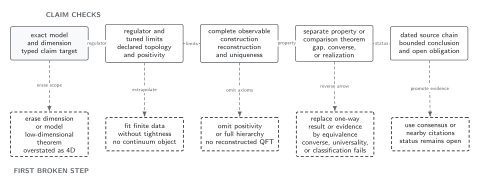
Changing dimension or matter content does not preserve a theorem. Finite-cutoff fits do not prove convergence; partial correlations or positivity do not supply the full reconstruction axioms. A one-way result does not establish equivalence or universality, and a nearby theorem or recent proposal does not establish the specified target. These are independent diagnostics. Schematic, not to scale. Structured description and source data (JSON)
Five checks catch these failures early. First, keep subscripts and matter content: , pure Yang–Mills, and Yang–Mills–Higgs are different models. Second, write limits with their order and topology; followed by is not automatically interchangeable with the reverse order. Third, ask whether all correlations, a generating functional, a net, or only one projected observable is controlled. Fourth, distinguish a construction functor from an equivalence by checking full faithfulness, essential image, and any inverse. Fifth, attach an open-status sentence to a date and primary source, because a later theorem may close only a narrower or neighboring obligation.
A reproducible frontier decision
Section titled “A reproducible frontier decision”For any proposed result, begin with a one-sentence target: “Construct this object for this model and dimension, in this topology, with these positivity and covariance properties.” Then separate four questions.
- Existence: Is there a genuine continuum object, only a regulated object, a formal series, an abstract algebra, or a subsequential scaling field?
- Recovery: Are the intended local observables, states, gauge-invariant sector and Lorentzian theory recovered from the constructed data? If uniqueness is claimed, under which comparison and hypotheses?
- Additional physics: Which gap, particle, scattering, confinement, or phase statement has been proved independently?
- Comparison or classification: What are the source and target categories, what functor is constructed, and which of faithfulness, fullness, essential surjectivity, realization, and converse are established?
The answer should end at the first missing proof obligation. Numerical data, perturbative expansions, exact solvable limits, anomaly checks, and categorical analogies can motivate that obligation or test a consequence. They do not alter its logical status. Conversely, saying “open” should not erase partial theorems: a Gaussian scaling theorem, a lower-dimensional Hamiltonian, a formal local construction, or a classification within a fixed target is a precise result that deserves its full hypotheses and conclusion.
Check your understanding
Section titled “Check your understanding”A paper proves that one smeared lattice gauge potential converges in distribution to a massive Gaussian one-form as the lattice spacing tends to zero in a joint weak-coupling, large-Higgs-length limit. Classify the conclusion and list three additional results needed before it could contribute to a proof of the four-dimensional pure Yang–Mills mass-gap problem.
Solution
The conclusion is a continuum scaling theorem for a projected observable in a gauge–Higgs model and in a specified parameter regime. It is not a construction of pure Yang–Mills, because Higgs matter remains part of the regulated model and the limiting field is Gaussian. At minimum one would need: (1) removal or decoupling of the Higgs sector while controlling a non-Abelian pure-gauge continuum limit; (2) construction of a sufficiently complete gauge-invariant observable algebra or correlation hierarchy with positivity, covariance, locality, and a physical Hilbert-space representation; and (3) a separate infinite-volume spectral theorem proving a positive vacuum gap uniformly after continuum removal. Identifying confinement or asymptotic completeness would require still further observable-specific theorems.
References
Section titled “References”- Aizenman, Michael, and Hugo Duminil-Copin. “Marginal Triviality of the Scaling Limits of Critical 4D Ising and Models.” Annals of Mathematics 194 (2021): 163–235; corrigendum 199 (2024): 479. DOI; Corrigendum.
- Benini, Marco, Victor Carmona, Alastair Grant-Stuart, and Alexander Schenkel. “On the Equivalence of AQFTs and Prefactorization Algebras.” arXiv:2412.07318 (2024). arXiv.
- Chatterjee, Sourav. “A Scaling Limit of Lattice Yang–Mills–Higgs Theory.” Probability and Mathematical Physics 7 (2026): 339–381. DOI; Open PDF, arXiv v4.
- Clay Mathematics Institute. “Yang–Mills and the Mass Gap.” Checked 7 September 2026. Problem page.
- Jaffe, Arthur, and Edward Witten. “Quantum Yang–Mills Theory.” Official Millennium problem statement, undated PDF with its own printed pagination. Open PDF.
- Thorngren, Ryan, John Preskill, and Łukasz Fidkowski. “Chiral Lattice Gauge Theories from Symmetry Disentanglers.” arXiv:2601.04304 (2026). arXiv.
Original QFT.org content:CC BY 4.0, unless an item supplies different terms. Third-party material retains its own terms.