

Curved-Spacetime AQFT, Stress Tensor, and Energy Inequalities
Curved-spacetime QFT supports strong structural theorems, but each one begins with a typed domain. A globally hyperbolic metric and a Green-hyperbolic field equation license the free algebra; a Hadamard condition licenses local composite fields; stress-tensor axioms leave finite curvature freedom; QEIs bind a declared sampler and state class; and semiclassical or boundary conclusions require further dynamical data. No single phrase such as “well behaved quantum field” carries all of those hypotheses.
Helpful background. Renormalized stress-tensor axioms and ambiguities provides the physical observable. Quantum energy inequalities provides the sampled-energy motivation. The semiclassical Einstein equation provides the backreaction problem.
Enter this chapter
Section titled “Enter this chapter”The chapter uses the site-wide metric and curvature conventions. For every result, record seven items before using it: spacetime class, field and coupling, state class, sampled observable and sampling function, curvature scale, renormalization prescription, and perturbative or backreaction order. A timelike-worldline QEI is not a null-geodesic theorem; ANEC is not a finite-segment inequality; Hadamard-state existence is not a preferred-state theorem; and a formal interacting algebra is not a convergent global theory.
The reusable chain begins with causal propagation. The advanced-minus-retarded propagator defines a nondegenerate phase space only after quotienting by the field equation. A Hadamard two-point function then supplies the universal singular structure needed for Wick products and the stress tensor. Local covariance and conservation classify the remaining curvature terms. Positivity of selected two-point distributions yields sampled lower bounds, while a focusing theorem or semiclassical equation adds geometric and dynamical hypotheses of its own.
The dependency diagram makes those one-way steps explicit. Follow the main row from geometry to local observables, then inspect the separate branches: sampled energy, semiclassical response, perturbative interaction, and boundary dynamics are different extensions of the common free-field core.
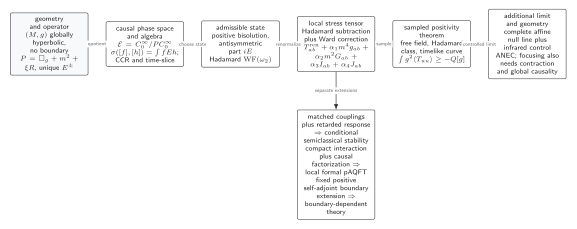
Global hyperbolicity, the field-equation quotient, and causal propagation construct the free algebra and its time-slice map. A Hadamard two-point function licenses local composite observables; local covariance and conservation leave declared curvature counterterms. Timelike QEIs, complete-geodesic ANEC limits, semiclassical response, formal interacting algebras, and boundary extensions then require different additional inputs. Every arrow is one-way, and the diagram is schematic and not to scale. Structured description and source data (JSON)
The chapter sequence
Section titled “The chapter sequence”Read the pages in this order.
- Algebraic free fields on curved spacetimes builds CCR or CAR algebras from causal propagators and proves time-slice for the scalar model.
- Existence, deformation, and gluing of Hadamard states transports an ultrastatic state through Cauchy neighborhoods and propagates its singularities.
- The renormalized stress tensor: conservation and ambiguities separates state dependence, Ward identities, scale dependence, and finite curvature tensors.
- Trace anomalies, local covariance, and scaling distinguishes the fixed Euler and Weyl-squared coefficients from the movable total derivative.
- Absolute and difference quantum energy inequalities derives a timelike free-scalar lower bound and explains its sampler dependence.
- Worldline, spacetime-volume, and null-energy bounds compares causal character and dimension, including the four-dimensional null counterexample.
- Averaged null energy and QNEI geometric hypotheses states the completeness, achronality, state, and limiting conditions behind ANEC results.
- Quantum energy inequalities and singularity-theorem interfaces adds effective-energy, initial-contraction, index-form, and global-causality inputs.
- Semiclassical Einstein equation: existence and stability results distinguishes special existence theorems from causal linear response and order reduction.
- Interacting pAQFT on curved spacetimes constructs local interacting formal algebras by causal factorization without asserting a global adiabatic limit.
- Boundaries, nonglobally hyperbolic spacetimes, and state obstructions makes boundary conditions part of the operator domain and identifies Cauchy-horizon obstructions.
This order is logical rather than merely thematic. The state and stress pages establish the distributions being averaged; the QEI pages then state what their positivity controls; only afterward can a geometric or semiclassical conclusion be assessed.
Hypotheses and licensed conclusions
Section titled “Hypotheses and licensed conclusions”| Object and domain | Required hypotheses | Licensed result | Excluded converse or upgrade | Adversarial check |
|---|---|---|---|---|
| Real free field on a boundaryless spacetime | Global hyperbolicity; formally self-adjoint Green-hyperbolic operator; quotient by the field-equation image | Nondegenerate symplectic space, CCR algebra, causal covariance, and time-slice | The algebra does not select a representation, vacuum, or Hadamard state | Retain $P C_0^\infty$ and exhibit the radical of the proposed symplectic form |
| Quasifree Klein–Gordon state | Globally hyperbolic metric; positive ultrastatic endpoint covariance or equivalent construction; Cauchy transport; propagation of singularities | Existence of Hadamard states on the target spacetime | Existence supplies neither stationarity nor a preferred natural state | Demand invariance on a future metric with no timelike Killing field |
| Renormalized scalar stress tensor in four dimensions | Hadamard state; local covariance; conservation; scaling and regularity; fixed subtraction scale and boundaryless domain | Finite state-dependent expectation plus conserved local curvature freedom; conformal trace anomaly | Conservation alone does not give uniqueness, and the $\Box R$ anomaly coefficient is not universal | Add a finite $R^2$ counterterm and track the shifted trace and gravitational coupling |
| Sampled energy or null contraction | Declared field and dimension; Hadamard state class; exact timelike or null domain; smooth sampler and normalization | Timelike free-field QEI; two-dimensional chiral null bound; theorem-specific volume bounds | No state-independent pointwise bound or general compact null-geodesic QEI in four dimensions | Narrow a timelike sampler, or take an infinite boost while holding the wrong normalization fixed |
| Complete null average or focusing argument | Affine completeness and limiting prescription; theorem-specific achronality, causal tube, field, state, initial contraction, and global causality | ANEC or a focal/incompleteness conclusion only under the named theorem’s full inputs | ANEC does not bound a finite negative pulse or imply a singularity without geometry | Truncate the geodesic, or use a noncontracting Minkowski congruence |
| Semiclassical equation or interacting perturbation | Matched renormalized couplings; conserved Hadamard source; state–geometry data; gauge and causal response; or compact interaction and formal series | Special FLRW existence results, controlled linear stability, or local pAQFT algebras order by order | No generic nonlinear well-posedness, convergent perturbation series, or global interacting vacuum follows | Count Planckian runaway roots outside the approximation, or set the coupling constant globally without an infrared theorem |
| Scalar field with timelike boundary | Fixed positive self-adjoint extension; boundary-preserving maps; boundary-adapted microlocal state condition | Extension-dependent dynamics, propagator, algebra, and ground state in the proved static model | The bulk differential expression does not determine a unique theory, and one Robin model is not generic boundary covariance | Compare two admissible extensions and their different spectra |
Structured table data (JSON) preserves the caption, scoped headers, rows, and reading order.
The table’s most important separation is between ultraviolet admissibility and infrared or dynamical control. A Hadamard condition makes the local stress tensor meaningful, but it does not ensure a complete null integral, an interacting vacuum, or a self-consistent geometry. Those are new conclusions with new hypotheses.
The failure map locates the first inference lost when a condition is removed. Read each lower box as the strongest statement that remains, not as a claim that the entire construction disappears.
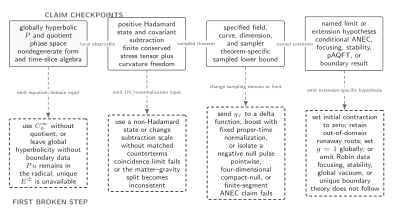
Each dashed branch removes one concrete input. Unquotiented equation-of-motion directions leave a degenerate phase space; a non-Hadamard state blocks local composite fields; a delta sequence defeats pointwise energy bounds; a finite null segment defeats ANEC; missing contraction defeats focusing; uncontrolled higher-derivative roots and a global constant coupling exceed semiclassical and perturbative domains; and omitted Robin data leave boundary dynamics nonunique. The diagram is schematic and not to scale. Structured description and source data (JSON)
Scope boundaries
Section titled “Scope boundaries”The chapter establishes theorem structure and construction mechanisms. Detailed particle-production calculations, detector models, black-hole thermodynamics, and numerical backreaction remain in the curved-spacetime volume. Entropy inequalities and information interpretations remain in the quantum-information volume. A conjectural quantum-focusing statement is not promoted to a theorem here.
Boundary and semiclassical claims are intentionally restricted. The AdS example fixes a positive self-adjoint extension; it does not cover arbitrary time-dependent boundaries. The semiclassical stability example is linearized about Minkowski space with a free field, a causal response kernel, and a declared treatment of high-frequency roots. The pAQFT construction is local and formal. These ceilings are scientific content, not defects to be hidden.
Review the chapter
Section titled “Review the chapter”Before applying a result, answer the following.
- Is the spacetime globally hyperbolic, or what fixed boundary or horizon structure replaces that assumption?
- Which operator, bundle, coupling, and self-adjoint domain define the field?
- What state class is used, and which part of the argument needs the Hadamard condition?
- Which stress component is sampled, on what causal submanifold, with what smooth function and normalization?
- Is the conclusion a difference QEI, absolute QEI, ANEC limit, entropy inequality, or focusing theorem?
- Which finite curvature tensors and renormalization scale enter the stress prescription?
- Does a backreaction claim solve the coupled state–geometry problem or only its linearization?
- Are higher-derivative modes retained, order reduced, or excluded by an explicit frequency cutoff?
- Is an interaction compactly supported and formal, or has a genuine global adiabatic limit been proved?
- Which failure example would invalidate the proposed upgrade?
Synthesis exercise
Section titled “Synthesis exercise”A free scalar state is Hadamard on a four-dimensional globally hyperbolic spacetime, and its energy density obeys a timelike QEI. May one conclude that its stress tensor is unique, that ANEC holds on every complete null geodesic, and that the semiclassical Einstein equation is stable?
Solution
No. Hadamard regularity makes a locally covariant renormalized stress tensor possible but leaves conserved curvature counterterms. A timelike QEI does not become a null-geodesic theorem without a controlled limiting argument and the required geometric and infrared hypotheses. Semiclassical stability additionally needs a self-consistent background solution, a gauge-fixed causal response kernel, matched couplings, a scale domain, and a declared treatment of higher-derivative modes. Each premise licenses only its own stage.
References
Section titled “References”- Brunetti, Romeo, Klaus Fredenhagen, and Rainer Verch. “The Generally Covariant Locality Principle—A New Paradigm for Local Quantum Physics.” Communications in Mathematical Physics 237 (2003): 31–68. DOI; Open PDF.
- Fewster, Christopher J. “Lectures on Quantum Energy Inequalities.” In Quantum Field Theory and Gravity, edited by Felix Finster et al., 97–156. Basel: Birkhäuser, 2012. DOI; Open PDF.
- Hollands, Stefan, and Robert M. Wald. “Local Wick Polynomials and Time Ordered Products of Quantum Fields in Curved Spacetime.” Communications in Mathematical Physics 223 (2001): 289–326. DOI; Open PDF.
Original QFT.org content:CC BY 4.0, unless an item supplies different terms. Third-party material retains its own terms.