

Wightman Fields, Reconstruction, and Structural Theorems
This chapter asks when proposed fields or vacuum correlators define a relativistic quantum field theory and when the standard structural theorems actually apply. It begins with operator-valued tempered distributions on one common invariant domain, passes to spectral and positive vacuum distributions, reconstructs the Hilbert-space theory, and then develops the analytic proofs of CPT, spin–statistics, and Haag-type no-go results. Every theorem is paired with a boundary case so that a missing hypothesis is not mistaken for a paradox.
Helpful background. Quantum fields as operator-valued distributions motivates smearing and common domains; the Källén–Lehmann representation motivates positive spectral measures; and CPT: hypotheses, content, and limits gives the physical structural theorem.
Enter the Wightman framework
Section titled “Enter the Wightman framework”Throughout, Minkowski space uses signature . Fields are smeared with Schwartz test functions unless a smaller test-function space is stated. Fourier-cone signs are always tied to an explicit exponential convention. These choices matter because spectral support, tube direction, and adjoint/order reversal change appearance when conventions change, even though their invariant content does not.
The chapter separates four layers:
- Field data: Hilbert space, vacuum, Poincaré representation, common dense domain, smeared fields, and adjoints.
- Vacuum data: the complete hierarchy of tempered -point distributions, with positivity, covariance, spectrum support, and local exchange identities.
- Reconstruction and analyticity: quotient-completion of the test-function algebra, Fourier–Laplace tubes, complex Lorentz extension, and edge-of-the-wedge continuation.
- Structural consequences: CPT, spin–statistics, Haag-type constraints, and the model classes for which the assumptions have actually been verified.
The dependency map makes the two theorem chains visible. The downward arrow is a second, fully licensed implication from the complete vacuum hierarchy; it is not a weaker or conjectural route.
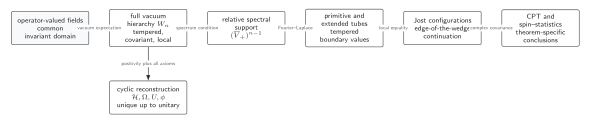
The Wightman axioms have two principal outputs: full positivity of the vacuum hierarchy gives cyclic Hilbert-space reconstruction, whereas positive-energy support and locality drive the analytic route to structural theorems. Every arrow is one-way and retains the hypotheses stated on the relevant page. The diagram is schematic and not to scale. Structured description and source data (JSON)
The Wightman framework does not assume a Lagrangian, canonical commutation relations, perturbation theory, a mass gap, or scattering states. Those may be added or proved in particular models. Euclidean Osterwalder–Schrader reconstruction belongs to the next chapter and is not substituted for the real-time theorem here.
The following table gives a linear, text-equivalent reading of the dependency map and records the first condition that blocks each common overstatement.
| Starting object | Domain and regularity | Essential input | Construction or theorem | Licensed conclusion | What is not implied | Boundary test |
|---|---|---|---|---|---|---|
| Smeared fields | Operator-valued tempered distributions on one common invariant dense domain | Vacuum, Poincaré covariance, positive energy, adjoints, and local or graded-local exchange | Take all vacuum expectation values in their stated order | A complete Wightman hierarchy with the inherited distributional and symmetry properties | Pointwise field operators or positivity from covariance alone | Attempt to multiply unsmeared fields or change domains between factors |
| Vacuum hierarchy | All tempered distributions Wn, not only the two-point function | Normalization, Hermiticity, covariance, spectral support, locality, and positivity of every polynomial | Quotient the Borchers algebra by null vectors and complete | A cyclic Hilbert-space theory, vacuum, Poincaré action, and fields, unique up to unitary equivalence | Reconstruction from a positive two-point kernel with arbitrary higher functions | Keep W2 positive but choose an incompatible W4 |
| Relative-momentum distributions | Tempered distributions in translation-invariant difference variables | Support in the appropriate products of the closed future cone and polynomial growth control | Fourier–Laplace transformation | Holomorphic functions in primitive tubes with the original distributions as tempered boundary values | The correct tube direction without fixing the Fourier sign, or arbitrary complex continuation | Reverse the Fourier exponential and check that the imaginary cone reverses |
| Ordered analytic functions | Primitive and extended tubes with real Jost configurations on their boundaries | Local or graded-local equality on a nonempty real open set, plus the relevant analytic continuation theorem | Edge-of-the-wedge continuation and complex Lorentz covariance | Equality of the specified orderings in their joined analytic domain | Equality of arbitrary time-ordered functions or permutations outside the proved domain | Choose a spacelike-looking configuration that fails the full Jost cone criterion |
| Covariant local field multiplet | Positive-metric Wightman theory with the representation and adjoint structure used by the theorem | Spectrum condition, locality, analyticity, and theorem-specific transformation laws | CPT or spin–statistics argument | An antiunitary CPT implementation or the permitted statistics grading for that field class | The same formula for nonlocal fields, indefinite-metric gauge potentials, or braid statistics in low dimension | Remove positive metric or replace four-dimensional exchange by braid-group exchange |
| Two time-slice field theories | Wightman fields satisfying the domain, covariance, irreducibility, and vacuum assumptions of the chosen Haag theorem | A unitary identification at one time together with the theorem's other hypotheses | Haag–Hall–Wightman comparison | If one field is free, the identified field has the corresponding free vacuum functions under the stated scope | Nonexistence of interacting QFT, or a no-go result for regulated or merely formal interaction pictures | Introduce a finite cutoff and identify exactly which Wightman assumption no longer holds |
Structured table data (JSON) preserves the same caption, headers, rows, and reading order.
Reading sequence
Section titled “Reading sequence”Each page answers one question and prepares the exact next step.
- Wightman Fields, Domains, and Axioms defines fields as operator-valued tempered distributions and verifies the axioms for the massive free scalar.
- Wightman Functions and Spectral Support derives the distributional, positive-type, spectral, covariance, and locality properties of the vacuum hierarchy.
- The Wightman Reconstruction Theorem builds the Hilbert space and fields from that hierarchy and tests the construction on a generalized free field.
- Tube Domains, Complex Lorentz Covariance, and Analyticity turns future-cone support into holomorphic Fourier–Laplace boundary values.
- Jost Points, Edge-of-the-Wedge, and Locality explains when different field orderings join into one analytic continuation.
- Analyticity, CPT, and Spin–Statistics isolates the common proof ingredients and the different conclusions of the two theorems.
- CPT Theorem Variants and Their Hypotheses treats neutral, charged, spinorial, algebraic, and geometry-dependent formulations without collapsing them into one formula.
- Spin–Statistics Theorems and Failure Modes shows where positive metric and four-dimensional exchange topology enter and why anyons are not counterexamples.
- Haag’s Theorem and Inequivalent Representations states the Haag–Hall–Wightman result precisely and applies it to the naïve free–interacting identification.
- Haag-Theorem Variants, Domains, and Proposed Evasions compares finite cutoffs, formal interaction-picture series, and algebraic interacting nets by the assumptions they change.
- Wightman-Framework Models, Counterexamples, and Scope distinguishes free, generalized-free, constructed low-dimensional interacting, and formal four-dimensional examples.
A reusable theorem check
Section titled “A reusable theorem check”For any claim in this chapter, ask in order:
- Are the fields genuinely smeared distributions on one invariant domain?
- Is the full vacuum hierarchy tempered and positive, rather than only its two-point member?
- Which Fourier convention and exact cone-support statement are used?
- Is locality an operator identity, a graded exchange identity, or only weak locality of vacuum functions?
- Which analytic domain is proved, and are the asserted real points actually Jost points?
- Does the conclusion give an operator symmetry, a correlator identity, a statistics grading, or only equality of selected low-order functions?
- Does the proposed counterexample retain every hypothesis, or does it move to a boundary, regulator, indefinite metric, nonlocal field, low dimension, or formal series?
This sequence prevents three recurrent errors: treating point fields as operators, treating Lorentz invariance as positive energy, and treating a theorem’s failure to apply as a violation of the theorem.
The failure map applies the same check adversarially. Its lower row records the first broken step, not a rival conclusion; later arrows are unavailable once an earlier input fails.
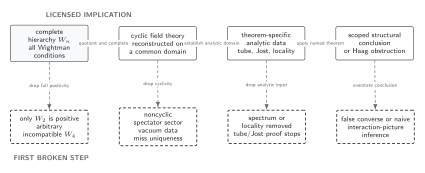
Each dashed downward arrow removes one indispensable input. Positivity of only the two-point function fails before reconstruction; a noncyclic spectator defeats uniqueness from vacuum data; missing spectrum or locality stops the analytic argument; and an illegal converse cannot be rescued by the forward theorem. The diagram is schematic and not to scale. Structured description and source data (JSON)
What completion looks like
Section titled “What completion looks like”After the first three pages, a reader should be able to decide whether a proposed hierarchy can be reconstructed. After the analyticity pages, the reader should be able to track the sign of the imaginary tube, verify the Jost cone criterion, and identify the boundary values being equated. After the structural pages, the reader should be able to state CPT, spin–statistics, or Haag conclusions with their exact field class and hypotheses. The final comparison makes clear which examples are constructions, which are Gaussian counterexamples to overstrong claims, and which remain formal or open.
The central standard reference for the real-time axioms, reconstruction, and structural theorems is Streater and Wightman 2016, Chapters 3–4, pp. 96–174. Citations on the individual pages identify the narrower theorem and model sources.
References
Section titled “References”- Streater, Raymond F., and Arthur S. Wightman. 2016. PCT, Spin and Statistics, and All That. Princeton Landmarks in Physics. Princeton University Press. DOI.
Original QFT.org content:CC BY 4.0, unless an item supplies different terms. Third-party material retains its own terms.