

The Displacement Operator and Defect Ward Identities
A defect breaks translations normal to its support. The resulting localized Ward identity defines a universal defect primary, the displacement operator. Its normalization is not freely rescalable: once the stress tensor, defect delta function, normal orientation, and shape-variation sign are fixed, its two-point coefficient is physical defect data.
Required background. Conformal boundaries and defects identify the broken transverse generators. Boundaries, flux, and boundary Ward identities provide the distributional flux balance.
Helpful background. Contact terms, equal-time commutators, and Schwinger terms explain why separated-point conservation does not determine localized terms.
Definition and sign convention
Section titled “Definition and sign convention”Let the flat defect lie at , and normalize the transverse delta function by
Choose an oriented orthonormal normal frame . Define by the response to a small embedding deformation :
Equivalently, with the induced measure included. In this convention the flat-space distributional Ward identity is
can occur when localized spin currents or normal-bundle couplings are present. Its derivative integrates to zero for a constant transverse translation, but it matters for local Ward identities. Improvement terms can move derivatives of delta functions among representatives without changing the integrated response. Billò et al. derive the complete geometric form and the improved representative in Billò et al. 2016, §§5.1–5.2.
Reversing the normal frame sends and . Changing only one of them changes the convention. The coefficient below is orientation independent.
Dimension and two-point normalization
Section titled “Dimension and two-point normalization”The divergence of the stress tensor has scaling dimension , while has dimension . Therefore
is a scalar under parallel rotations and a vector under . Conformal symmetry fixes
for a parity-even flat defect. Reflection positivity gives when is Hermitian and the defect configuration admits the required reflection. A vanishing implies that the displacement creates a null state; after quotienting null states, a topological defect has no local response to smooth deformations. The converse requires the usual locality and completeness assumptions.
The normalization also fixes bulk-to-defect couplings. In the conventions of Billò et al., a bulk scalar one-point coefficient and the unnormalized bulk–displacement two-point coefficient obey
The coefficient multiplying a unit-normalized displacement block is obtained only after dividing by the appropriate power of . This relation follows from an integrated broken-translation Ward identity, not from an arbitrary choice of defect-operator scale Billò et al. 2016, §5.2, eqs. (5.27)–(5.30).
First-order shape response
Section titled “First-order shape response”For separated bulk insertions and compactly supported ,
A constant reproduces a transverse translation of the entire defect relative to fixed bulk points. A linear tests the broken mixed rotations. These integrated checks fix signs and contact terms. If an insertion crosses the deformed support, the formula needs an additional prescription for operator transport; the separated-support expression does not define that process.
At second order, coincident displacement insertions generate local counterterms and possible operator mixing:
The singularity as must be extended as a distribution. Its nonlocal part is fixed by ; local polynomial terms depend on the shape-renormalization scheme. This is why a separated two-point normalization alone does not determine every curved-defect contact term.
Canonical free scalar at a boundary
Section titled “Canonical free scalar at a boundary”For , use the conformally improved stress tensor
Choose the normal so that the Ward representative is ; reversing the normal reverses . At separated boundary points, the conformal Dirichlet and Neumann conditions give
The second formula follows by setting in and retaining the improvement. Dropping that improvement gives a different operator and fails the conformal Ward identity.
Using
Wick contraction yields
For Neumann,
Differentiating this boundary covariance in the expression for gives the same result:
This equality is specific to the canonically normalized free planar scalar and the improved stress tensor. It does not assert that Dirichlet and Neumann boundary CFTs have identical spectra or anomaly coefficients. Normal ordering removes self-contractions; coincident extensions still require local counterterms.
From exact Ward data to later evidence
Section titled “From exact Ward data to later evidence”The figure below separates exact implications of the localized Ward identity from conditional folding, RG, numerical, and inversion steps. The identity fixes the normalization convention for and its shape response; the dynamical coefficient must be computed or supplied as separately Ward-normalized CFT data. A monotonicity statement, exclusion, or reconstructed spectrum then needs its own hypotheses and evidence.
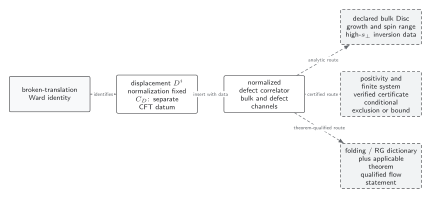
Schematic evidence flow from broken transverse translations to the displacement operator, with retained as a separate dynamical datum in the normalized two-point function. Folding and defect RG, numerical certification, and Lorentzian inversion are distinct continuations: arrows indicate required inputs, not automatic theorems or completed computations.
The structured equivalent is:
| Stage | Input | Supported relation | Evidence type | Limitation or continuation |
|---|---|---|---|---|
| Local Ward identity | , , normal frame | and | Exact distributional identity | Improvements and contact terms must be declared |
| Shape response | Compactly supported | Exact first variation | Crossing the support needs an operator-transport rule | |
| Defect datum | Ward-normalized | Conformal covariance plus positivity when applicable | alone does not fix local shape counterterms | |
| Folding or interface analysis | Two-sided theory and orientation map | Translate stress flux and displacement data | Conditional equivalence | Product-theory anomalies and gluing must match |
| Defect RG statement | Universal subtraction and fixed ambient CFT | Compare qualified endpoint quantities | Dimension-specific theorem or conjecture | See Boundary entropy and defect monotonicity |
| Numerical crossing | Serialized blocks, spectra, positivity domain | Exclusion or allowed region with a certificate | Planned specialized computation | No numerical result follows on this page |
| Lorentzian inversion | Ordering, kernel, boundedness, arcs, low-spin terms | Recover qualified defect data | Planned analytic continuation | Contact and low-spin ambiguities remain separate |
Failure tests
Section titled “Failure tests”Delta-function test. Integrate the Ward identity over a small transverse ball. Its flux must reproduce the integrated displacement with the declared sign.
Dimension test. The power in must be , not except for a boundary where .
Improvement test. Recompute the free Neumann operator with and without . Only the improved expression transforms as the displacement of a conformal boundary.
Normal-reversal test. Reverse , , and together. and every physical shape response must remain unchanged.
Contact-term test. Never infer a curved-defect anomaly coefficient from separated alone. Establish the required contact-term relation in the relevant dimension first.
Interface translation is developed on Interfaces, folding, and fusion. Dimension-specific anomaly relations belong to Boundary and defect Weyl anomalies.
References
Section titled “References”Original QFT.org content:CC BY 4.0, unless an item supplies different terms. Third-party material retains its own terms.