

Minimal Models and Fusion Rules
Virasoro minimal models turn null-vector decoupling into a finite, exactly solvable bootstrap. Their central charges and primary weights lie on a Kac table; null states impose BPZ differential equations; compatible local solutions determine fusion and correlators. The unitary Ising model supplies a complete benchmark, including a normalized four-spin correlator rather than only a list of dimensions.
Required background. Highest-weight modules, null states, and the Kac determinant construct the irreducible Virasoro quotients. Crossing and positivity explain channel equivalence and the extra sign constraints present in a unitary theory.
Helpful background. Characters and multiplet counting connect null quotients to torus traces.
Minimal spectra and Kac identification
Section titled “Minimal spectra and Kac identification”For coprime integers , the Virasoro minimal model convention used here is
Labels lie in , , with the field identification
The corresponding Verma module has singular vectors at levels and . Quotienting both submodules yields finitely many irreducible chiral modules. The full CFT still requires a compatible left–right pairing; the Kac table alone specifies only chiral representation data.
The unitary series has . Other coprime pairs are generally nonunitary: the algebraic formulas remain valid, but the Hermitian form has negative-norm states. The finite spectrum, null decoupling, and fusion construction were established in Belavin, Polyakov, and Zamolodchikov 1984, §§2–5, pp. 344–369.
For Ising, , , and . The complete Kac data are
| Full field | Identified chiral labels | Generating singular-vector levels | ||
|---|---|---|---|---|
The diagonal bulk theory pairs each holomorphic module with its antiholomorphic copy. With unit-normalized two-point functions, choose real fields and ; field rephasings can change signs of odd OPE coefficients, so the normalization and reality convention are part of the data. Relative to the course thermal convention, this page uses . Changing the sign of alone cannot change .
From a null state to the BPZ equation
Section titled “From a null state to the BPZ equation”The Ising spin state obeys
Insert this relation at in a correlator with primary fields . The stress-tensor Ward identity converts into contour residues, while . Null-state decoupling therefore gives
This is a chiral equation on a configuration-space patch: collision points are removed, an ordering of insertions is fixed, and fractional powers require a branch. It does not by itself choose a single-valued full correlator.
Use the unit-normalized plane identity vacuum, and define inside full correlators. This is the full-field version of the normalized chiral insertion at infinity. For four spins, place the insertions at and initially take . On principal square-root branches, two holomorphic solutions with the normalization used in the full pairing below are
Near ,
The exponents identify the intermediate weights and . In the full pairing below, the energy-channel leading term has coefficient , fixing with unit two-point normalization. The positive sign is the declared energy-field convention; the four-spin correlator is unchanged under . The energy-channel block already includes this magnitude and is not normalized to a unit leading term. This magnitude-versus-sign distinction is explicit in Di Francesco, Mathieu, and Sénéchal 1997, §12.3.3, p. 451, Eqs. (12.63)–(12.64). The diagonal full correlator is
Analytic continuation of each chiral block has monodromy, but the displayed pairing is single-valued on the punctured sphere and invariant under the crossing transformations generated by and with their matching prefactors. Exact Ising blocks and normalization checks are worked out in Di Francesco, Mathieu, and Sénéchal 1997, §§8.2–8.4 and 12.2–12.4.
Fusion from allowed local exponents
Section titled “Fusion from allowed local exponents”Null equations restrict which intermediate highest weights can occur. In , the multiplicity-free Virasoro fusion rule is
where advances by two from to
and advances by two from to
followed by the Kac identification. Applied to Ising,
The fusion coefficient is an allowed-channel multiplicity, not an OPE coefficient. For example, while . Virasoro fusion gives because is absent from , even though three-point kinematics alone would permit a scalar coefficient. The distinction between fusion multiplicities and normalized structure constants is emphasized in Ginsparg 1990, §§4–5.
Exact constructions need more than a central charge
Section titled “Exact constructions need more than a central charge”The figure places the minimal model beside four other compact constructions. Inspect the arrows into the center: each route must supply a chiral algebra, a spectrum, a rule selecting or projecting states, and a modular completion.
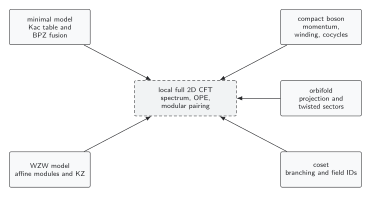
Schematic comparison of rational and compact constructions. Matching central charges is never sufficient: null quotients, momentum–winding lattices, affine integrability, branching, projections, twisted sectors, and left–right modular completion determine different theories.
An equivalent construction checklist is:
| Construction | Chiral algebra | Spectrum and selection | Modular-completion obligation | Normalization anchor |
|---|---|---|---|---|
| Virasoro minimal model | Irreducible Virasoro modules | Kac table modulo and null submodules | Choose a nonnegative integral left–right pairing and check sewing | Unit two-point functions and a declared sign for |
| Compact boson | current algebra, enlarged at special radii | Even momentum–winding lattice with locality cocycles | Sum the full lattice and all sectors required by any quotient | and a declared radius convention |
| WZW model | Affine | Integrable highest weights at level | Pair affine characters and satisfy fusion/factorization | Long-root length and current-OPE metric |
| Coset | Commutant of | Branching selection, field identifications, fixed-point resolution | Include every branching sector in a modular-closed pairing | Embedding index and inherited levels |
| Orbifold | Invariant algebra plus twisted modules | Projection in every twisted sector | Sum over commuting twists, including fixed-point multiplicities | Group action, cocycle phases, and factor |
Comparing low-dimensional model evidence
Section titled “Comparing low-dimensional model evidence”The following shared comparison keeps spectrum type, diagonalizability, positivity, and the meaning of correlators in separate fields. Rows outside the rational unitary core are included only to mark where the assumptions change; their constructions belong to the next chapter.
| Benchmark | Spectrum and measure | Dilatation action | Inner product | Correlator status | Fusion or OPE | Modular behavior | Exact evidence and normalization |
|---|---|---|---|---|---|---|---|
| Ising | Three discrete Virasoro sectors; counting measure | Diagonal | Unitary | Ordinary single-valued bulk correlators after chiral pairing | Finite semisimple fusion | Three characters transform by finite ; diagonal | Null equations, exact four-spin blocks, characters; |
| Yang–Lee | Two discrete Virasoro sectors; counting measure | Diagonal | Nonunitary, indefinite | Ordinary bulk correlators after pairing | Finite semisimple fusion | Two-character finite modular representation | BPZ equations and exact characters; negative primary weight records nonunitarity |
| Compact boson | Countable discrete momentum–winding lattice | Diagonal | Unitary at positive radius | Ordinary after zero-mode neutrality and cocycle completion | Lattice addition with locality phases | Theta-function lattice sum is modular invariant | Gaussian correlators; fixes dimensions |
| Noncompact free boson | Continuous momentum with Lebesgue measure | Diagonal | Delta-normalized positive generalized states | Distributional in momentum labels; ordinary for suitable wave packets | Continuous charge addition | Integral kernel and target-volume divergence | Gaussian path integral; zero-mode measure must be declared |
| Logarithmic example | Discrete generalized modules | Jordan blocks occur | Nonunitary | Ordinary position-space logarithms, with generalized-state pairings | Nonsemisimple fusion | Characters alone may not close; generalized traces can be needed | Exact hypergeometric degeneracy and logarithmic two-point forms |
| Liouville theory | Continuous spectrum with a nontrivial spectral measure | Diagonal on the principal spectrum | Unitary in its standard regime | Distributional in continuum labels; smeared observables are ordinary | Continuous fusion integral | Modular transformations act by an integral kernel | Exact structure constants and conformal blocks require fixed delta normalization |
Reproducible checks
Section titled “Reproducible checks”A reproducible calculation should test the Kac identifications, null levels, normalized BPZ blocks on a fixed complex domain, fusion closure, character coefficients, and exact identities with declared tolerances.
Common pitfalls
Section titled “Common pitfalls”Confusing a chiral solution with a local correlator. A BPZ solution is generally multivalued. A full correlator requires a left–right pairing whose monodromies cancel and whose channel limits have admissible OPE coefficients.
Reading OPE coefficients from fusion multiplicities. Fusion says which representations may appear and with what multiplicity. Three-point normalization supplies additional continuous or discrete data.
Calling every minimal model unitary. Only the adjacent series is unitary. Finite Kac data and exact solvability do not imply positivity.
Exercises
Section titled “Exercises”Derive from the general fusion bounds.
Solution
For in , the sum begins and ends at . The sum runs in steps of two from to
Thus .
References
Section titled “References”- Belavin, Alexander A., Alexander M. Polyakov, and Alexander B. Zamolodchikov. “Infinite Conformal Symmetry in Two-Dimensional Quantum Field Theory.” Nuclear Physics B 241, no. 2 (1984): 333–380. DOI.
- Di Francesco, Philippe, Pierre Mathieu, and David Sénéchal. Conformal Field Theory. Graduate Texts in Contemporary Physics. New York: Springer, 1997. DOI.
- Ginsparg, Paul. “Applied Conformal Field Theory.” In Fields, Strings and Critical Phenomena, Les Houches Session XLIX, edited by Édouard Brézin and Jean Zinn-Justin, 1–168. Amsterdam: North-Holland, 1990. arXiv.
Original QFT.org content:CC BY 4.0, unless an item supplies different terms. Third-party material retains its own terms.