

The Trace Ward Identity and Weyl Anomaly
The trace Ward identity is the local equation that distinguishes a fixed-point Weyl anomaly from ordinary running, explicit masses, improvements, and contact terms. Its clean derivation starts from the generating functional with spacetime-dependent sources. The resulting trace is an operator-valued distribution; equations that hold away from other insertions need not include all of its contact terms. The local-RG derivation, including derivative-of-source terms, is given in Osborn 1991, §§2–3.
Required background. Weyl Covariance on Curved Backgrounds fixes the source and stress-tensor signs. Local RG and Trace Identities supplies the away-from-fixed-point framework. Helpful background. What Is an Anomaly? separates anomalous symmetry response from explicit breaking.
The local Weyl equation
Section titled “The local Weyl equation”Work in Euclidean signature with . Let be dimensionless sources for renormalized operators , coupled with a plus sign in the Euclidean action. The metric stress tensor and scalar insertions are fixed by
Write the ordinary mass-scale beta function as at fixed bare theory. The local transformation combines with . Using ordinary coordinate-density functional derivatives, its generator is
There is no additional in this coordinate-derivative measure. To check the sign, consider a constant physical length : the dependence on and the Callan–Symanzik equation imply . A beta function defined by increasing length instead satisfies .
Osborn uses and a positive inverse-metric Weyl generator . Denote his combined metric-and-coupling operator by . Metric inversion gives , while ; the two changes leave the anomaly functional on the right unchanged. His action-defined stress has the opposite sign to the metric stress here. These translations fix the beta sign without changing the coupling flow Osborn 1991, printed preprint pp. 5–6, Eqs. (2.1)–(2.5), PDF.
The omitted terms act on background gauge fields and include derivatives of required by vector beta functions and improvements. Renormalization gives
For constant sources and away from coincident insertions, this implies schematically
The current divergence includes any retained improvement or virial contribution. Relevant sources have their own Weyl weights: for engineering dimension and before anomalous mixing, a source transforms classically as , giving the trace contribution . The displayed beta and stress conventions must be translated together when comparing sources.
At a conformal fixed point with no virial obstruction, modulo redundant flavor rotations. On a curved background the trace can still equal . In flat space the smooth curvature density vanishes, but differentiating the generating functional produces anomalous contact terms in stress-tensor correlators.
Fixed-point anomalies in two and four dimensions
Section titled “Fixed-point anomalies in two and four dimensions”For a nonchiral two-dimensional CFT with on a closed surface, the inherited positive round-sphere curvature and the displayed metric variation give
Here the holomorphic tensor has its usual OPE normalization, . Relevant local counterterms have been separated, and the partition function is normalized to realize this local anomaly. Integrating a constant Weyl rescaling on the round sphere gives
For a real scalar, omitting the constant eigenfunction gives , with . Normalizing the constant-field volume independently of the metric instead gives and the displayed response. Thus the area factor is necessary when using this scalar determinant as a check. The finite Weyl formula and the explicit distinction are derived in Conformal anomalies and Liouville theory, using Sarnak 1990, §1, pp. 603–605, PDF. This scalar example is not a definition of every interacting CFT.
In four dimensions, the parity-even purely gravitational anomaly in the same metric-stress convention is
with
Here is the Weyl tensor, and retain their conventional positive free-field values. The and coefficients multiply nontrivial anomaly densities. The coefficient is shifted by a finite counterterm and is therefore scheme dependent, realizing the nontrivial-versus-removable classification of Deser and Schwimmer 1993, printed preprint pp. 2–3, PDF.
For a direct sign check, a real conformal scalar has and when is positive and invertible. Zeta variation gives , whose local heat-coefficient density has universal part . Thus , in the displayed trace. Vassilevich defines stress by the positive inverse-metric derivative of the same , so his trace is the negative of ours Vassilevich 2003, printed preprint p. 40, Eq. (4.28), and pp. 65–66, Eqs. (7.1)–(7.8), PDF.
On a round , , and has no zero mode. Therefore the universal logarithm obeys
The spectral scaling gives the same result, since . Renormalization scales are held fixed; cosmological and Einstein counterterms can add separate power-law terms. Boundaries introduce additional surface densities, so none of these closed-manifold integrals is a complete boundary formula.
Contact terms are part of the identity
Section titled “Contact terms are part of the identity”A trace insertion at coincident points needs a prescription for the other operators. For a concrete check, take the conformally improved free massless scalar in flat and keep its elementary insertions fixed under metric variation. With and the vacuum subtraction understood,
The two connected Wick contractions give
The positive contact sign follows from the stated stress and Green-function conventions. Thus the flat-space trace vanishes at separated points but acts nontrivially as a distribution.
For a general source-defined composite, differentiating the generating functional also differentiates the operator’s metric and source dependence, normalization, mixing and counterterms. Those additional local terms cannot be inferred from the elementary example by substituting a general scaling dimension. The local-RG prerequisite derives the source-differentiated identity with these terms retained.
The two arrows from the renormalized generating functional separate fixed-point CFT data (A) from local Weyl response (B). Inspect how these distinct inputs enter the calculations below, without an arrow that would turn endpoint comparison into an automatic flow theorem.
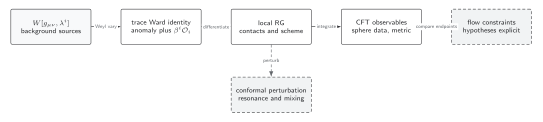
Schematic dependencies, not to scale. For and positive covariant-metric variation, the trace contains , where at fixed bare theory. The ellipsis retains the stated derivative, relevant-source and insertion-contact qualifications. Choosing finite counterterms changes local response without changing separated-point data at fixed normalization. Letters identify inputs to distinct calculations; the dashed endpoint arrow requires dimension-specific theorem hypotheses.
An equivalent text description is:
| Starting datum | Renormalized output | Invariant conclusion |
|---|---|---|
| Metric source | Stress-tensor insertions plus local metric contacts | Separated-point data after normalization |
| Weyl variation at a fixed point | Type-A and type-B densities plus trivial terms | Nontrivial anomaly coefficients only |
| Running scalar sources | plus mixing and contacts | Fixed-point values and scheme-covariant flow statements |
| Round-sphere background | Radius dependence, finite terms, and zero-mode factors | Dimension-dependent universal part |
| Integrated deformation | UV singularities and counterterms | Beta functions or anomalous dimensions after basis and scheme are fixed |
Counterterm and improvement tests
Section titled “Counterterm and improvement tests”Before calling a trace contribution anomalous, ask whether it is the Weyl variation of a finite local functional. In four dimensions,
on a closed manifold. Hence adding shifts by . By contrast, no diffeomorphism-invariant local counterterm shifts the Euler and Weyl-squared coefficients while preserving the same fixed-point problem.
An improvement term changes by . Whether it can remove a virial or trace term depends on the existence, dimension, and global definition of . A statement about scale versus conformal invariance must therefore name the improvement hypothesis rather than deleting total derivatives formally.
Common pitfalls
Section titled “Common pitfalls”Setting as an operator distribution. At a CFT it vanishes at separated flat-space points after improvement, but Ward-identity contacts and curved-space anomalies remain.
Calling the beta term an anomaly. A nonzero describes running under a chosen coupling parametrization. A fixed-point Weyl anomaly remains even when beta functions vanish.
Treating as universal in four dimensions. Its coefficient changes under a finite counterterm. Only a declared scheme makes a numerical value meaningful.
Exercises
Section titled “Exercises”Use the two-dimensional anomaly to compute the response of to a constant rescaling of a round .
Solution
Let denote the sphere radius and its scalar curvature. With and the anomaly-normalized CFT partition function,
Gauss–Bonnet supplied . For a scalar determinant, the constant-mode normalization must be the one described above; alone has a different radius response.
References
Section titled “References”- Deser, S., and Schwimmer, A. “Geometric Classification of Conformal Anomalies in Arbitrary Dimensions.” Physics Letters B 309 (1993): 279–284. DOI. Open PDF; the locators above use the printed preprint pages.
- Osborn, H. “Weyl Consistency Conditions and a Local Renormalization Group Equation for General Renormalisable Field Theories.” Nuclear Physics B 363 (1991): 486–526. DOI.
- Sarnak, P. “Determinants of Laplacians; Heights and Finiteness.” In Analysis, et cetera, edited by P. H. Rabinowitz and E. Zehnder, 601–622. Academic Press, 1990. Open PDF.
- Vassilevich, D. V. “Heat Kernel Expansion: User’s Manual.” Physics Reports 388 (2003): 279–360. DOI. Open PDF: arXiv:hep-th/0306138v3; printed preprint page labels are used above.
Original QFT.org content:CC BY 4.0, unless an item supplies different terms. Third-party material retains its own terms.