

Cross Ratios and Four-Point Kinematics
Four generic points in have two independent conformal invariants. Cross ratios compress the geometry, but they do not erase channel, prefactor, reality, or branch information. Euclidean configurations satisfy a conjugation condition; Lorentzian orderings arise as distinct boundary values in which the two variables can be independent. A complete kinematic convention must therefore name both the invariant pair and its analytic sheet.
Required background. Scalar Two- and Three-Point Functions fixes external normalization and conformal covariance. Conformal Geometry, Maps, and Compactification supplies finite-map domains. Helpful background. Branches, Sheets, Analytic Continuation, and Monodromy supplies continuation language.
Two invariants and one prefactor convention
Section titled “Two invariants and one prefactor convention”Define
A useful scalar four-point convention is
Every point has the required scaling weight. Other prefactors move powers of and between the kinematic factor and ; crossing equations must be translated rather than compared term by term. Standard scalar conventions and their crossing transformations are reviewed in Poland, Rychkov, and Vichi 2019, §§ II.A–II.B.
Introduce by
A conformal transformation places the points in a two-plane and, formally, at . In a genuine Euclidean configuration, . For four collinear points in the standard ordered sector, . The discriminant
vanishes for collinear configurations, where the conformal frame has an enhanced stabilizer; it is not a physical singularity by itself.
Channels and the six anharmonic images
Section titled “Channels and the six anharmonic images”The three pairings are:
Point permutations generate six distinct images. Applying the same fractional-linear map to and gives:
| Map of | Map of | Distinguished limit |
|---|---|---|
| at | ||
| Exchanges and | ||
| Exchanges zero and infinity | ||
| Sends to infinity | ||
| Generated by exchanging points 1 and 2 | ||
| Remaining anharmonic image |
These pairs follow directly from and . They provide a round-trip test for a crossing implementation: composing the same transposition twice must return , and the six images must close.
Euclidean region and Lorentzian sheets
Section titled “Euclidean region and Lorentzian sheets”The figure organizes channel choices and limits together with analytic continuations. Inspect the difference between changing pairings within the Euclidean region and winding around a branch point.
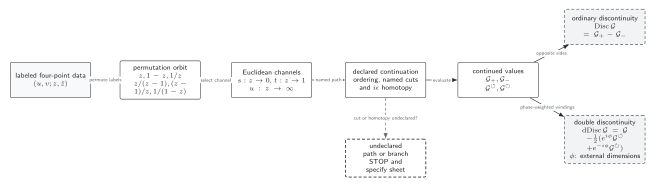
The , , and channels are centered at . In Euclidean signature and a chosen channel converges in its radial domain. Lorentzian continuation allows and to approach independent real values with ordering-dependent prescriptions. The ordinary discontinuity subtracts values on opposite sides of a named cut; the double discontinuity instead combines the Euclidean value with clockwise and counterclockwise continuations and external-dimension phases. The diagram is schematic; neither combination is defined without its continuation paths.
The accessible equivalent is:
| Domain | Relation between and | Required extra data | Permitted statement |
|---|---|---|---|
| Separated Euclidean points | Choice of prefactor and OPE channel | Single-valued Euclidean correlator away from coincidences | |
| Euclidean collinear sector | with an ordering interval | Ordering of the four points | Real boundary within one sector |
| Complexified configuration | independent complex variables | Branch cuts and homotopy class of the path | Analytic continuation on a named sheet |
| Lorentzian Wightman ordering | Independent boundary values, often real after the limit | Strict ordering | One ordered correlator |
| Time-ordered correlator | Sum of boundary values with step functions | Time-ordering prescription and contact terms | Distribution-valued time-ordered function |
| Coincident or null separation | At , , infinity, or another singular locus | Distributional extension and limiting procedure | Only a qualified limit |
The principal Euclidean square root in
uses a cut along . Continuing around reverses the sign of the square root and changes to its reciprocal. Thus a radial series with cannot be carried around the branch point term by term and still be called the same convergent expansion. The cut-plane map and radial domain are derived in Hogervorst and Rychkov 2013, §§ 2–3.
Identical-scalar crossing check
Section titled “Identical-scalar crossing check”For identical scalars with
exchange sends . Equality of the correlator gives
The powers arise from the prefactor; with another prefactor the reduced equation changes. The equality is first Euclidean and then extends to other sheets only through a declared analytic continuation.
Common pitfalls
Section titled “Common pitfalls”and are always complex conjugates. That is the Euclidean reality condition. Lorentzian boundary values generally treat them as independent before the limit.
A point permutation never changes the sheet. Its algebraic map is only part of the operation. A Lorentzian continuation path can wind around branch points.
The reduced correlator is convention independent. Only the full correlator is. Prefactor changes multiply and its crossing equation by powers of .
Exercises
Section titled “Exercises”Verify the map in the table.
Solution
Let and . Then
Applying the map again returns , so it represents a transposition.
References
Section titled “References”- Hogervorst, Matthijs, and Slava Rychkov. “Radial Coordinates for Conformal Blocks.” Physical Review D 87 (2013): 106004. DOI; Open PDF
- Poland, David, Slava Rychkov, and Alessandro Vichi. “The Conformal Bootstrap: Theory, Numerical Techniques, and Applications.” Reviews of Modern Physics 91 (2019): 015002. DOI; Open PDF
Original QFT.org content:CC BY 4.0, unless an item supplies different terms. Third-party material retains its own terms.