

The CFT Regge Limit and Boundedness
The CFT Regge limit is a high-boost limit of a four-point function on a specified Lorentzian sheet. It controls whether complex-spin contours close, how many subtractions a dispersion relation needs, and which low-spin terms remain undetermined. The limit resembles high-energy scattering, but the correlator, kinematic variables, and boundedness theorem must be established on the CFT side.
Required background. Lorentzian correlators and causal orderings fixes the continuation path and sheet. High-energy and Regge limits supplies the scattering comparison without identifying an amplitude with a correlator.
Helpful background. Causality, growth, and analytic domains explains how an arc estimate depends jointly on analyticity and polynomial growth.
The second-sheet boost limit
Section titled “The second-sheet boost limit”For identical Hermitian scalars, write
Start in the Euclidean region, continue clockwise around so that while remains on its first sheet, and only then set
Reversing the continuation gives the conjugate ordering when the operators and positions obey the corresponding reality conditions. The variable measures the inverse boost; is an impact-parameter-like separation on hyperbolic space. This is not the Euclidean OPE limit, because the nontrivial monodromy is taken first. It is also not the lightcone limit at fixed .
For a single exchanged primary of spin , its second-sheet block behaves schematically as
up to external-dimension and normalization factors. Thus an isolated exchange of higher spin grows rapidly. A complete unitary correlator need not be governed by the largest spin appearing in its Euclidean OPE: the infinite sum can reorganize into a Regge trajectory. Conformal Regge theory expresses that reorganization through a Sommerfeld–Watson transform and harmonic functions of ; see Costa, Gonçalves, and Penedones 2012, §§2–4.
What boundedness is actually needed
Section titled “What boundedness is actually needed”Suppose the relevant normalized second-sheet correlator obeys
Then is a Regge-growth threshold. A complex-spin projection whose arc carries an additional factor can close for , subject also to endpoint convergence in . For the scalar four-point inversion formula in an ordinary unitary CFT, reflection positivity and causality give the standard safe domain ; this is why its universal derivation does not promise spin-zero or spin-one data Caron-Huot 2017, §§2.3 and 3.4.
This statement and its lightcone-bootstrap context are reviewed in Poland, Rychkov, and Vichi 2019, §IX. It has the following qualifications:
- The bound concerns the normalized correlator in the causal configuration used in the proof, not every unsmeared Wightman distribution pointwise.
- Reflection positivity controls Euclidean coefficients; the Lorentzian inequality additionally uses analyticity, operator ordering, and a bounded domain reached without crossing singularities.
- The chaos bound can constrain an appropriate Rindler or thermal correlator after its strip analyticity and factorization assumptions are verified. It is not a free-standing bound on an arbitrary conformal block Maldacena, Shenker, and Stanford 2016, §§2–4.
- A large higher-spin gap can justify stronger approximations, but it is not required for the basic inversion statement. Conversely, a gap alone does not prove an arc vanishes.
The diagram below connects the sheet choice to inversion and dispersion. Inspect the arc at infinity: its treatment, rather than formal analyticity alone, decides whether extra low-spin or subtraction data are needed.
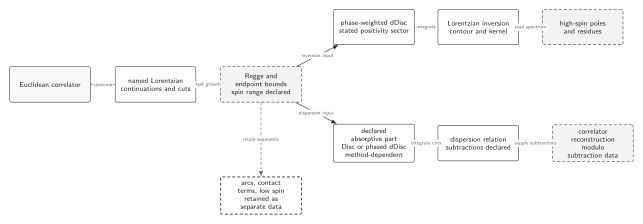
Schematic relation among continuation, double discontinuity, Regge growth, inversion arcs, and dispersion subtractions. A nonvanishing arc is retained as low-spin or subtraction data rather than silently discarded.
Hypotheses, arcs, and surviving ambiguities
Section titled “Hypotheses, arcs, and surviving ambiguities”The table gives a semantic form of the hypothesis/subtraction matrix. Each row is a separate theorem pattern; entries are not transferable without proof.
| Method | Continuation and positivity input | Growth assumption | Arc or subtraction treatment | Domain and remaining ambiguity |
|---|---|---|---|---|
| Scalar Lorentzian inversion | Fixed Wightman ordering; crossed-channel double discontinuity; reflection-positive identical-scalar setup when positivity is used | ) with endpoint control | Complex-spin arc vanishes for | Poles and residues above threshold; lower spins remain independent |
| Unsubtracted CFT dispersion | Declared cut plane and both channel discontinuities | Correlator decays sufficiently on the large contour | Large contour set to zero only after a uniform estimate | Correlator fixed by cuts up to terms with zero discontinuity allowed by the estimate |
| -subtracted CFT dispersion | Same cut and crossing data | Polynomial growth of known degree | Subtract at a declared point and retain constants or contact structures | Reconstruction modulo the subtraction basis |
| Positive Tauberian inference | Euclidean positive measure or nonnegative OPE weights | Transform asymptotic with controlled remainder | No Lorentzian arc; smoothing kernel replaces pointwise inversion | Averaged cumulative spectral asymptotic, not individual levels |
A conformal-exchange test
Section titled “A conformal-exchange test”For a second-sheet exchange of spin , the scaling gives if that exchange is considered alone. Hence an inversion contour closes only for . In a full correlator, this is merely a diagnostic: one must estimate the resummed correlator, because cancellations and Reggeization can lower the effective intercept.
As a second check, the generalized-free connected correlator vanishes, while its disconnected pieces have fixed second-sheet powers and no growing connected Regge exchange. The inversion of those pieces reproduces mean-field double-twist data; assigning them an interacting Regge trajectory would be a category error.
Failure modes
Section titled “Failure modes”Taking limits in the wrong order. Sending before the monodromy stays on the Euclidean sheet and does not test the Regge arc.
Testing one block instead of the full correlator. Individual blocks can grow faster than their resummed sum. A bound on one truncation is not automatically a bound on the CFT.
Importing Froissart language without its hypotheses. A CFT correlator has no scattering mass gap or flat-space impact parameter unless an additional limit establishes those structures.
Using unsmeared inequalities at singular configurations. Wightman correlators are distributions. When a proof uses smearing or separated Rindler domains, the conclusion retains that domain.
Exercises
Section titled “Exercises”A second-sheet contribution scales as at fixed . Find the corresponding and the open half-plane in which the simple complex-spin arc estimate can vanish.
Solution
Matching gives . The arc estimate is safe only for , with any separate -endpoint conditions also imposed. Nothing in this scaling alone determines the data at spins .
References
Section titled “References”- Caron-Huot, Simon. “Analyticity in Spin in Conformal Theories.” Journal of High Energy Physics 2017, no. 9 (2017): 078. doi:10.1007/JHEP09(2017)078.
- Costa, Miguel S., Vasco Gonçalves, and João Penedones. “Conformal Regge Theory.” Journal of High Energy Physics 2012, no. 12 (2012): 091. doi:10.1007/JHEP12(2012)091.
- Maldacena, Juan, Stephen H. Shenker, and Douglas Stanford. “A Bound on Chaos.” Journal of High Energy Physics 2016, no. 8 (2016): 106. doi:10.1007/JHEP08(2016)106.
- Poland, David, Slava Rychkov, and Alessandro Vichi. “The Conformal Bootstrap: Theory, Numerical Techniques, and Applications.” Reviews of Modern Physics 91, no. 1 (2019): 015002. doi:10.1103/RevModPhys.91.015002.
Original QFT.org content:CC BY 4.0, unless an item supplies different terms. Third-party material retains its own terms.