

Schwinger–Keldysh Actions for Open QFT
An open Schwinger–Keldysh action turns reduced dynamics into a field theory of forward and backward histories. Its structure makes response, damping, and noise visible and supports loop and RG calculations. Normalization and reality impose sharp identities, but an arbitrary action obeying those identities need not define a completely positive map; that stronger statement follows automatically only when the action is derived from a legitimate microscopic trace or a well-defined Lindblad generator.
Required background. Influence functionals produce the doubled action by a microscopic trace. Unitarity normalization and largest-time identities explain the closed-system contour constraints. Helpful background. Lindblad field dynamics supplies the generator whose coherent-state path integral is translated below.
Structural constraints in the r/a basis
Section titled “Structural constraints in the r/a basis”For real fields,
The effective action must satisfy
The first identity follows from and ensures that every vertex has at least one leg. The second is the contour form of Hermiticity. With weight , convergence of a local Gaussian noise sector requires on real configurations. Causal response requires the field to act as the response field: a retarded inverse kernel connects to a later , while correlators containing a latest-time insertion vanish.
A general quadratic action can be written
where for a stationary Hermitian theory and . The retarded propagator is and the statistical correlator is generated by the noise insertion between and . The zero in the inverse-kernel entry is exact: a nonzero term there would violate equal-history normalization.
Thermal equilibrium adds a dynamical KMS symmetry that relates to the dissipative part of . Drive and multiple reservoirs generally break that relation while leaving normalization and causality intact. The effective-action conditions are developed systematically for driven systems in Sieberer, Buchhold, and Diehl 2016, §§3–5 and for general dissipative effective theories in Crossley, Glorioso, and Liu 2017, §§2–3.
From a Lindblad generator to contour vertices
Section titled “From a Lindblad generator to contour vertices”For normal-ordered bosonic jump symbols , the dissipative part of the coherent-state contour action has the schematic exact form
with ordering corrections fixed by the chosen discretization. It vanishes when the two histories coincide. For linear jumps, its imaginary part contains a positive square proportional to . Nonlinear jumps produce vertices with several and legs; replacing their operator products by classical symbols without retaining the ordering prescription changes the generator.
The inverse map is conditional. A local action quadratic in with positive noise can often be represented by Gaussian stochastic forces, but that does not prove complete positivity for all quantum states. To reconstruct a Lindblad generator, one must identify a positive Kossakowski factorization of all dissipative vertices and respect operator ordering and the regulated domain. Normalization alone is weaker: it constrains the difference structure but allows coefficient choices that fail positivity.
Loss and pumping for one scalar mode
Section titled “Loss and pumping for one scalar mode”Take one complex bosonic mode with Hamiltonian , loss , and incoherent pump . In a standard normalization, the quadratic action has retarded inverse kernel and noise strength
Thus response measures the difference of loss and pump, whereas fluctuations measure their sum. The stationary occupation, when , is
This follows either from the master equation,
or from the Keldysh propagator. The agreement checks the normalization and the relative noise coefficient. If , the quadratic model has no normalizable stationary state: nonlinear loss, saturation, or a finite Hilbert space is then required. Calling the divergent Gaussian solution a steady state hides a missing operator.
For a real damped scalar mode one may equivalently write
with . This action is normalized and causal. It is Lindblad-compatible only after the field variables, cutoff, jump operators, and relation between and have been specified. A thermal bath fixes that relation; a driven bath does not.
Sources, response, and renormalization
Section titled “Sources, response, and renormalization”Couple sources as . Differentiating with respect to probes physical expectation values, while a derivative inserts a response field. The physical limit sets the two contour sources equal after differentiation. Retarded support and the vanishing of all- latest-time structures should be checked after regularization, not assumed from formal continuum notation.
Interactions generate every local doubled operator allowed by symmetry and the contour identities. A convenient truncation grades terms by derivatives, powers of , and powers of . Terms linear in determine deterministic equations and response; even imaginary powers begin the noise hierarchy; higher powers encode non-Gaussian noise and quantum jump structure. Integrating out modes can mix these sectors, so a purely non-Hermitian retarded action is not closed under RG in general.
Consistency hierarchy
Section titled “Consistency hierarchy”For an open action, check in this order:
- at the regulated level;
- the contour reality relation;
- causal support of and largest-time zeros;
- nonnegative Gaussian noise kernel;
- positive factorization of nonlinear dissipative vertices when a Lindblad interpretation is claimed;
- preservation of these properties under counterterms and coarse-graining.
The open-dynamics consistency and evidence matrix records the conclusion supported by each level. The dedicated consistency page supplies state-space and dynamical tests when the inverse map is not manifest.
Common failure modes
Section titled “Common failure modes”Equating normalization with complete positivity. The zero-action condition on equal histories is necessary for trace preservation, not sufficient for a CPTP map.
Dropping ordering information. A nonlinear coherent-state symbol depends on time slicing and normal ordering; a naive classical replacement changes contact terms.
Using negative noise to fit response. Retarded damping and noise are independent out of equilibrium, but covariance positivity still constrains .
Assuming a quadratic steady state exists. Net gain closes the Liouvillian gap in the wrong direction unless nonlinearities or finite occupation stabilize the dynamics.
The Schwinger–Keldysh action occupies the influence-functional stage of the diagram; a Lindblad generator appears only after additional locality and timescale assumptions.
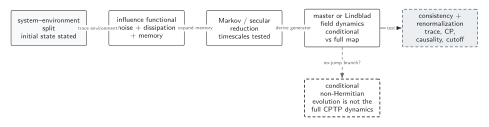
At the influence-functional node, encodes normalization, retarded structure encodes causality, and the imaginary quadratic sector is constrained by noise positivity. These conditions do not by themselves imply a time-local GKSL equation. The solid path displays the extra reduction, and the dashed branch distinguishes conditional non-Hermitian evolution from the full density-matrix map. The diagram is schematic and not to scale.
In text, first test the doubled action directly through its normalization, reality, causal, and positivity identities. Only when memory is short on the system scales should one match its local coefficients to a master-equation generator and then repeat the complete-positivity and cutoff checks.
Exercises
Section titled “Exercises”Verify the occupation of the loss–pump model.
Solution
The adjoint dissipators give and . Hence . Setting the derivative to zero gives , which is finite only for net loss.
Why must every allowed interaction vertex contain an field?
Solution
If a vertex contained only fields, it would remain nonzero at and violate . The conclusion holds for the complete regulated action, although separate diagrams or counterterms may cancel before the identity is restored.
Continue to spectra, drive, and RG
Section titled “Continue to spectra, drive, and RG”Noise and dissipation derives thermal and nonequilibrium kernel relations. Driven steady states uses interacting open actions to study criticality, and open-system renormalization follows the doubled operator basis across scales.
References
Section titled “References”- Crossley, Michael, Paolo Glorioso, and Hong Liu. “Effective Field Theory of Dissipative Fluids.” Journal of High Energy Physics 2017, no. 9 (2017): 095. doi:10.1007/JHEP09(2017)095. Open preprint.
- Kamenev, Alex. Field Theory of Non-Equilibrium Systems. Cambridge: Cambridge University Press, 2011. doi:10.1017/CBO9781139003667.
- Sieberer, Lukas M., Michael Buchhold, and Sebastian Diehl. “Keldysh Field Theory for Driven Open Quantum Systems.” Reports on Progress in Physics 79 (2016): 096001. doi:10.1088/0034-4885/79/9/096001. Open preprint.
Original QFT.org content:CC BY 4.0, unless an item supplies different terms. Third-party material retains its own terms.