

Conventional Relativistic Navier–Stokes Instability and Acausality
Conventional relativistic Navier–Stokes theory is reliable as a low-frequency constitutive expansion, but its Landau and Eckart exact equations are not satisfactory relativistic initial-value systems. Diffusive sectors are parabolic and have instantaneous support; the Eckart acceleration–heat coupling produces an equilibrium instability; and conventional stable rest-frame diffusion becomes unstable in a boosted formulation. These conclusions do not apply to every possible first-order hydrodynamic frame.
Required background. Relativistic Dissipative Hydrodynamics derives the infrared poles. Symbols, Characteristics, and PDE Type supplies the parabolic/hyperbolic distinction.
Helpful background. BDNK First-Order Causal Hydrodynamics gives the counterexample to the blanket claim that derivative-first-order theories must be acausal.
Diffusion has instantaneous tails
Section titled “Diffusion has instantaneous tails”The shear channel of conventional Landau first order is
For localized initial data in spatial dimensions, the Green function is
It is nonzero for every at every . Thus the exact diffusion equation has no finite domain of dependence. Its principal part is parabolic, not relativistically causal.
The violation occurs in the high- completion of a hydrodynamic pole whose derivation assumed . Therefore it does not show that the microscopic theory is acausal. It does show that the unregulated first-order equation should not be used as an exact relativistic evolution law.
Eckart’s homogeneous instability
Section titled “Eckart’s homogeneous instability”In the conventional Eckart frame, the heat flux includes acceleration:
Consider a homogeneous transverse velocity perturbation, so spatial gradients vanish. Then
Momentum conservation includes the time derivative of the momentum density :
For constant background coefficients,
Besides the constant mode, there is
Positive —the sign required by entropy production—therefore gives exponential growth. Hiscock and Lindblom establish this generic instability and the associated conventional-frame pathologies Hiscock and Lindblom 1985, §§II–IV, pp. 726–731.
Boosted diffusion instability
Section titled “Boosted diffusion instability”A compact model exposes why rest-frame damping is insufficient. Write the covariant-looking diffusion equation
In the rest frame it gives . Now take a homogeneous perturbation in coordinates where the background fluid has . Since , obeys
The additional root is
which lies in the upper half-plane. A Lorentz transformation has mixed the parabolic spatial principal part into higher time derivatives. The root is outside the strict infrared domain for small , but it prevents the exact equation from defining a frame-independent stable relativistic initial-value problem.
Landau and Eckart are not all frames
Section titled “Landau and Eckart are not all frames”The pathologies above belong to conventional matching choices and exact truncations. A general first-order decomposition allows derivative corrections to local energy density, pressure, and energy flow. Those terms vanish after using ideal equations order by order, so they do not change first-order on-shell transport. Kept in the exact PDE, however, they change its principal symbol.
Kovtun finds open regions of general-frame coefficients with linearly stable equilibria and explicitly notes that Landau–Lifshitz lies outside them Kovtun 2019, §§3–4, pp. 11–18, Open PDF. BDNK further imposes characteristic and nonlinear conditions. Therefore the correct conclusion is:
Conventional Landau/Eckart relativistic Navier–Stokes equations are parabolic, acausal as exact PDEs, and generically unstable in the stated settings. First derivative order by itself does not imply those failures.
The framework comparison is recorded in the relativistic hydrodynamic consistency reference.
EFT cutoff and regulator
Section titled “EFT cutoff and regulator”A relaxation term can replace diffusion by a telegrapher equation,
Its characteristic speed is and its new mode relaxes at . This is not a free repair: must be matched, the speed must be causal, the sound and coupled-charge channels need their own inequalities, and the resulting theory has a new validity domain.
A numerical lattice also limits propagation per step, but discretization does not convert the continuum parabolic theory into a causal constitutive model. Results must be stable as the grid is refined within the EFT window, and any regulator dependence must remain below the declared truncation error.
The first column of the schematic isolates the conclusion established here. Follow its dashed vertical arrow from conventional first order to the parabolic-instability/acausality test, without extending that diagnosis to every first-order frame.
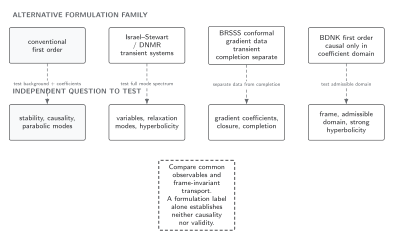
Conventional Landau- and Eckart-frame first-order equations exhibit parabolic support and, in the relativistic setting, generic boosted-frame instabilities. That is a formulation-specific result, not a no-go theorem for all first-order constitutive tensors. The remaining columns indicate distinct completions that require their own coefficient and principal-symbol tests; the diagram is schematic and not a chronology.
In text: Fourier diffusion gives a damped low- pole but instantaneous continuum support, and conventional relativistic first order can acquire growing boosted modes. Relaxation variables or admissible general-frame time derivatives alter the principal part; their success must be established rather than inferred from the failure shown in the first column.
Exercise
Section titled “Exercise”Derive the two telegrapher roots and their small- limits.
Solution
The dispersion polynomial is
so
At small ,
At large , . Hence and give damping, while causal characteristics additionally require in this isolated channel.
Common pitfalls
Section titled “Common pitfalls”Diagnosing microscopic causality from the pole. The pole is an infrared expansion. The exact parabolic PDE is the object with instantaneous support.
Using entropy positivity as a stability proof. Eckart’s example has positive conductivity and an exponentially growing mode.
Saying “first order is acausal.” Conventional frames are; suitable general-frame BDNK theories show that constitutive derivative order alone is not the cause.
Where this leads
Section titled “Where this leads”Israel–Stewart, BRSSS, and DNMR Transient Hydrodynamics compares common transient completions. BDNK First-Order Causal Hydrodynamics constructs a causal route without adding independent stress variables.
References
Section titled “References”Original QFT.org content:CC BY 4.0, unless an item supplies different terms. Third-party material retains its own terms.