

Gauge-Theory Effective Kinetic Theory
Leading-order gauge-theory effective kinetic theory (EKT) evolves hard quasiparticle distributions while consistently incorporating screened elastic scattering and collinear splitting with Landau–Pomeranchuk–Migdal (LPM) interference. Neither process is a small correction to the other: both change a hard distribution on the same parametric time scale and both are required for leading-order chemical and kinetic equilibration.
Required background. Collision kernels, conservation, and detailed balance supplies Boltzmann structure; soft and collinear singularities supplies the singular limits; HTL theory supplies screening and asymptotic masses. Helpful background. Validity and breakdown of kinetic descriptions explains the quasiparticle boundary.
Degrees of freedom and kinetic equation
Section titled “Degrees of freedom and kinetic equation”For each hard species with momentum , EKT uses an on-shell distribution obeying
The quasiparticle dispersion includes the asymptotic thermal mass at the accuracy needed in collinear denominators. The description assumes weak coupling and that variations are slow on the hard scale . Very high occupancy , coherent fields, and quantum correlations not reducible to lie outside its basic domain.
The stress tensor and conserved currents are moments of plus matching corrections:
Here is the degeneracy. The collision operator must annihilate exact conserved moments, ensuring and the corresponding charge equations.
Screened elastic scattering
Section titled “Screened elastic scattering”Elastic matrix elements contain soft -channel exchange, apparently divergent as . HTL screening and dynamical response regulate the soft region. A convenient implementation separates transfers at an arbitrary scale :
The dependence on cancels to leading order. Using a Debye mass in every propagator without matching can double count or distort transverse dynamical screening. Conservation and detailed balance should be tested numerically after discretization, not presumed from the continuum formula.
For a process , gain and loss contain the quantum statistical combination
It vanishes for Bose–Einstein or Fermi–Dirac distributions with chemical potentials satisfying the reaction’s conserved-charge constraints.
Collinear splitting and the LPM equation
Section titled “Collinear splitting and the LPM equation”A nominal splitting is enabled by thermal masses and repeated soft kicks. During its formation time, amplitudes with different scattering histories interfere. The splitting rate is therefore obtained from a transverse integral equation. Schematically,
where measures transverse momentum mismatch, includes asymptotic masses, and is the soft broadening kernel. The rate is proportional to the real part of with species-dependent splitting functions and color factors.
The physical solution is regular at finite and decays sufficiently fast at large for the rate integral to converge; a finite-grid solver must demonstrate insensitivity to that ultraviolet boundary. The inverse merging process and virtual loss term follow from the same kernel. Including splitting but not merging violates detailed balance, omitting the virtual term violates probability conservation, and adding independent soft scatterings during formation double counts interactions already resummed by the LPM equation. Arnold, Moore, and Yaffe showed that screened and LPM-complete effective processes form a leading-order kinetic theory Arnold, Moore, and Yaffe 2003, §§ 1–5.
Verification workflow
Section titled “Verification workflow”A usable solver should demonstrate:
- exact discrete energy, momentum, and charge conservation to tolerance;
- zero collision term for equilibrium distributions;
- cancellation of soft/hard separation scales;
- convergence in momentum, angle, and transverse LPM grids;
- positivity or a documented positivity-preserving update;
- agreement with linearized transport benchmarks near equilibrium.
These tests correspond to the kinetic row of the hot-gauge plasma validity table. A fit to one relaxation curve cannot replace them.
Limitations
Section titled “Limitations”Leading-order EKT has a controlled expansion only at weak coupling. It does not automatically describe the earliest coherent Glasma field, the magnetic sector, or a strongly coupled plasma. In an anisotropic state, plasma instabilities may compete with collisional evolution. “Leading order” also does not imply small numerical corrections at realistic coupling.
Effective kinetic theory is the hard-quasiparticle branch of the matched hot-gauge description, not the static or ultrasoft branch.
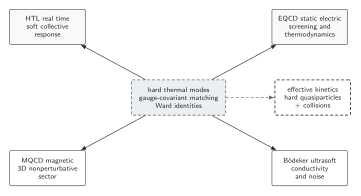
The kinetic branch evolves occupations for hard quasiparticles and encodes soft exchanges through screened kernels and LPM-resummed collinear processes. HTL information enters those kernels, but an EKT solution is not an HTL correlator; nor does it capture the static magnetic sector or Bödeker time scale. The diagram is schematic and assumes weak coupling and scale separation.
In text, kinetic theory is selected when occupancies admit a quasiparticle description and gradients are long compared with microscopic formation and collision scales. Matching and subtraction prevent the soft physics in its collision kernel from being counted again as an independent sector.
Within that kinetic domain, the plasma state still determines whether collisions dominate or unstable soft fields compete with them.
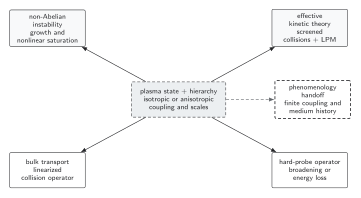
Near isotropic equilibrium, the EKT branch contains screened scattering and LPM-suppressed processes. Strong anisotropy can instead activate unstable soft fields, so collisional evolution alone must be justified. Bulk transport and hard-probe coefficients are distinct operator projections, and the dashed phenomenology branch marks extrapolation beyond the controlled weak-coupling regime. The diagram is schematic and not to scale.
Accordingly, an EKT calculation must state the distribution, coupling, screening and splitting prescriptions, conservation residuals, and regulator tests. Transport coefficients or probe kernels extracted from it require their own operator definitions and uncertainty estimates.
Exercises
Section titled “Exercises”1. Detailed balance. Insert into the statistical factor for .
Solution
Use . The loss term differs from the gain term by . Energy conservation and make this factor unity, so the difference vanishes.
2. Why two processes? If elastic scattering conserves particle number, what failure follows from omitting processes in a gluon plasma?
Solution
Elastic scattering can redistribute momentum but cannot relax an initially incorrect gluon number toward its equilibrium value. The system may approach a kinetically shaped distribution with a spurious chemical potential. Collinear splitting and merging provide the leading-order number-changing channel.
Continue to weak-coupling transport coefficients or plasma instabilities.
References
Section titled “References”- Arnold, Peter, Guy D. Moore, and Laurence G. Yaffe. “Effective Kinetic Theory for High Temperature Gauge Theories.” Journal of High Energy Physics 2003, no. 1 (2003): 030. DOI.
- Arnold, Peter, Guy D. Moore, and Laurence G. Yaffe. “Photon Emission from Ultrarelativistic Plasmas.” Journal of High Energy Physics 2001, no. 11 (2001): 057. DOI.
- Baym, Gordon, Jean-Paul Blaizot, François Gelis, and Takashi Matsui. “Landau–Pomeranchuk–Migdal Effect in a Quark–Gluon Plasma and the Boltzmann Equation.” Physics Letters B 477, no. 1–3 (2000): 28–36. DOI.
Original QFT.org content:CC BY 4.0, unless an item supplies different terms. Third-party material retains its own terms.