

Open Heavy-Flavor Transport and Hadronization
Open heavy flavor tests how charm and bottom quarks exchange momentum with QCD matter and then hadronize. The heavy mass supplies a hierarchy, but the inferred diffusion coefficient is never isolated from the initial heavy-quark spectrum, cold-nuclear effects, bulk history, relativistic transport kernel, fragmentation/coalescence, hadronic rescattering, feed-down, and detector selection.
Required background. Distribution functions and transport equations supplies the kinetic description, diffusion, conductivity, and susceptibility supplies transport limits, and bulk evolution supplies the medium. Helpful background. Langevin fields, gauge EKT, heavy-quark symmetry and HQET, and inverse-problem error budgets develop the approximations used here.
Evidence status on this page was checked through 10 August 2026.
Hierarchies and transport equations
Section titled “Hierarchies and transport equations”Heavy quarks are produced predominantly in initial hard scatterings because suppresses thermal creation. A phase-space density obeys a Boltzmann equation
If momentum transfers per collision are small compared with the heavy-quark momentum scale and correlations are short lived, expanding the collision integral gives a Fokker–Planck equation,
Equivalently, a stochastic update uses drag and longitudinal/transverse noise. At , an isotropic convention often defines
with the Einstein relation fixing drag so the stationary distribution is thermal. At finite momentum, Ito/Stratonovich discretization and momentum-dependent diffusion add derivative terms. Stating only “Langevin” does not define the kernel.
Charm at moderate momentum may receive non-negligible hard transfers and radiation; bottom more cleanly realizes a Brownian hierarchy at low momentum. A Boltzmann solver and a Langevin solver should agree only in the latter’s expansion domain.
Microscopic kernels and medium coupling
Section titled “Microscopic kernels and medium coupling”Perturbative kernels use screened elastic exchange and medium-induced radiation; nonperturbative approaches use lattice correlators, -matrix interactions, functional methods, or effective models. A Euclidean lattice extraction of a diffusion coefficient is an inverse spectral problem and carries reconstruction assumptions Aarts et al. 2017.
The quantity often plotted as is dimensionless but not automatically universal. Definitions can differ by relativistic normalization, quark mass scheme, treatment of radiation, and whether the coefficient is a zero-momentum equilibrium limit or an effective fit over finite .
The background fields determine the accumulated interaction. Initial nuclear PDFs, transverse-momentum broadening, and possible saturation modify the baseline before QGP transport. These cold-nuclear effects must be constrained with or a common nuclear calculation.
Hadronization and the hadronic stage
Section titled “Hadronization and the hadronic stage”At the switching region, a heavy quark can fragment or recombine with a flowing light quark. Coalescence enhances heavy baryons and strange-heavy mesons and transfers light-quark flow to the final hadron. Fragmentation functions calibrated in vacuum cannot alone represent that channel.
The hadronization model must conserve four-momentum and charges, normalize probabilities across hadron species, and avoid counting the same configuration as both coalescence and fragmentation. Subsequent hadronic diffusion and resonance interactions can further change low- charm flow. Decays from , excited heavy hadrons, and weak-decay chains alter reconstructed yields.
Observable discrimination
Section titled “Observable discrimination”The usual observables are:
Suppression constrains integrated energy loss but is correlated with the baseline spectrum. Flow constrains coupling to the anisotropic medium but is correlated with bulk evolution and coalescence. Species ratios such as and , displaced heavy-flavor jets, and heavy-flavor angular correlations help separate transport from hadronization and early-field effects.
Bayesian heavy-quark studies have shown that combined and can constrain parameterized diffusion within a fixed transport/hadronization model Xu et al. 2018. The evidence does not yet select a unique microscopic kernel across momentum and temperature.
The typed heavy-flavor record in the global-inference provenance table requires the production/nuclear baseline, Boltzmann or Langevin discriminator, coefficient definitions, radiative terms, bulk fields, hadronization and feed-down, dataset covariance, validity domain, and evidence cutoff.
Open heavy flavor occupies its own branch because transport through the medium and conversion into measured hadrons are inseparable parts of the forward model.
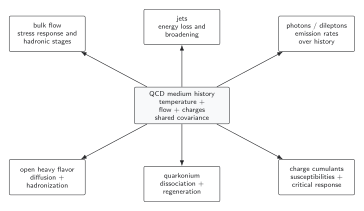
The open-heavy-flavor branch combines an initial heavy-quark and cold-nuclear baseline, Boltzmann or Langevin evolution with explicitly defined drag and diffusion coefficients, possible radiative processes, and fragmentation or coalescence with feed-down. Quarkonium is a separate bound-state branch, not a synonym for heavy flavor. Shared medium fields and covariance connect the probes without making their kernels interchangeable. The diagram is schematic and not to scale.
In text, discriminate the transport approximation by its momentum-transfer and correlation-time assumptions, vary hadronization and feed-down consistently, and fit suppression and flow observables with their covariance. The extracted diffusion coefficient is conditional on those choices and the bulk history.
Exercises
Section titled “Exercises”1. Einstein relation in the nonrelativistic limit. For , require .
Solution
. Vanishing probability current requires , so . With , this gives .
2. Degeneracy. A model raises -meson by increasing both coalescence and the heavy-quark interaction. Which measurement helps distinguish them?
Solution
Species-resolved and ratios are directly sensitive to recombination chemistry, while heavy-flavor correlations and higher- observables retain more transport information. A joint fit with covariance is needed.
Continue to quarkonium dynamics.
References
Section titled “References”- Aarts, Gert, et al. “Heavy-Flavor Production and Medium Properties in High-Energy Nuclear Collisions—What Next?” European Physical Journal A 53 (2017): 93. DOI.
- Apolinário, Liliana, Yen-Jie Lee, and Marta Winn. “Heavy Quarks and Jets as Probes of the QGP.” Progress in Particle and Nuclear Physics 127 (2022): 103990. DOI.
- Cao, Shanshan, et al. “Toward the Determination of Heavy-Quark Transport Coefficients in Quark-Gluon Plasma.” Physical Review C 99, no. 5 (2019): 054907. DOI.
- Xu, Yingru, et al. “Data-Driven Analysis for the Temperature and Momentum Dependence of the Heavy-Quark Diffusion Coefficient in Relativistic Heavy-Ion Collisions.” Physical Review C 97, no. 1 (2018): 014907. DOI.
Original QFT.org content:CC BY 4.0, unless an item supplies different terms. Third-party material retains its own terms.