

Initial Conditions and Pre-Equilibrium Evolution
The initial-condition stage converts two quantum nuclei into an event-by-event stress tensor and conserved currents on a switching hypersurface. Nuclear geometry, small- color fluctuations, saturation, classical Glasma fields, and pre-equilibrium evolution all affect that map. The correct output is not a single entropy profile but a versioned field ensemble with correlations and conservation checks.
Required background. Small- evolution and high-energy factorization supplies the nuclear wavefunction at high energy. Helpful background. Plasma instabilities and gauge-theory EKT supply two weak-coupling pre-equilibrium mechanisms.
From nuclear configurations to fields
Section titled “From nuclear configurations to fields”An event begins with nucleon positions, subnucleonic degrees of freedom, and deposited color charge. In a Color Glass Condensate description, large- sources are stochastic and small- gauge fields are solved for at a resolution scale. The saturation scale separates dense nonlinear fields from harder dilute modes. Its value and fluctuations depend on the chosen small- evolution, nuclear thickness, and calibration.
Immediately after the collision, the classical Yang–Mills fields form the Glasma. Their energy–momentum tensor is
IP-Glasma simulations combine impact-parameter-dependent saturation with event-by-event Yang–Mills evolution and produce fluctuating eccentricities and initial flow Schenke, Tribedy, and Venugopalan 2012. Their predictions remain conditional on source ensembles, infrared regulation, lattice discretization, coupling, and mapping from fitted deep-inelastic data to nuclei.
Centrality is part of that mapping, not a synonym for impact parameter. The simulated event must be ranked with a multiplicity or detector estimator corresponding to the experimental one, including its fluctuations and bin response. Replacing this by fixed impact-parameter intervals can bias eccentricities and hard-probe geometry.
Pre-equilibrium propagation
Section titled “Pre-equilibrium propagation”A common interface begins at an early proper time and ends at . Free streaming gives a useful limiting map but neglects interactions. Effective kinetic theory can propagate the stress tensor when occupancies and momenta enter its weak-coupling quasiparticle domain. Classical-statistical fields can describe high occupancy before ultraviolet modes become quantum. Hybrid response frameworks such as KoMPoST linearize kinetic response around an expanding background and supply Green functions for perturbations Kurkela et al. 2019.
No switch should be chosen only because a clock reaches a conventional number. One checks whether the downstream hydrodynamic variables dominate the response and whether residual nonhydrodynamic modes are acceptably small. The hydrodynamization page makes that criterion explicit.
Conservation provides a nonnegotiable check. Between two hypersurfaces bounding a region ,
and similarly for each conserved current. Numerical residuals should converge with grid and timestep. Deposited baryon, electric, and strangeness currents become essential at lower beam energy.
Switching-surface data product
Section titled “Switching-surface data product”At every surface element, decompose
with , , , and . A reusable output includes:
- hypersurface geometry, orientation, coordinates, units, metric, and event weight;
- and every before decomposition;
- after a declared frame choice;
- two-point/event correlations or the random seed and generator needed to reconstruct them;
- model version, parameters, nuclear configuration, regulator, grid, and switch criterion;
- conservation, positivity, and discretization residuals.
The common downstream provenance fields and typed probe interfaces are defined in the heavy-ion global-inference provenance table.
Limitations and failure cases
Section titled “Limitations and failure cases”A scalar energy-density profile loses initial momentum, pressure anisotropy, and conserved currents. Replacing a Glasma tensor by an equilibrium ideal-fluid tensor at the same generally creates entropy and changes flow. Landau matching is a projection, not proof that hydrodynamics applies.
The CGC is controlled at small and high saturation scale, classical fields require high occupancy, and weak-coupling EKT requires scale separation. Applying these descriptions outside their domains is a model extension. At finite beam energy, stopping and longitudinal structure prevent a boost-invariant two-dimensional initialization from being complete.
The forward-model graph makes visible why uncertainty in the initial geometry and pre-equilibrium evolution survives into every inferred medium parameter.
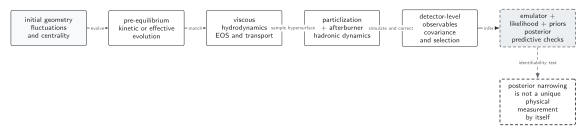
The first two nodes are this page’s focus: nuclear geometry, deposition and longitudinal structure specify the initial fields, and pre-equilibrium dynamics transports them to the hydrodynamic switching surface. Conserved fluxes and the full stress/current information must be matched, not merely an energy-density profile. The later nodes show how downstream data constrain these early choices only through the complete model. The dashed warning marks identifiability, not a failure of Bayesian inference. The diagram is schematic and not to scale.
In text, vary the initial-state family and switching time while preserving energy–momentum and charge continuity, then propagate those alternatives through the same hydrodynamic, particlization, detector, covariance, and inference treatment. A narrow posterior within one initialization is not a model-independent reconstruction of the earliest stage.
Exercises
Section titled “Exercises”1. Landau frame. Show that the Landau velocity is a timelike eigenvector of .
Solution
The Landau condition is exactly the eigenvalue equation for , with . It makes the energy-diffusion current vanish in the local rest frame. Existence of a physical timelike eigenvector is a matching check.
2. Missing information. Two initial states have the same but opposite transverse momentum densities. Do they define the same hydrodynamic initial condition?
Solution
No. determines the flow velocity under Landau matching, so the states begin with different collective motion and evolve differently. Energy density alone is insufficient.
Continue to the kinetic-to-hydrodynamic map.
References
Section titled “References”- Gelis, François, Edmond Iancu, Jamal Jalilian-Marian, and Raju Venugopalan. “The Color Glass Condensate.” Annual Review of Nuclear and Particle Science 60 (2010): 463–489. DOI.
- Kurkela, Aleksi, Aleksas Mazeliauskas, Jean-François Paquet, Sören Schlichting, and Derek Teaney. “Effective Kinetic Description of Event-by-Event Pre-Equilibrium Dynamics in High-Energy Heavy-Ion Collisions.” Physical Review C 99, no. 3 (2019): 034910. DOI.
- Kurkela, Aleksi, Aleksas Mazeliauskas, Jean-François Paquet, Sören Schlichting, and Derek Teaney. “Matching the Nonequilibrium Initial Stage of Heavy Ion Collisions to Hydrodynamics with QCD Kinetic Theory.” Physical Review Letters 122, no. 12 (2019): 122302. DOI.
- Schenke, Björn, Prithwish Tribedy, and Raju Venugopalan. “Fluctuating Glasma Initial Conditions and Flow in Heavy Ion Collisions.” Physical Review Letters 108, no. 25 (2012): 252301. DOI.
Original QFT.org content:CC BY 4.0, unless an item supplies different terms. Third-party material retains its own terms.