

Memory Functions and Slow-Mode Projection
Mori–Zwanzig projection isolates a chosen set of slow operators and places all orthogonal dynamics into a memory kernel. For transport, the resulting memory matrix separates exact conserved overlaps, coherent relaxation, antisymmetric reactive mixing, and an incoherent remainder without assuming quasiparticles. Its power and its main danger are the same: the answer is controlled only if the slow basis is complete at the claimed order.
Required background. Sources, linear response, and Kubo formulae fixes susceptibilities and current response. Banach and Hilbert spaces, completion, and Riesz representation supplies the projection-space language. Helpful background. Linearized kinetics and relaxation modes gives a collision-operator realization, while memory kernels in closed-system evolution develops the time-domain reduction.
The thermal operator inner product
Section titled “The thermal operator inner product”For zero-mean operators, define the Kubo–Mori product
Choose slow operators whose susceptibility matrix is nonsingular. The orthogonal projector is
This is a projection in operator space, not a statement that the retained variables are classical. It is invariant under an invertible change of slow basis. A singular signals a redundant operator or an unremoved null direction and must be resolved before inversion.
Mori–Zwanzig projection decomposes evolution into reversible motion inside the slow subspace, a retarded memory convolution, and an orthogonal force Zwanzig 1961, pp. 983–987 Forster 1995, ch. 5. With , define
up to the harmless temperature normalization that accompanies alternative definitions of . The projected propagator ensures that slow propagation is not counted twice Mori 1965, §§2–4.
Conductivity in matrix form
Section titled “Conductivity in matrix form”For a slow basis with the same symmetry as a current , the homogeneous conductivity can be written
is the dissipative memory matrix, is the antisymmetric frequency matrix generated by reversible dynamics or time-reversal breaking, and is response entirely orthogonal to the retained slow sector. Exact factors of depend on the normalization of the Kubo–Mori product; the displayed formula uses the susceptibility convention above. Positivity applies to the dissipative Hermitian part of in a passive equilibrium state.
The formula is exact if the full slow subspace and the exact projected kernel are used. Practical calculations truncate the basis and approximate . A small matrix is not justified merely because it fits a narrow peak; every omitted operator whose relaxation rate is comparable to the frequencies of interest can change the result.
One nearly conserved momentum
Section titled “One nearly conserved momentum”Suppose momentum is the only relevant slow operator, time reversal sets , and the incoherent part is regular. Then
If is smooth across the narrow peak, define
and obtain
Thus the Drude weight is a static overlap, while the width is controlled by projected momentum relaxation. If , slow momentum does not create an electric Drude peak in that channel.
Weak breaking and order counting
Section titled “Weak breaking and order counting”Let with . Then
and, provided the projected force correlator is regular in the unbroken theory,
The leading rate can therefore be computed from a force–force correlator evaluated at , while static susceptibilities are needed only at their corresponding order. This controlled simplification fails if the unbroken force correlator contains an additional infrared singularity or if another operator becomes slow as Lucas and Sachdev 2015, §§II–III, Open PDF.
Taking first restores a delta function; taking at fixed gives a finite value proportional to . The order of these limits is part of the physical claim.
Completeness tests and relation to kinetics
Section titled “Completeness tests and relation to kinetics”Use at least four checks:
- Include all exactly conserved operators with the current’s symmetry. Omitting momentum at nonzero density produces a spurious finite dc conductivity.
- Enlarge the slow basis and test stability of the target combination, not only of individual matrix entries.
- Verify the projected-force spectral density and susceptibility signs and the relevant Ward identities.
- In a quasiparticle regime, compare with the near-zero modes of the linearized collision operator. The projection and kinetic descriptions should agree after matching normalizations and retained modes.
The method remains useful without quasiparticles because it relies on operator overlaps and timescale separation. It does not create that separation: broad continua or a dense set of comparable rates require a larger basis or a nonlocal memory function.
The transport-extraction covariance reference records the slow basis, susceptibilities, weak-breaking order, kernel covariance, frequency window, basis-enlargement check, and evidence date.
The chain below supplies the observable context for a memory-matrix calculation. Inspect the response, spectral, and inference stages: projecting onto slow operators is a controlled forward-model reduction only when the slow basis is complete and its kernel uncertainty is carried into the final claim.
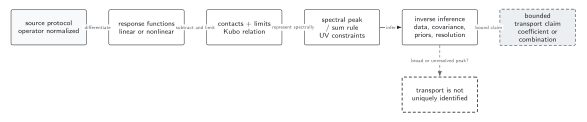
Memory projection separates exact conserved overlap, coherent slow relaxation, and an incoherent remainder inside the response stage. Susceptibilities, projected force spectra, weak-breaking order, and basis truncation then propagate through the same spectral and inference gates as any other transport calculation. The diagram is schematic and does not display the projector or matrix inversion explicitly.
In text: choose and normalize the slow operators, invert their susceptibility matrix, compute the projected memory kernel and reactive matrix, retain the orthogonal response, and enlarge the basis until the target combination is stable. A narrow fitted peak cannot substitute for this completeness test.
Exercise: the omitted-momentum failure
Section titled “Exercise: the omitted-momentum failure”Assume translations are exact, , and . What happens to ? Why can a calculation omitting be misleading?
Solution
With in the low-frequency limit,
Therefore
A truncation that excludes can return only the regular incoherent part and incorrectly label it as the full finite dc conductivity. The missing delta weight is required by the exact conserved overlap.
References
Section titled “References”- Forster, Dieter. 1995. Hydrodynamic Fluctuations, Broken Symmetry, and Correlation Functions. Advanced Book Classics. Boca Raton, FL: CRC Press. DOI.
- Lucas, Andrew, and Subir Sachdev. 2015. “Memory Matrix Theory of Magnetotransport in Strange Metals.” Physical Review B 91 (19): 195122. DOI. Open PDF.
- Mori, Hazime. 1965. “Transport, Collective Motion, and Brownian Motion.” Progress of Theoretical Physics 33 (3): 423–455. DOI.
- Zwanzig, Robert. 1961. “Memory Effects in Irreversible Thermodynamics.” Physical Review 124 (4): 983–992. DOI.
Transport Extraction, Inverse Problems, and Error Budgets treats the slow-basis truncation as one component of a wider model-discrepancy budget. Spectral Functions and Transport Peaks provides the analytic tests for the resulting coherent peak.
Original QFT.org content:CC BY 4.0, unless an item supplies different terms. Third-party material retains its own terms.