

Quantum Scars, Hilbert-Space Fragmentation, and ETH Exceptions
ETH can fail weakly because a sparse set of exceptional eigenstates has atypical local data, or strongly because the dynamically accessible Hilbert space splits into many invariant sectors. Quantum scars, Hilbert-space fragmentation, localization, and ordinary symmetry sectors are therefore not interchangeable. The decisive questions are how many states are exceptional, which initial states overlap them, what operator algebra connects the sector, and whether the obstruction survives perturbations and increasing size.
Required background. ETH defines the typical-state matrix-element expectation being tested. Helpful background. Spectral statistics and late-time evidence supplies sector-resolved diagnostics that can distinguish an exception from unresolved symmetry.
A classification by measure and connectivity
Section titled “A classification by measure and connectivity”| Mechanism | Structure in Hilbert space | Typical diagnostic | Thermalization statement |
|---|---|---|---|
| exact symmetry | finite or controlled set of irreducible sectors | commuting generators and projectors | test ETH separately in each sector |
| quantum scars | subextensive or measure-zero atypical eigenstates, often in towers | low entanglement, unusual matrix elements, coherent revivals from selected states | weak ergodicity breaking for states with appreciable overlap |
| fragmentation | many invariant Krylov sectors within one conventional symmetry sector | connectivity graph and sector-dimension distribution | thermalization may occur only within each fragment |
| integrability | extensive commuting charges organize states | Poisson-like statistics plus charge-complete dynamics | ordinary Gibbs ensemble generally replaced by a GGE |
| many-body localization | quasi-local integrals in a disordered bounded model regime | local memory, slow entanglement, spectral and finite-size tests | absence of ordinary thermalization within the established regime |
| kinetic constraint or prethermal blockade | transition amplitudes or rates suppressed, sometimes only approximately | lifetime and perturbation scaling | long-lived arrest need not be an exact ETH exception |
The classification is operational. An exact symmetry is not fragmentation merely because it block-diagonalizes the Hamiltonian. A single disconnected state is not extensive fragmentation. Long revivals do not by themselves prove scar eigenstates; nearly harmonic finite-size spectra or drive synchronization can also revive.
Rare scars versus extensive fragmentation
Section titled “Rare scars versus extensive fragmentation”Let be the decomposition into Krylov components generated from basis states by repeated action of . Define
Fragmentation is meaningful when the decomposition persists after all conventional symmetries have been resolved and the distribution of has a nontrivial thermodynamic scaling. A strong form has exponentially many components or a largest component whose fraction vanishes. Weak fragmentation can leave one giant component plus many small ones.
Scarring has a different measure. Suppose atypical eigenstates lie in a sector of dimension . If , typical microcanonical sampling can still satisfy ETH, yet an initial state with
of order one can show persistent nonthermal dynamics. The relevant evidence is therefore both spectral measure and preparation overlap.
The PXP model supplied a prominent finite-system scar tower and coherent revivals Turner et al. 2018. Exact constructions also show that one may embed atypical eigenstates into otherwise thermal-looking spectra Shiraishi and Mori 2017. These examples demonstrate mechanisms, not a universal classification of every revival.
A graph test for fragmentation
Section titled “A graph test for fragmentation”Choose a local basis compatible with fixed conventional charges. Make one vertex for each basis state and connect two vertices when the corresponding off-diagonal Hamiltonian matrix element is nonzero. Then:
- compute connected components at several sizes;
- verify that the components are not explained by a missing ordinary symmetry;
- record their dimensions and quantum numbers;
- diagonalize representative large and small components separately; and
- perturb every kinetic constraint allowed by the intended physical setting.
Dipole-conserving models provide explicit examples in which local constraints fragment the Hilbert space beyond global charge sectors Sala et al. 2020. Connectivity is basis-sensitive in general, so the physical claim must name the local product basis or operator algebra that defines accessible moves. An arbitrary unitary basis change can make a sparse graph dense without changing the dynamics.
Stability and the continuum boundary
Section titled “Stability and the continuum boundary”An exception earns a durable interpretation only after perturbation tests.
- Exact protection: algebra or symmetry keeps the subspace invariant.
- Asymptotic protection: leakage vanishes with a controlled parameter or size.
- Prethermal protection: leakage is small only for a bounded time.
- Fine tuning: a generic allowed perturbation destroys the effect at order one.
For localization, finite-size drift, rare resonances, long-range interactions, and coupling to external baths remain material. This page therefore treats many-body localization as a bounded class of ETH failure, not as a universal continuum-QFT phase claim. Current model-specific evidence belongs with the many-body localization treatment.
The same boundary applies to scars and fragmentation. Lattice constraints may have continuum limits, but their invariant sectors, operator norms, and perturbations must be tracked through that limit rather than assumed to survive it.
A minimum diagnosis
Section titled “A minimum diagnosis”Before naming an ETH exception, report:
- exact symmetry resolution and energy-density window;
- fraction and scaling of atypical eigenstates;
- initial-state overlap with those states or sectors;
- graph or projector evidence for invariant components;
- local observables, entanglement, and level diagnostics within each component;
- size, time, boundary, and disorder scaling;
- stability under every physically allowed perturbation; and
- the distinction between exact, asymptotic, and prethermal protection.
The thermalization and chaos evidence matrix gives the common evidence ceiling. An exception row should weaken, not silently replace, its sector and finite-size controls.
Common failure modes
Section titled “Common failure modes”Counting symmetry blocks as fragmentation. Resolve all conventional charges first; fragmentation is residual dynamical disconnection.
Inferring scars from a revival. Establish atypical eigenstates, their tower or algebra, and the preparation overlap.
Letting rare states refute weak ETH. A vanishing fraction can coexist with typical-state ETH while still controlling selected initial states.
Extrapolating small exact diagonalization. Sector counts and resonance scales can drift rapidly; report the observable finite-size trend and competing fits.
Use the upper-right part of the figure to focus on exceptional subspaces rather than bulk averages. Scars and Hilbert-space fragmentation can preserve atypical dynamics even when most states satisfy ETH-like or random-matrix diagnostics.
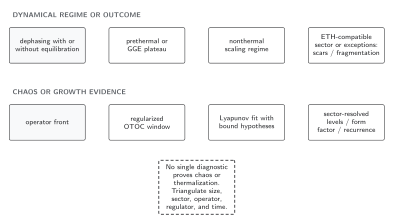
ETH exceptions must be characterized by their sector dimension, spectral weight, initial-state overlap, and stability under perturbations. The diagram is schematic: its upper-right node distinguishes ETH-compatible sectors from scars or fragmentation, and no arrow combines them into one phase or time sequence.
In text-equivalent form, first resolve exact symmetries, then count disconnected sectors or atypical eigenstates and measure their overlap with the quench. Bulk level statistics and typical-state ETH tests do not rule out experimentally important exceptional dynamics.
Exercises
Section titled “Exercises”A sector has dimension and contains scar states. The initial state has total scar weight . Classify the claim.
Solution
, so the scars are measure zero and do not by themselves refute typical-state ETH. The order-one preparation overlap can nevertheless produce weak ergodicity breaking and revivals for that initial state. Stability and increasing-size dynamics remain necessary.
A connectivity graph splits into even- and odd-parity components only. Is this fragmentation?
Solution
No. It is ordinary symmetry resolution. Construct the graph within each parity sector; only additional disconnected components can support a fragmentation claim.
Continue to dynamical and spectral chaos tests
Section titled “Continue to dynamical and spectral chaos tests”OTOCs test operator noncommutativity rather than eigenstate typicality. Late-time spectral evidence shows how unresolved fragments or symmetries create false random-matrix failures. Concrete scar and fragmentation models continue in Volume XII.
References
Section titled “References”- Moudgalya, Sanjay, B. Andrei Bernevig, and Nicolas Regnault. “Quantum Many-Body Scars and Hilbert Space Fragmentation: A Review of Exact Results.” Reports on Progress in Physics 85 (2022): 086501. doi:10.1088/1361-6633/ac73a0. Open preprint.
- Sala, Pablo, Tibor Rakovszky, Ruben Verresen, Michael Knap, and Frank Pollmann. “Ergodicity Breaking Arising from Hilbert Space Fragmentation in Dipole-Conserving Hamiltonians.” Physical Review X 10 (2020): 011047. doi:10.1103/PhysRevX.10.011047. Open preprint.
- Shiraishi, Naoto, and Takashi Mori. “Systematic Construction of Counterexamples to the Eigenstate Thermalization Hypothesis.” Physical Review Letters 119 (2017): 030601. doi:10.1103/PhysRevLett.119.030601. Open preprint.
- Turner, C. J., A. A. Michailidis, D. A. Abanin, Maksym Serbyn, and Zlatko Papić. “Weak Ergodicity Breaking from Quantum Many-Body Scars.” Nature Physics 14 (2018): 745–749. doi:10.1038/s41567-018-0137-5. Open preprint.
Original QFT.org content:CC BY 4.0, unless an item supplies different terms. Third-party material retains its own terms.