

Moiré Flat-Band Quantum-Matter Platforms
A moiré platform is specified by a geometric superlattice, a downfolded band model, and an interaction environment—not by twist angle or filling alone. Relaxation, heterostrain, displacement fields, dielectric screening, gates, remote bands, spin and valley flavors, disorder, and the measurement kernel determine whether a nominal flat band is isolated and whether a correlated-phase inference is unique.
Required background. Bloch, Wannier, and effective band theories supplies band projection and Wannier constraints. Lattice fermions and effective Hamiltonians supplies the interacting downfolding problem.
Helpful background. Fractional Chern insulators and moiré systems develops the fractionalized topological phases whose evidence requires stronger diagnostics than flatness.
Moiré geometry and kinetic scales
Section titled “Moiré geometry and kinetic scales”For two identical hexagonal lattices of lattice constant rotated by a small angle , the ideal moiré period is
Lattice mismatch, heterostrain, and relaxation make a spatially varying tensorial quantity rather than a single scalar. The local twist distribution inferred from microscopy should therefore be propagated into the band-model parameters.
A schematic single-valley continuum model has block form
where labels valley, describes the isolated layers, is the moiré tunneling, and includes displacement, strain, and electrostatic potentials. Bistritzer and MacDonald 2011, pp. 12233–12237 give the foundational twisted-bilayer continuum construction. The parameter covariance is substantial: different relaxation or tunneling parameterizations can fit similar low-energy dispersions while predicting different topology and wave-function form factors.
For a target band, record at least
Large indicates energetic isolation, but it does not ensure uniform Berry curvature, localized symmetric Wannier functions, or weak remote-band mixing under interactions. Topological or fragile bands can obstruct a one-orbital Wannier description; a Hubbard model chosen only for convenience may then discard symmetry or geometry. Koshino et al. 2018, §§II–IV exhibit the multiorbital Wannier and extended-Hubbard structure of twisted bilayer graphene.
Projected interactions and screening
Section titled “Projected interactions and screening”The unscreened Coulomb scale associated with one moiré cell is
The ratio is an organizing measure of correlation, not a phase diagram. Metallic gates at distance , dielectric anisotropy, frequency-dependent screening, and nearby bands make the interaction momentum dependent. A common two-dimensional gate-screened form is
before band form factors. After projection,
Normal ordering removes the one-body self-contraction. The term is understood to be canceled by a neutralizing background or fixed-charge convention; if it is retained, it is a separately declared charging energy. The form factors carry sublattice, layer, valley, spin, and Berry-geometric information. Replacing them by unity can change exchange, flavor polarization, pairing, and topological response even if is unchanged.
The validity figure shows the steps from geometric calibration to a correlated-phase claim. Inspect the inhomogeneity branch: a resistance feature at nominal integer filling can arise from percolation through a distribution of local fillings and gaps.
Validity map for moiré flat-band platforms. Geometry, downfolded Hamiltonian, correlated response, and phase identity are separate conclusions with increasing model and evidence requirements. Original schematic, not to scale; material evidence is bounded through 10 August 2026.
Filling, topology, and evidence ceilings
Section titled “Filling, topology, and evidence ceilings”State the filling convention as particles or holes per moiré unit cell relative to a declared reference, together with the active spin–valley degeneracy. A label such as is otherwise ambiguous across devices and theories. Flavor polarization changes the Fermi volume and interaction projection; displacement fields can change both bandwidth and Chern character.
A correlated insulator requires an activation or compressibility statement with contact and inhomogeneity controls. The transport anomaly reported by Cao et al. 2018, main text was an early magic-angle correlated-insulator observation, but the evidence logic does not reduce to its filling label. Superconductivity requires zero-resistance, magnetic response where feasible, critical-current and field systematics, and alternatives such as filamentary conduction. A Chern state requires a properly quantized response or equivalent topological diagnostics with longitudinal dissipation and domain effects controlled. Fractional filling plus a transport anomaly is not sufficient for a fractional Chern phase.
Zhang et al. 2026, main text and source data reported a moiré-enhanced flat band in rhombohedral graphene and tied the band feature to a specific device geometry and measurement program. It is evidence for that platform and parameter window, not a universal continuum parameter set. The source assessment on this page is current through 10 August 2026. Later device results, revised band fits, corrections, and phase status belong in the Quantum Matter and Emergence Research synthesis.
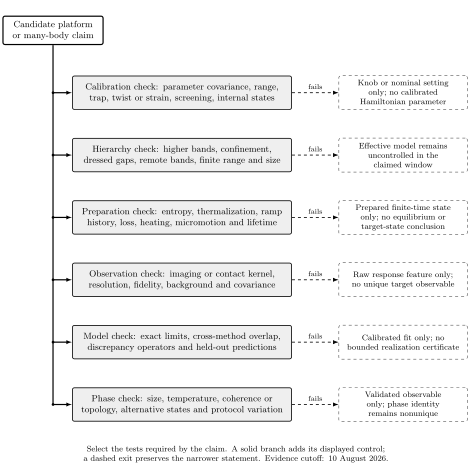
The canonical cold-atom and synthetic-matter claim test matrix places the calibrated term, scale hierarchy, preparation, observable, resolution, discrepancy, and date ceiling in one record. A reproducible workflow should evaluate the topological many-body diagnostics while propagating platform-calibration and model-discrepancy uncertainties.
Exercise
Section titled “Exercise”Geometric and Coulomb scales. For graphene with at , estimate . With , estimate using . Compare with a hypothetical bandwidth .
Solution
Converting the angle gives . Thus
The Coulomb scale is
so . This suggests strong interactions relative to the nominal bandwidth, but it does not identify a phase. Gate screening, form factors, remote bands, spatial variation of , flavor degeneracy, temperature, and disorder can all change the conclusion.
References
Section titled “References”- Bistritzer, R., and MacDonald, A. H. (2011). “Moiré bands in twisted double-layer graphene.” Proceedings of the National Academy of Sciences 108, 12233–12237. doi:10.1073/pnas.1108174108.
- Cao, Y., Fatemi, V., Demir, A., Fang, S., Tomarken, S. L., Luo, J. Y., Sanchez-Yamagishi, J. D., Watanabe, K., Taniguchi, T., Kaxiras, E., Ashoori, R. C., and Jarillo-Herrero, P. (2018). “Correlated insulator behaviour at half-filling in magic-angle graphene superlattices.” Nature 556, 80–84. doi:10.1038/nature26154.
- Koshino, M., Yuan, N. F. Q., Koretsune, T., Ochi, M., Kuroki, K., and Fu, L. (2018). “Maximally localized Wannier orbitals and the extended Hubbard model for twisted bilayer graphene.” Physical Review X 8, 031087. doi:10.1103/PhysRevX.8.031087.
- Zhang, H., Lu, J., Liu, K., Wang, Y., Wang, F., Wu, S., Chen, W., Cai, X., Watanabe, K., Taniguchi, T., Avila, J., Dudin, P., Watson, M. D., Louat, A., Sato, T., Yu, P., Duan, W., Song, Z., Chen, G., and Zhou, S. (2026). “Moiré enhanced flat band in rhombohedral graphene.” Nature Materials 25, 566–572. doi:10.1038/s41563-025-02416-2.
Original QFT.org content:CC BY 4.0, unless an item supplies different terms. Third-party material retains its own terms.